Showing posts with label conference. Show all posts

Tuesday, November 18, 2025

CFP: 2026 AJJ Annual Conference @ Akita University, May 23-24th, 2026

2026 AJJ Annual Conference
May 23-24th, 2026
Akita University

Conference Theme

Entanglements and Embodiments: Anthropology, Ethnography and Sensing Japan

Location

The conference will be held at Akita University’s Tegata Campus (walking distance from Akita Station and bus station with a convenient bus connection from Akita Airport)

Keynote Address

“Anthropology of Japan in Japanese Anthropology before and after AJJ”
delivered by Nakamaki Hirochika, Professor Emeritus, National Museum of Ethnology (Minpaku)

Call for Papers

The theme for this year’s AJJ meeting is influenced by the work of phenomenologically oriented anthropologists such as Tim Ingold, Paul Stoller, and Thomas Csordas. In differing ways, they are all anthropologists who place perception and interpretation at the core of their ethnographic writing and theoretical explorations. However, as is AJJ tradition, one need not be limited to their work or interpretations to submit a panel or paper.

Overall, we would like to invite reflections on how anthropologists of Japan are impacted by their idiosyncratic and inimitable connections to this country and their chosen field sites. This may include inquiry into the social, physical, political, or affective dimensions that any given anthropologist or folklorist has experienced. Some core considerations might include:

・How do personal experiences influence the selection of a specific location within Japan as a site, a research topic, theoretical frameworks, methods, writing styles, or approaches?
・How does an anthropologist’s sensory engagement mediate the process of interpreting cultural phenomena?
・How is this process consciously suppressed or supported in their analytical writing?

Submitting a Panel or Paper

Panel slots will be 90 minutes, usually divided along the lines of 3 papers, 20 minutes each, then 30 minutes of discussion (though there is some flexibility here if needed).

Full panels are given preference, but please feel free to apply with individual paper proposals.

Papers that clearly relate to the conference theme will be given preference, but others will also be considered.

The application deadline is January 15th 2026. We aim to reply to applicants by February 1st 2026.

Fees for the conference and reception (including food and drinks) will be as follows:

Tenured Faculty: ¥5000 conference fee and ¥3000 reception fee.
Employed but not tenured: ¥3000 / 2000
Graduate Students: ¥2000 / 1000
There is no conference fee for undergraduates; however the reception will cost ¥1000.


Prizes

The Befu Prize and Bookman Prize will be awarded at the end of the conference. For details on the rules for the two prizes, see the following links:

https://www.ajj-online.net/the-harumi-befu-prize/

https://www.ajj-online.net/the-mark-bookman-prize/

**Any paper by a non-tenured scholar or student that is accepted for the conference will be eligible for entry to the prize competitions. Eligible candidates will be asked to supply a 5-minute video summarizing their presentation to assist us in organizing the judging process.


For more information: https://www.ajj-online.net/2025/11/02/cfp-2026-ajj-annual-conference/

Thursday, April 3, 2025

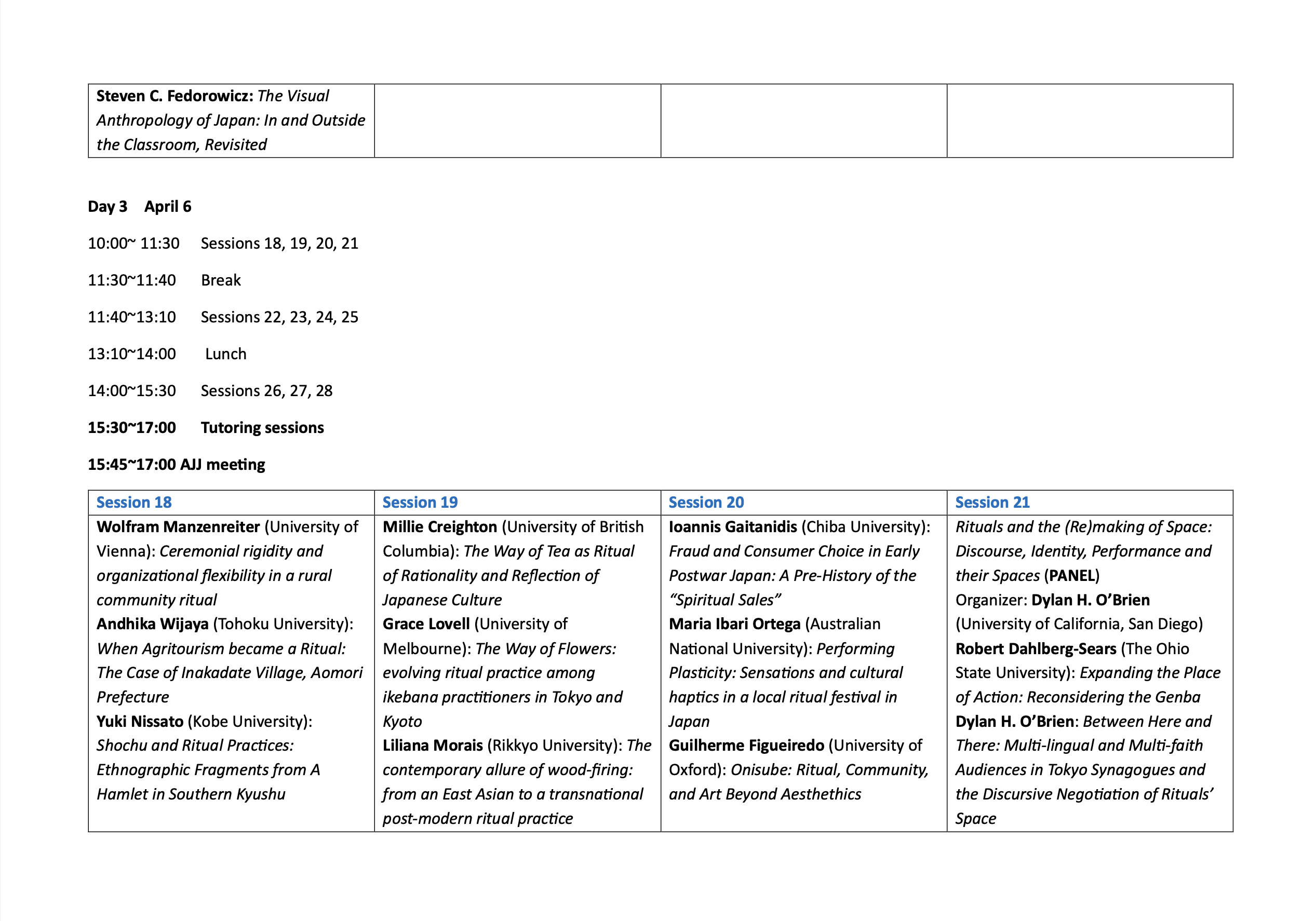
The Visual Anthropology of Japan: In and Outside the Classroom, Revisited

JAWS / AJJ Joint Conference 2025
Session 14 - Reflecting and Revisiting「Teaching Japan」
University of Hyogo - Kobe Campus for Commerce
Building 5
April 5, 2025, 15:40 - 17:10

Campus access: https://www.u-hyogo.ac.jp/english/access/#id01

Campus map: https://www.u-hyogo.ac.jp/about/access/kobeshoka/

Paper 4: The Visual Anthropology of Japan: In and Outside the Classroom, Revisited
Steven C. Fedorowicz, Professor, Kansai Gaidai University

Abstract: My chapter describes teaching a class comprised of international exchange students from many different countries alongside local students preparing for their study-abroad programs called “Visual Anthropology of Japan” at a Japanese university from 2006 to 2014. Topically, the course was about the presentation and representation of culture through film, photography, and other visual communication arts within the shifting anthropological ecologies of media, methods, and theory. Teaching “Japan” in this context required several balances of instruction and guidance for students of different academic levels, backgrounds, language skills and expectations studying together in the same class. Because of my training and background in cultural anthropology and visual anthropology, I do not consider my text as a theoretical treatise on pedagogy per se. Rather it is closer to an ethnographic—sometimes autoethnographic—account based on the fieldwork of teaching this course under certain conditions at a global educational setting. In my presentation, I will revisit this setting through the reflexive lens of ba (Kajimaru, Coker and Kazuma 2021), specifically, the convergence of players, place and performance during the period of the multimodal turn in visual anthropology that coincided with the class. This reminiscent revisit reaffirms the potential and possibility for a more active student learning environment and further course development to make a new and improved version of the course.

For more details about the conference and panel: https://visualanthropologyofjapan.blogspot.com/2025/02/announcement-jawsajj-joint-conference.html

Thursday, February 27, 2025

Announcement: JAWS/AJJ Joint Conference 2025 @ University of Hyogo

The Japan Anthropology Workshop (JAWS) and the Anthropology of Japan in Japan (AJJ) joint conference will be held in Kobe from April 4th (Friday) to April 6th (Sunday), 2025. The conference will take place in person, focusing on the theme: Ritual Practices and Daily Rituals in Japanese Society.

Venue: University of Hyogo, Kobe Campus for Commerce, Kobe, Japan


Ritual Practices and Daily Rituals in Japanese Society

The 21st century began as one of the most prosperous periods in human history, only to be profoundly affected by a pandemic and multiple wars, which have had a deep impact on society as a whole. As anthropologists, our role is to document, interpret, and possibly offer solutions for a better future. A significant part of understanding human behavior is the analysis of ritual and ritual practices.

In this edition of the JAWS/AJJ Conference, we aim to explore the role of ritual practices in Japanese society from various perspectives. Rituals can be sacred or social, serving as a form of cultural communication that transmits the cognitive categories and dispositions that shape people’s perceptions of reality (Bell 2009). By analyzing the underlying mechanisms of rituals, we can gain a deeper understanding of human society, as well as the universal and culturally specific aspects that define our communities.

As Joy Hendry suggests, “In many anthropological studies, ritual and religion are closely related, although in complex societies, there is often no particular connection between them, and the term ‘ritual’ may also refer to behavior, like etiquette, that is determined by society and where individuals have little choice in its execution.”

Rituals have always been a key focus for anthropologists, both globally and in Japan. While rituals are not difficult to identify, they are open to numerous interpretations and approaches, drawing interest from social psychologists, folklorists, scholars of religion, communication, the performing arts, and more. We do not seek to impose a specific definition of ritual, as this could be contentious. Instead, we encourage participants to focus on the concept of change. How would you define ‘ritual’ in your research? How has it evolved? This is the central debate we wish to foster, with the goal of deepening our understanding of modern Japan and inspiring broader discussions within world anthropology.


Schedule:
Of special note to visual anthropologist is Session 14 on Saturday, April 5, 15:40-17:10.

Panel: Reflecting and Revisiting「Teaching Japan」
Chair and Organizer: Steven C. Fedorowicz, Professor, Kansai Gaidai University
Discussants: Ioannis Gaitanidis (Associate Professor, Chiba University) and Greg Poole (Professor, Doshisha University)

Panel Abstract:

Teaching Japan: A Handbook (Gaitanidis and Poole 2024) was launched and introduced at the Anthropology of Japan in Japan 2023 Annual Meeting. In their opening chapter, co-editors Gaitanidis and Poole discussed the logic behind the book, “…despite the rich history of critical discussion around ‘researching Japan,’ there is not yet a comprehensive guide for taking these scholarly debates into the undergraduate, and (often) non-Japanese Studies, classroom. This then was the impetus for this forthcoming interdisciplinary collection of pedagogical case studies…” The book launch was a year and a half ago, and the book chapters were written long before that. This panel strives to continue the discussion that Teaching Japan began through a revisit of our chapters, to rethink, reflect, self-criticize and/or build upon our original ideas. In his presentation, McMorran asks critical questions about ethnographies in/about Japan to further explore the validity and value of collaborative ethnographic research beyond the borders of Japan. Fassbender rethinks teaching methods and approaches to counteract the influence of social media that limits students in their understanding of complicated and multifaceted issues surrounding gender and reproductive politics. McGuire reassesses teaching methods and approaches to explore the complexities of social inequality through intersectionality and reflects on the inclusion of literature that looks beyond Japanese society. Fedorowicz revisits the potential for a more active student learning environment and further course development amidst the current multimodal turn in and outside the classroom to make a new version of his course. Discussion and feedback are especially encouraged.

Paper 1: Japan All Around: Teaching about Japanese Society in Singapore
Chris McMorran, Associate Professor, National University of Singapore

In my chapter in Teaching Japan: A Handbook, I discussed disciplinary shifts in anthropology toward studies that are multi-sited and unbounded by national borders. Despite admitting the importance of such geographically promiscuous research, however, I shared my rather conservative approach to teaching about Japan through ethnography, specifically ethnographies based in Japan. I concluded my chapter by asking about the risks and potential rewards of using ethnography to move beyond a Japan-centered understanding of Japanese society. In this presentation, I introduce an ongoing pedagogical effort to answer this question. I outline a course I teach in Singapore that includes students in qualitative research among Japanese citizens residing in the small city-state. Despite its dry title, “Japanese Political Economy” approaches the subject from a distinctly human angle, by focusing on the ways Japan’s political economy has impacted the work lives and family lives of Japanese citizens residing in Singapore. In my presentation, I share the course aims, the research assignment, and the insights gained from several years of teaching the course. What have students learned about Japan and Japanese society by examining the work lives and family lives of those who reside outside its borders? Finally, despite their physical distance from Japan, how can students be inspired by anthropology to see, and investigate, Japan all around them?

Paper 2: How to Unlearn Reproductive Politics in the Classroom
Isabel Fassbender, Assistant Professor, Kansai Gaidai University

Building on my chapter, Teaching Gender and the Politics of Reproduction in Japan: Self-Government as a Theoretical Reference Point, recent experiences and observations in a course offered to mostly one-semester foreign exchange students inform this presentation about challenges and opportunities in teaching reproductive politics in university. It discusses classroom strategies to create a space to learn about reproductive politics in Japan and at the same time consider biomedical ethical questions detached from social ideologies or political partisanship for students that come from a background where these issues are often highly politicized. Contents of the course focus on historical circumstances and contemporary debates surrounding population control and reproduction in Japan (including pregnancy, birth, reproductive technologies, and contraception). However, as a matter of course, ideological and political frameworks that shape current debates in Western contexts often circumscribe the scope within which students access legal and ethical questions surrounding these issues. Not rarely in today’s media landscape, opinions are significantly conditioned through social media channels, which can be simplified and/or biased. It is thus crucial to provide students with opportunities to unlearn or question their preconceptions along with factual knowledge. Teaching methods that emphasize particular historical, socio-political, and cultural circumstances in Japan, as well as presenting diverse viewpoints and theories beyond neoliberal and capitalist approaches that automatically equate developments in science and technology with moral and ethical progress, have proven to be effective in broadening the scope of possible class debates in the context of reproductive politics.

Paper 3: How (un)equal is Japanese Society: Thinking with Intersectionality in the Classroom
Jennifer M. McGuire, Associate Professor, Doshisha University

Understanding inequality in Japan requires moving beyond single-axis frameworks. To fully grasp the causes and consequences of social inequalities, we need tools that delve into the complexity of oppression and power. In this presentation, I discuss how I use intersectionality as a provisional concept and analytical tool in an advanced level course in an English-taught program at a Japanese university. I argue that despite significant obstacles to its use in a university course, including a relative lack of English-language sources about Japan, it is crucial to view and interpret Japanese society through an intersectional lens to challenge assumptions and develop a more nuanced understanding of social inequalities. I analyze data collected in the classroom, particularly class discussions and students’ written responses, focusing on how gender intersects with class and disability to produce inequalities and discrimination. Additionally, I examine the need for heightened sensitivity and awareness when teaching in a multidisciplinary, multilingual setting where students’ positionalities and subjectivities can result in particularly complex relationships to Japan. While I argue that intersectionality helps us move beyond stereotypical and superficial understandings of marginalized social groups, I also reflect on the significant challenges of applying a framework that originated in Black feminism in the United States to a society with a vastly different sociopolitical and historical context.

Paper 4: The Visual Anthropology of Japan: In and Outside the Classroom, Revisited
Steven C. Fedorowicz, Professor, Kansai Gaidai University

My chapter describes teaching a class comprised of international exchange students from many different countries alongside local students preparing for their study-abroad programs called “Visual Anthropology of Japan” at a Japanese university from 2006 to 2014. Topically, the course was about the presentation and representation of culture through film, photography, and other visual communication arts within the shifting anthropological ecologies of media, methods, and theory. Teaching “Japan” in this context required several balances of instruction and guidance for students of different academic levels, backgrounds, language skills and expectations studying together in the same class. Because of my training and background in cultural anthropology and visual anthropology, I do not consider my text as a theoretical treatise on pedagogy per se. Rather it is closer to an ethnographic—sometimes autoethnographic—account based on the fieldwork of teaching this course under certain conditions at a global educational setting. In my presentation, I will revisit this setting through the reflexive lens of ba (Kajimaru, Coker and Kazuma 2021), specifically, the convergence of players, place and performance during the period of the multimodal turn in visual anthropology that coincided with the class. This reminiscent revisit reaffirms the potential and possibility for a more active student learning environment and further course development to make a new and improved version of the course.

Wednesday, October 30, 2024

Announcement of Conference Presentation:「Intersectionality in Japanese Deaf Communities」

「Intersectionality in Japanese Deaf Communities」

Abstract: Are Deaf people in Japan simply disabled, or a linguistic minority, or both? Various physical conditions and individual situations combine to determine access to social welfare, attitudes, identities and language use. Not all deaf people are the same. And Japan itself is not as homogeneous as many believe it to be. An estimated 5 percent of Japan’s population belong to minority groups that suffer from societal oppression. What happens when a deaf individual belongs to one or more of these other minorities? Intersectionality, which emerged from Black feminists in the United States, is a framework that acknowledges and explores concurrent identities and ensuing injustices: racism, sexism, gender discrimination, ableism and other inequalities. This presentation, based upon academic theories, the efforts of activists and my own years of fieldwork, will describe diversity and intersectionality found in deaf communities in Japan, specifically Deaf/LGBTQ+, Deaf/Zainichi Korean and Deaf/Blind groups.

SouthWest Conference on Asian Studies
Stephen F. Austin State University
Panel V 4.5: “Community and Memory in East Asia”
Saturday, November 2, 8:45 am – 10:00 am (10:45 pm – 12:00 am in Osaka, Japan)

Conference program here: https://www.swcas.net/

Thursday, February 16, 2023

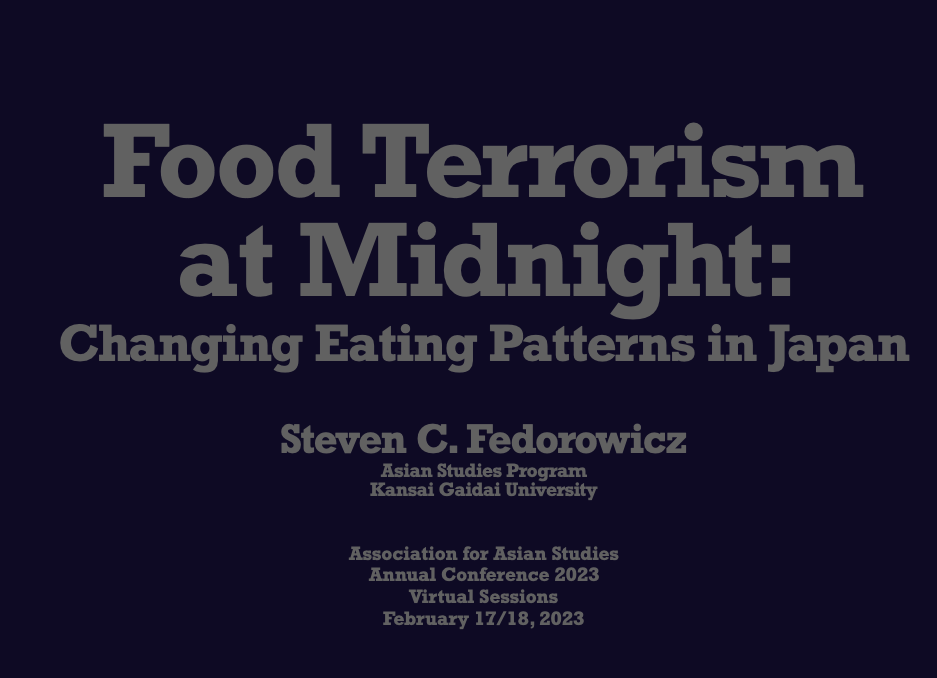
「Food Terrorism at Midnight: Changing Eating Patterns in Japan」@ Association for Asian Studies Annual Conference 2023 Virtual Sessions February 17/18, 2023

I am dedicating this presentation to Dr. Mark Hollstein, who passed away unexpectedly, suddenly and tragically on January 31, 2023. Mark was my friend and colleague for twenty years. We had many things in common - Japan, research, family life, politics, music and Star Trek. We talked almost every day. I was able to show Mark an early draft of this presentation and he gave me lots of good feedback. I miss him so much. Deepest condolences to his wife, son, family, friends and students. Rest in Peace.

See Mark's obituary here: https://www.legacy.com/us/obituaries/saltlaketribune/name/mark-hollstein-obituary?id=40271263
Food Terrorism at Midnight:
Changing Eating Patterns in Japan

Steven C. Fedorowicz
Asian Studies Program
Kansai Gaidai University

Abstract: In Japan, food and drink are prominent in cooking shows, travel shows, variety shows, dramas, manga, anime, books, magazines, blogs, Facebook and Instagram. The term “food porn” has been used to describe some media due to its sensual presentation intended to provide unattached pleasure or gratification for viewers. Since the 2010s, the Japanese term meshi tero (“food terrorism”) has been used with a meaning similar to “food porn.” However, food terrorism implies a deliberate attack or form of harassment that creates jealousy or resentment, causing victims to run to the kitchen or convenience store for snacks. Late-night food terror is especially insidious. Midnight has become a prime time for the television networks to air new food terrorism dramas. My research builds upon Stalker’s detailed history of the Japanese gourmet boom (2016) and Longcore’s discussion of “ethnographic culinary adventures... for the enjoyment, entertainment, and enlightenment of foodies and anthropologists alike” (2019). Food terrorism became more pronounced in 2020, when the Japanese government imposed restrictions on dining out during the COVID-19 pandemic. People now watch food terrorism with feelings of nostalgia, envy and/or hopefulness about being able to dine out again without concern. This paper examines food terrorism and changing eating patterns in Japan through multimodality (Collins et al. 2017) and sensory ethnographic methodologies (Pink 2009).

Keywords: visual anthropology, ethnographic photography, food porn, food terrorism, Japan

Session: V1-408
Contemporary Japanese and Korean Society
Friday, February 17, 2023, 8:00-9:30 PM (EST)
Saturday, February 18, 2023, 10:00-11:30 AM (Japan time)

For registration and information about the conference: https://www.asianstudies.org/conference/register2023/#

Monday, October 3, 2022

Announcement and Preview: “What the Future of Anthropological Research Should Look/Sound/Feel Like: A Visual Ethnography of a Standing Drink Bar in Japan”


SouthWest Conference on Asian Studies
University of Central Arkansas, USA
Session 7.1 (Virtual)
October 8, 2022
9:30-10:45 AM (Central Daylight Time)
11:30 PM-12:45 AM (Japan Standard Time)

Abstract: Boyer et al. (2016) ask “What should the anthropological research article of the future look and sound and feel like (emphasis mine)?” This research project is a visual ethnography of a forty-year-old tachinomiya (standing drink bar) in Osaka called Tenbun. Tenbun features many kinds of food and drink, a lively and relaxed atmosphere and plenty of colorful characters. The study is based upon long-term patronage, focused participant-observation and photography, a photo exhibition and other post-fieldwork encounters. My current analysis re-positions the research in wider social and academic contexts including multimodality, sensory ethnography, food anthropology and media studies. My work is informed by, first, Collins et al. who reflect on the “changes in the media ecologies” (2017), and, second, Pink’s multisensoriality (2009). I explore how to use new technologies, engagements and collaborations in methodology and dissemination of findings to create a new sensory narrative about the standing drink bar, Tenbun.

For more information and full conference schedule: https://www.swcas.net/

Monday, August 1, 2022

"第14回国際手話言語学会 - Theoretical Issues in Sign Language Research 14: 2022, Osaka, Japan" - September 26- October 1, 2022 - National Museum of Ethnology (Minpaku)

TISLR14 will be held at the National Museum of Ethnology (Minpaku). TISLR will be held for the 14th time, but this is the first time it will be held in Asia. For this reason, we have also incorporated a project (panel discussion) that will serve as an opportunity to build a network for sign language linguistics research in Asia. This conference will be held online and onsite in parallel, with consideration given to preventing the spread of the novel coronavirus. We look forward to your active participation and submission of research presentations. 

Date: September 26 (Mon), 2022 - October 1 (Sat), 2022

Venue: Hall at the National Museum of Ethnology
Online and onsite sessions will be held in parallel
National Museum of Ethnology
10-1 Senri Expo Park, Suita, Osaka
565-8511, Japan

Main organizer: National Museum of Ethnology

Schedule:
September 25 (Sun) – 26 (Mon) : Pre-event (Japanese sign language class, Asian sign language workshop, welcome drink [tentative], meeting with interpreters [Presenters are required to attend])
September 27 (Tue) - September 30 (Friday): Theoretical Issues in Sign Language Research (TISLR14)

Official languages: Japanese Sign Language, American Sign Language, International Sign Language, English


https://www.tislr2022.jp/

Tuesday, June 14, 2022

VAoJ is going to Lithuania (at least virtually) with「Tenbun: The Intersections of Performance, Place and Ethnographer in a Japanese Standing Bar」

Abstract:

Gerald Berreman describes a dilemma within ethnography: “how to be scientific and at the same time retain the humanistic insights—the human relevance—without which no account of human beings makes sense” (1966: 346). He suggests that, rather than choosing one or the other, ethnographers should develop a methodology that is both insightful and scientific. How to accomplish this in practice is still a question for ethnographers today.

This presentation is a visual ethnography of a tachinomiya (standing drink bar) in Osaka, Japan, called Tenbun. The bar features many kinds of food and drink in a “grimy” (Farrer 2019) and lively atmosphere, populated with an array of colorful characters. Following the recent work of Kajimaru et al. on the concept of ba (place, space), this research describes Tenbun as more than a location. Rather, it is “a co-emergence of performance, place and peoples” (2021: x). The ethnographer plays a dual role as an immersed participant at Tenbun and later as a distanced cultural analyst. My attempt to describe Tenbun in both insightful and scientific ways uses multimodality (Collins et al. 2017), sensory ethnography (Pink 2009) and photography.


Conference Information:

Old Discipline, New Trajectories: Theories, Methods and Practices in Anthropology
Hosted by Faculty of Philosophy at Vilnius University
Vilnius, Lithuania June 16-18, 2022
Webpage: https://www.sasciconf2021.fsf.vu.lt/

My paper is in Panel session no.2, ANTHROPOLOGICAL EXPLORATION OF ART AND PERFORMATIVE PRACTICES.
JUNE 16, 2022 (Thursday), 13:00-15:00 local time.
Japan time: JUNE 16, 2022 (Thursday), 19:00.

Special Bonus Photo:

Saturday, November 27, 2021

「Food and Drink at a Japanese Standing Bar: An Appetizing Production – Extended Media Mix」@ AJJ (Anthropology of Japan in Japan) 2021 Annual Meeting, Dec. 4

Abstract:

In Japan, food is prominent in documentaries, cooking shows, travel shows, variety shows, dramas, manga, anime, books, magazines, blogs, Facebook and Instagram. This food, not eaten but consumed, provides gratification and knowledge. Many of these media descriptions are set in izakaya (Japanese-style pubs) and tachinomiya (Japanese standing bars) that serve B-kyu gurume (B-rank food)—comfort food and/or local food. These are fascinating shops and sites to explore the production (cooking) and consumption (eating) of food. Media portrayals are another form of production, that of information and recreation, that is “good to think” (Levi-Strauss 1962), “communicated” (Barthes 1966; Dusselier 2009) and “shared among people” (Cheung 2002).

This presentation is a multimodal visual ethnography of a 40-year-old tachinomiya in Osaka called Tenbun. Tenbun features many kinds of food and drink, a lively and relaxed atmosphere and plenty of colorful characters including the owner, employees and regular customers. Based upon long-term patronage, focused participant-observation and photography, a photo exhibition and other post-fieldwork encounters, my analysis positions the research within the intersection of food anthropology and the popular Japanese “foodie” media. Matthew Longcore discusses how Anthony Bourdain, Gordon Ramsey and other Western food experts feature “ethnographic culinary adventures [that] bring food and film together for the enjoyment, entertainment, and enlightenment of foodies and anthropologists alike” (2019). Nancy Stalker provides an excellent and detailed history of popular Japanese media that influences and reflects the so-called modern “gurume boom” beginning in the 1980s and 90s (2016). I build upon this history through explorations of current documentaries, TV dramas and social media, gaining different perspectives to re-position my tachinomiya research in wider social and academic contexts.

Virtual talk on Zoom.
Saturday, December 4, 2021
Special presentation: 1:00 - 2:00 PM Japan time

AJJ takes place December 3-5. Participation is free, but you must register to get the Zoom link. Lots of good people and scholarship at the AJJ! Check it out!

For the link and full meeting program, go to https://www.ajj-online.net/2021/11/10/2021-annual-meeting-program/

Wednesday, September 29, 2021

「There Are Two Sides to Every Noren: Photo Exhibition as Art and Anthropology」@ A/R/P (Art/Research/Practice) 2021, October 3

There Are Two Sides to Every Noren:
Photo Exhibition as Art and Anthropology

のれんの表裏には異なる意味があります:
アートと人類学としての写真展

Abstract: Visual anthropology is an intersection of art and science – it entails commitment, ethical concerns, close relationships and ever-changing negotiations with participants (subjects and audience). This on-going research project is a visual ethnography of a tachinomiya (Japanese standing bar) in Osaka called Tenbun. It is based on my years of patronage, including two years of dedicated participant-observation and photography. Tenbun features many kinds of food and drink, a lively and relaxed atmosphere and plenty of colorful characters including the owner, employees and regular customers. One outstanding feature of this tachinomiya is its long, dark blue noren, a kind of fabric curtain as its entrance that signals that the shop is open for business and provides partial seclusion for the shop and customers. The noren can be seen as a fluid wall; when calm it blocks much of the view from the outside, but when the wind blows its separated partitions offer more glimpses of the inside. The glimpses can be narrow or revealing. One cannot control the wind; this fluid wall illustrates the complexities of personal privacy in public spaces in Japan, especially in the context of taking photographs in public and image rights. An important component of this project was a photo exhibition with prints and portraits illustrating the atmosphere of Tenbun. Initially I thought the photo exhibition to be the final product of the fieldwork and research. But I found the exhibition and interactions with the gallery audience to reveal important aspects of heuristic processes, meaning-creation, evocation and multivocality. Viewers were doing more than merely looking at my photographs, they were analyzing, scrutinizing, reacting and providing various interpretations and valuable feedback. In this multi-media presentation, I will discuss the "post-fieldwork encounters" of the photo exhibition as a collaborative media event through multimodal analyses and autoethnographic vignettes.

A/R/P (Art/Research/Practice) 2021
Tokyo University of the Arts 
Oct. 3 - Session 7 - 13:30 - 15:00
via Zoom (conference registration required - free!)
For more information about the conference and program:
https://arp.geidai.ac.jp/?fbclid=IwAR2sMtNm5ANkyfKO6iaSuRcLOl7GXktKmxlhcBrGJWq7oxZH42-FLmLTM4c

I'm really looking forward to this conference!

おすすめ!Check out Can Tamura's presentation, "Pandemic-Friendly Posthuman Ethnographic Filmmaking: The 24 Solar Terms of Echigo-Tsumari," Session 8, Oct. 3, 15:15-16:45.

Tuesday, September 28, 2021

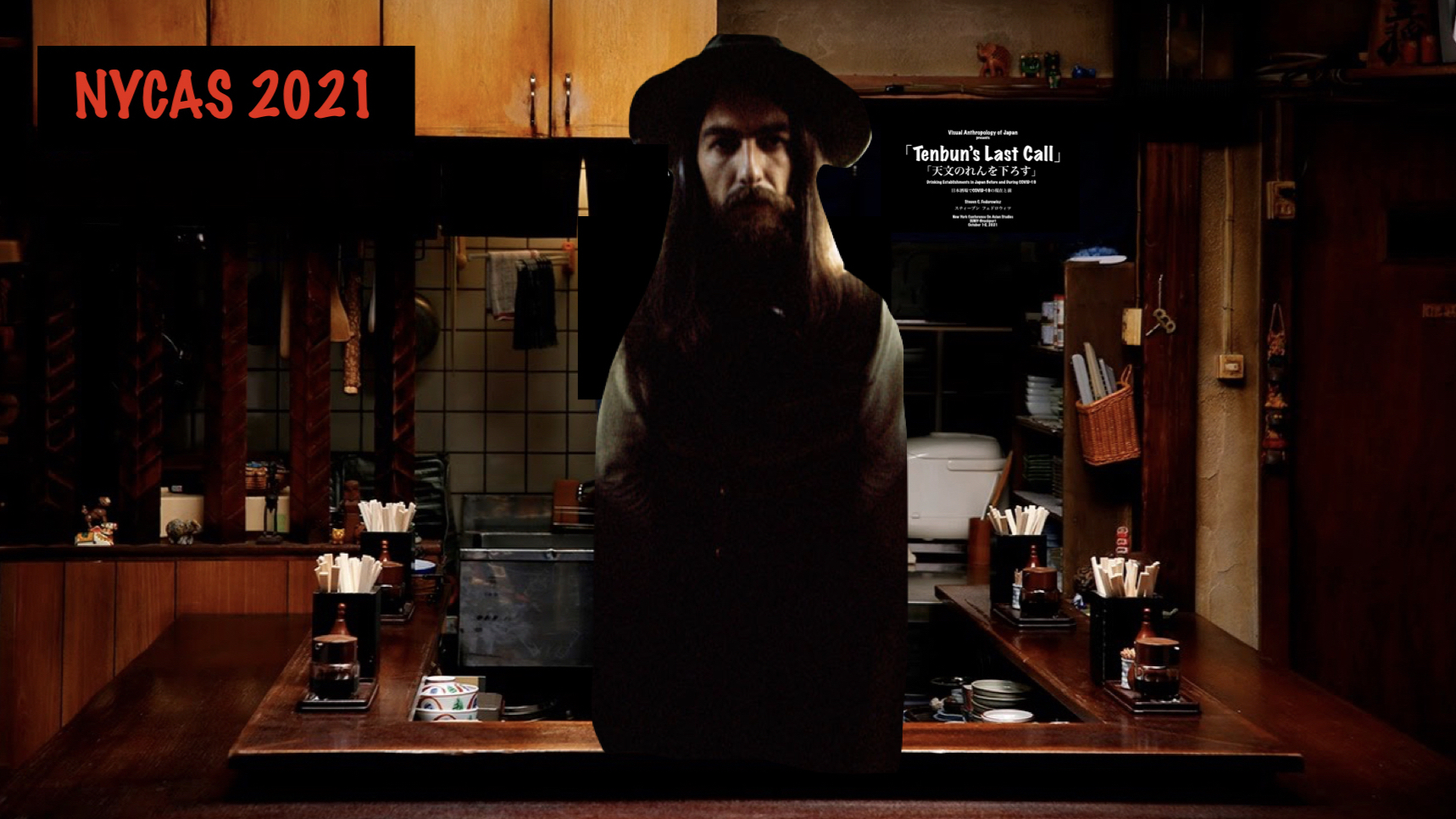
「Tenbun’s Last Call: Drinking Establishments in Japan Before and During COVID-19」@ New York Conference on Asian Studies 2021, Oct. 1-2

Abstract: This presentation is a multimodal visual ethnography of drinking establishments such as izakaya (“Japanese pubs”) and tachinomiya (“standing bars”) in Japan before and during the COVID-19 pandemic. The focus will be on a 40-year-old standing bar in Osaka called Tenbun. Tenbun serves many kinds of alcohol and food items and has a lively atmosphere with plenty of colorful characters, including the owner, employees and regular customers. Not only is it a popular place to eat and drink, it is an important setting for socialization. This study is based upon over two years of dedicated participant-observation and photography, a photo exhibition and other post-fieldwork encounters. COVID-19 has brought changes for eating and drinking establishments in terms of safety precautions and consumption behavior; many shops have been forced to close. Tenbun closed shop in March, 2020. This research project examines the intersection of food anthropology, multimodal research methods, recent research on drinking establishments and the plethora of “foodie” media productions. It has also become a form of salvage ethnography. My data and photographs not only preserve Tenbun but also document the eating, drinking and socializing habits of Japan before the COVID-19 pandemic.

SUNY Brockport, Brockport, New York
October 1, 2021 - Session A1
11:00 AM - 12:30 PM EDT (12:00 - 1:30 AM, Oct. 2 Japan time)
via Zoom (conference registration required)
For information on the conference and program:
https://www.brockport.edu/academics/conferences/new_york_asian_studies/

Thursday, April 9, 2020

Asian Studies Conference Japan 2020 in Tokyo Canceled - along with at least one great panel (hope we can do it in the near future...)


This is what we were going to do:

Disability and Accessibility in Japan

Accessibility is more than ensuring the “ability” of people with disabilities to access products, services, structures, and systems. Questioning access in Japan requires unpacking the meaning given to the spaces, networks, and systems by the people that create and utilize them. Accordingly, this panel shifts its focus to the actors involved in Japan’s accessibility: experts, students, educators, and advocates.
The panel begins by analyzing the collaborative mechanisms of accessibility before introducing ethnographies of deaf and hard-of-hearing people to explore positionality in information accessibility. In the first paper, Mark Bookman uses the 1964 and 2020 Paralympic Games in Tokyo as case studies to illustrate how compliance, coordination, and competition between experts in various fields can make the difference between erecting and dismantling barriers for persons with disabilities. Next, Jennifer M. McGuire sheds light on deaf and hard-of-hearing university students’ emic understandings and usage of reasonable accommodations. McGuire shows how concerns about disability disclosure can pose distinct barriers to information access. Junko Teruyama presents an auto-ethnographic analysis of a non-signer in a team-ethnography of signing deaf and hard-of-hearing schoolteachers. Teruyama illuminates issues of language and information accessibility as well as cultural literacy, which reflect the lived experiences of schoolteachers in a hearing environment. Finally, Steven Fedorowicz’s ethnography of local grassroot deaf groups working to improve sign language interpretation, dissemination of basic and emergency information and understanding of diversity and intersections in representations of deaf identities illustrates how networking, lecture/workshops and media productions are used to advance cultural and personal accessibility.


Friday, August 9, 2019

Post-Conference Blues -and- Dealing with the Best and Worst of Tokyo...


The SEAA is over. It was my first time to Waseda University - who would have thought it was so big? After much wandering through the campus and extreme heat I finally found the venue and could enjoy some interesting presentations and discussions. Our session on Saturday went very well. I was happy to meet old and new colleagues.

In the next few days I will deal with my post-conference blues and Tokyo culture shock with posts about some of my adventures.

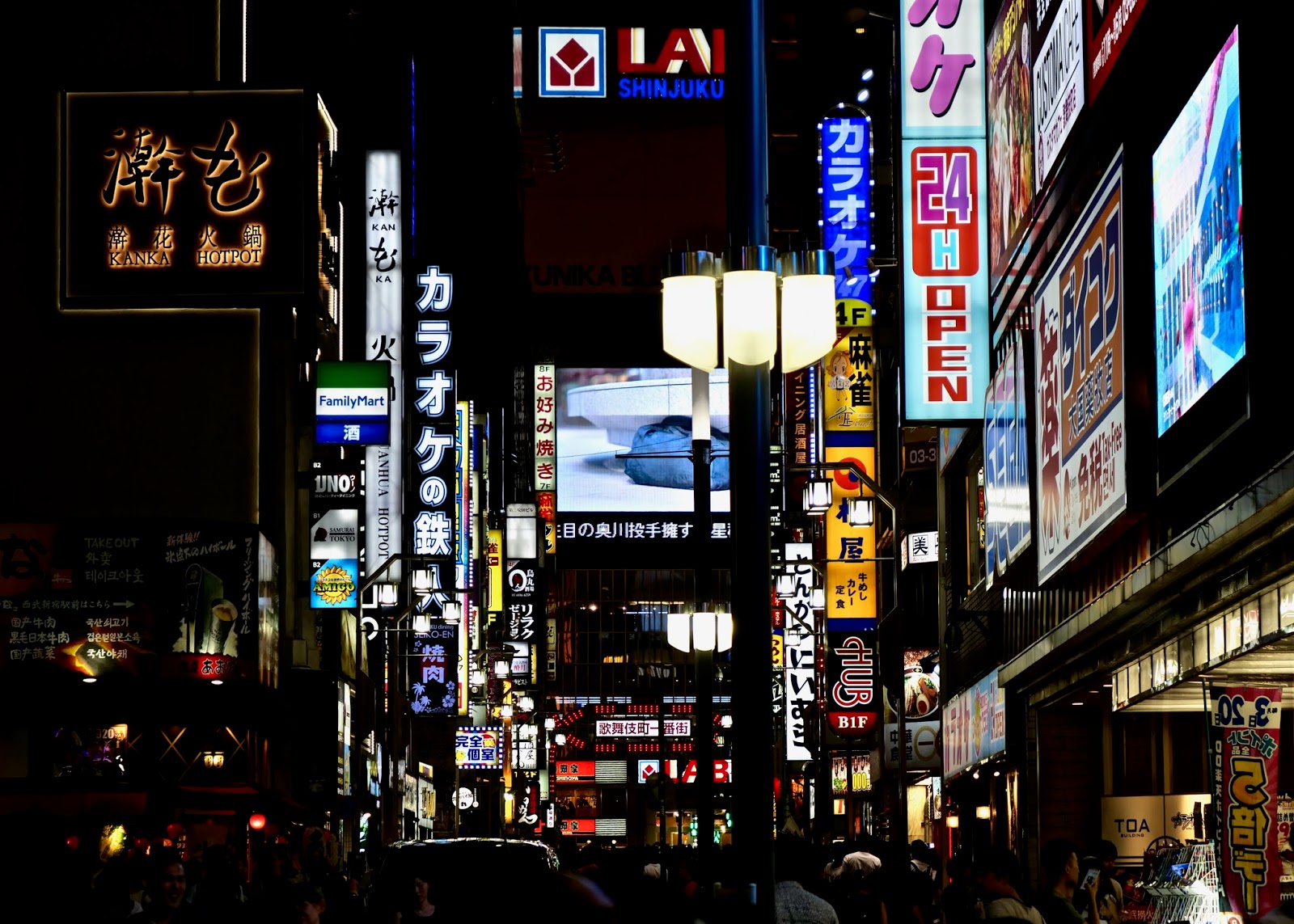
But Tokyo did not start out well. I made the mistake of getting a hotel room in Shinjuku...


Big, intimidating, hot and crowded... Not knowing much about the area, all of the shops and restaurants looked suspicious. But I was able to find a little respite at a nearby English-style pub that was showing the Hanshin Tigers baseball game (and the return of pitcher Fujinami!).


But unfortunately the pub was not smoke-free...

And worse yet I had to return to my hotel room. The biggest mistake I made was booking a room at an APA hotel. It was inexpensive and conveniently located (or so I thought) - what could go wrong?


I was aware of the problematic politics of the owner of the hotel chain, his ultranationalistic right wing opinions and his tendency to place a certain kind of "literature" (right wing ethnocentric propaganda), including books he wrote, in all of the hotel rooms (and on display at the front desk). But surely after this was exposed in the news with great controversy this practice had stopped. Nope.

"Despite calls for boycott, Apa hotel chain will keep books denying Nanking Massacre," The Japan Times, 1/25/17.
url: https://www.japantimes.co.jp/news/2017/01/25/national/despite-calls-boycott-apa-hotel-chain-will-keep-books-denying-nanking-massacre/

"Apa hotels won't remove books that deny 1937 Rape of Nanking for Olympics," The Japan Times, 6/3/17.
url: https://www.japantimes.co.jp/news/2017/06/03/national/apa-hotels-wont-remove-books-deny-1937-rape-nanking-olympics/

Here is what I found in my room.


There were a lot of foreign, especially Chinese, guests staying at the hotel... How about not insulting your customers? And where was the omotenashi?


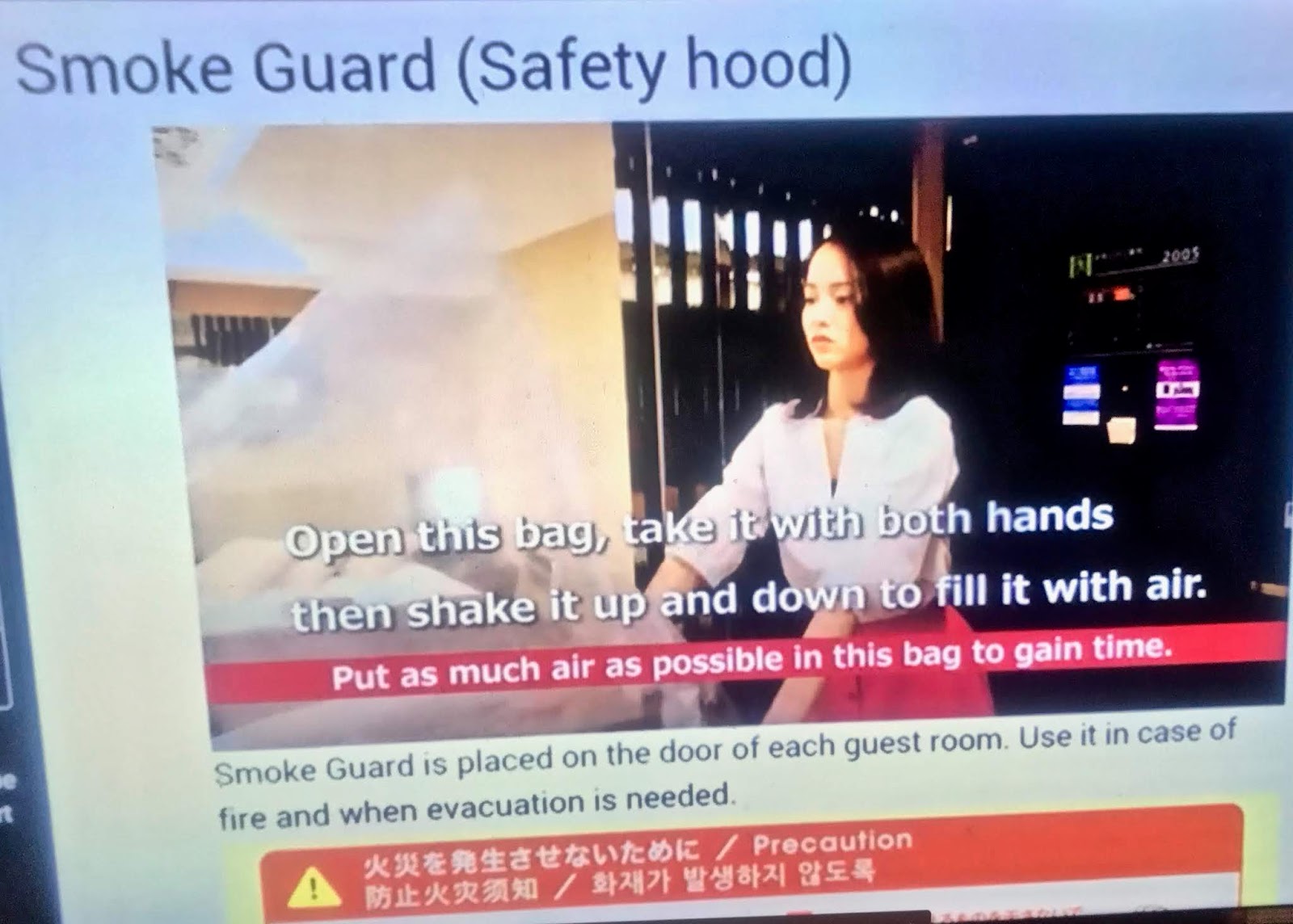
Perhaps I shouldn't complain about the small room (very different than the picture on their website), unfriendly staff, broken air conditioner/television/toilet, slow elevators and poor barrier-free facilities. After all, this is not a hotel review (but I do hope you can find mine on a certain hotel reservation website titled WORST HOTEL EXPERIENCE EVER!). But I do want to mention the fire alarm that went off around midnight on the 24th floor. I was staying on the 25th floor. We were told to stay in our rooms until the staff could determine what was going on. I watched staff members going from room to room on the 24th floor. One room didn't answer and they merely skipped it and moved on to the next room. After almost an hour we were given the all clear signal - false alarm. Safe. But it did make me wonder about their fire safety and evacuation procedures. And there it was on the hotel tv monitor. Check out these crappy screen captures from their "for your safety" presentation.


Here is the actual safety hood.


The safety instructions continue...


Feeling safe?

To end on a positive note, the hotel does feature a public bath on the top (28th) floor. It might be the safest place in the building...


Ah Tokyo... and oh yeah, there was an earthquake during my trip as well...

I have an obvious bias against Tokyo. But there are a lot of great things there if you can find them. I will try to focus on some of those in the next posts...

Wednesday, November 26, 2014

Visual Anthropology at the 2014 AJJ Fall Meeting

The 2014 Anthropology of Japan in Japan Fall Meeting will take place at Nanzan University in Nagoya, Japan on Saturday, November 29 and Sunday, November 30.

Click here for instructions to access Nanzan University.

Below is information on VAOJ events that might be of interest to visual anthropologists:

An Introduction to Visual Anthropology (Guest Lecture)

This lecture/workshop will examine visual anthropology, especially in the Japanese context, through a deconstruction of the term and an exploration of “the visual,” “visualization” and “anthropology.” We will then perform a reconstruction and consider the origins and functions of visual anthropology. Visual anthropology is more than using cameras and the passive viewing of images. Theoretical concerns such as the relationship(s) between the visual anthropologist, subjects and audience will be discussed. Finally, the challenges of doing visual anthropology will be presented through a proposed set of guidelines for “shooting culture” (both photography and film) in Japan.

R Building - Room R33
Saturday, November 29, 1:30-2:45 PM

Inspiration Porn and Representations of Deaf People in Japan (Paper Presentation)

This paper will deal with so-called "inspiration porn" and its relationship to disability identities with a focus on deaf people in Japan. Inspiration porn can be described as the idealization of disabled people “overcoming” -- doing common everyday life tasks (e.g. riding a train, having a job) or for achievements that have nothing to do with their particular disability (e.g. deaf athletes). Cross-cultural examples, observations and perspectives will be discussed to set up an exploration of how disabled and deaf people are portrayed in various media. Japanese deaf people are often critical of the representations of deaf protagonists and characters in popular television dramas and movies. Such representations create strong but inaccurate images of deafness and sign language that ultimately serve to perpetuate deficit models of disability. On the other hand, representations of disabled/deaf people themselves as seen on NHK programs such as Baribara (Barrier Free Variety Show) and the “Deaf People” corner of Minna no Shuwa (Everyone’s Sign Language) challenge and add to a social welfare discourse with abled (bodied) Japanese and their (re)evaluations of who or what makes up contemporary mainstream society.

R Building - Room R51
Saturday, November 29, 3:00-4:15 PM

There are many more interesting presentations, lectures and film screenings on both days.
For more information about the AJJ Fall 2014 Meeting: http://ajj2014meeting.blogspot.jp/

Friday, May 9, 2014

New Horizon of Anthropological Films from Japan

The Japanese Society of Cultural Anthropology (JASCA) will hold their 50th Anniversary Conference jointly with the International Union of Anthropological and Ethnological Sciences (IUAES) Inter-Congress in May, 2014. Several other anthropological organizations are participating as well.

The conference aims to attract well over 1000 international and domestic delegates to Chiba City in Greater Tokyo. The theme will be The Future with/of Anthropologies. The language of the conference will be English.

For more details: http://www.iuaes.org/japan2014/

This is probably the biggest anthropology conference of the year. One session might be of particular interest to visual anthropologists and filmmakers:

New Horizons of Anthropological Films form Japan

Convener: Itsushi Kawase (National Museum of Ethnology, Japan)

Currently, a considerable number of films have been produced by Japanese anthropologists centering on the variety of cultures in the world. Since 2006, more than 70 films have been presented in the film program in the annual meetings of the Japanese Society of Cultural Anthropology. Some of them have been circulated and discussed widely in the internationally-acclaimed academic film festivals. The recent dramatic growth of the anthropological/ethnographic film platforms and visual anthropologists’ scholarly networks in the world have further facilitated the production and progress of methodology of anthropological filmmaking in Japan. Furthermore, several interdisciplinary audio-visual workshops led by anthropologists explore the new form of audio-visual storytelling and expand the practice of knowledge creation in humanities in conjunction with film, contemporary art and anthropology. This film program will present some of the latest films produced by anthropologists in Japan. We invite scholars who are interested in integrating film as the practice of doing anthropology and have the discussion on different audio-visual approaches to anthropological subjects as well as the different styles and conventions employed in the construction of films.

Date and Time: May 18th, 10:30- Venue: Room 304(3rd Floor), International Conference Hall, Makuhari Messe

For more information: http://www.cva-iuaes.com/japan2014/

Thursday, October 17, 2013

Ethnographies of Hope in Contemporary Japan


Date: October 19, 2013
Venue: University of Osaka, Graduate School of Human Sciences
Convenors: Iza Kavedžija and Scott North

In recent years, amidst a faltering economy, the Japanese have witnessed a proliferation of narratives of diminishing hope and decline. Social consequences range from withdrawal from the public domain into the private sphere (Zielenziger 2006), to political apathy among the young (McVeigh 1998, 2004), to the strengthening of right wing rhetoric (Japan Times, 23/5/2013; Nakano n.d.). Yet a vague sense of disillusionment or hopelessness would seem to be the most widespread public reaction.

While the situation, both politically and economically undoubtedly warrants concern, such an attitude is far from the only one possible. The cross-cultural perspective afforded by anthropology indicates that people living in much more dire circumstances, in places struck by war or hunger for example, nevertheless hope and strive for better lives (e.g. Vigh 2009), and actively attempt to transform their communities. Other research indicates that positive emotions are contagious within certain limits (Fowler and Christakis 2008), suggesting that hope can be purposely increased.

This workshop seeks to examine ethnographically the feelings, perceptions and narratives of hopelessness in contemporary Japanese society. Furthermore, it seeks to outline some of the cases in which new approaches, organizations, or grassroots efforts have fostered renewed feelings of hope.

One sample paper that might be of interest:

The Hope for Medical Interpretation for Deaf People (and Foreigners)
Steven C. Fedorowicz
Kansai Gaidai University

Abstract: A new city hospital in Hirakata-shi, Osaka is scheduled to open in 2014. In 2011, a small group of deaf citizens decided that the timing was right to request a service to be implemented at the new hospital they lacked and desperately needed – medical interpretation in Japanese Sign Language (JSL). The group figured it could strengthen their position by aligning themselves with foreign residents in the city. By including foreigners, the group’s goals broadened “to change the city to be friendly to every citizen with a secured and comfortable life… [and] to ensure easy access for the hearing impaired and foreign residents to medical care” (The First Forum poster). One of the first strategies to recruit foreigners was to elicit the assistance of an American anthropologist fluent in JSL. Public forums were scheduled featuring doctors, professors, interpreters and other specialists to discuss the need and future prospects of medical interpretation. Initially there were feelings of optimism and great hope that policies and services crafted locally would ultimately serve as a template for medical interpretation in other areas in Japan as well. However, the planning and implementation of the forums proved to be extremely challenging. Personal and political rifts between deaf people, interpreters and others added to the difficulties of increasingly unfocused goals and strategies. This presentation will be an auto-ethnographic account of the highs and lows of the group’s efforts from the perspective of the American anthropologist struggling to balance research and activism.

For previous VAOJ coverage of the Hirakata-shi medical interpretation forums: http://visualanthropologyofjapan.blogspot.jp/search?q=medical+interpretation

For more conference information (schedule, abstracts, etc.): http://ethnographiesofhope.wix.com/workshop#!workshop/cjg9

Wednesday, November 28, 2012

Visual Anthropology at the AJJ


The 2012 Anthropology of Japan in Japan (AJJ) Fall Workshop@Kyoto
Doshisha University, Muromachi Campus (Imadegawa) 
December 1st & 2nd, 2012

“Belonging in Japan and Beyond”

This meeting will explore what it means to feel a sense of Japanese cultural and/or national heritage within Japan or beyond its territorial borders.

***

Lots of good visual anthropology going on this week. Many thanks to my students for their efforts in creating photographs and films - both the photo exhibition and film festival were extremely successful. Thanks to all who came to both events.

In case you need another dose of visual anthro, you are in luck. The AJJ Fall Workshop is in the Kansai this year and has a lot of interesting presentations scheduled. Of particular interest to visual anthropologists will be this session:

Sunday, December 2nd, 13:30~15:30
Session 6 (Law School at the “Kambaikan,” 2F, Room KMB208)

Sights of Community: Exploring Belonging in Visual Practice
Organizer and Chair: Steven C. FEDOROWICZ (Kansai Gaidai University)

Belonging in the Work of Japanese Contemporary Artist Fuyuko Matsui (Eva MISKELOVA, Masaryk University / Kansai Gaidai University)

Exploring Devotees of a Sexy Cyber Green-Haired Guru (John SHULTZ, Kansai Gaidai University)

Fujoshi Between Pleasure and Danger: Yaoi/BL Fandom and the Management of Spoiled Identities in Japan (Jeffry T. HESTER, Kansai Gaidai University)

How to Play Deaf in Japan (Steven C. FEDOROWICZ, Kansai Gaidai University)

For more information about the AJJ Fall Workshop, check out the AJJ Blog: http://www.ajj-online.net/www.ajj-online.net/Blog/Entries/2012/11/19_Annual_Meeting_Program.html 

For directions to Doshisha University: http://www.doshisha.ac.jp/english/access/ima-access.html