Showing posts sorted by relevance for query germany. Sort by date Show all posts

Wednesday, August 25, 2010

The German Deaf Museum


Even before I came to Germany I was hoping that I would be able to meet some German deaf people and have the opportunity to study German Sign Language. My students at Goethe, Bastian and Armin, found a web page for a "deaf museum" in Frankfurt and I was excited to check it out. As it turns out, the museum, which opened only last year, is the only deaf museum in Germany. And its founder and curator, Lothar Scharf, has done incredible research on deaf people in Germany during the Nazi era. Lothar has been very generous sharing his research with me and more. In the short time I have been in Germany he has become a very good friend.


I was able to spend some time at the deaf museum and the Frankfurt Deaf Center located above the museum, meet German deaf people and observe German Sign Language (DGS). I found German Sign Language to be similar to American Sign Language and completely different from Japanese Sign Language. Here is a brief description of German Sign Language:

German Sign Language or Deutsche Gebärdensprache is the sign language of the Deaf community in Germany. It is often abbreviated as DGS. It is unclear how many use German Sign Language as their main language; Gallaudet University estimated 50,000 in 1986. The language was not invented; it has evolved naturally though use in deaf communities over hundreds of years.

Germany has a strong oralist tradition and historically has seen a suppression of sign language. German Sign Language was first recognised legally in a disability act in May 2002. Since then, Deaf people have a legal entitlement to Sign Language interpreters when communicating with federal authorities, free of charge.

German Sign Language is unrelated to spoken German. The two have very different grammars, though as the dominant language of the region, German has had some influence on German Sign Language. A signed system that represents the German language has been developed, which is known as "Signed German" (Lautsprachbegleitende(r) Gebärden, Lautbegleitende Gebärden or LBG). It is rarely used as a natural means of communication between deaf people. Another system of manually representing German is known as "Phonembestimmes Manualsystem" (Phonemic Manual System). Similar systems that represent the English language are known as Manually Coded English.


Source: http://www.german-language-school.info/german/signlanguage.asp


Lothar has told me that in reality the number of deaf people is smaller, perhaps around 40,000. And he is pessimistic about the future of deaf people in Germany. For one thing, deaf people were sterilized during Nazi time so genetically deaf people in Germany were unable to have children. And cochlear implants are very popular (and are apparently free for deaf people to get). And I understand from Lothar that "Deaf Pride" as it exists in the United States and Japan is not so prevalent in Germany. Most deaf people want to communicate with and be a part of the hearing world. Realistically, that's where better jobs are. Here are a couple of more links about the deaf situation in Germany:

Link to article, "Deaf education in Germany"

Link to overview of deafness in Germany, "Deaf Community - Germany"


The German deaf situation seems so different from what I have encountered in Bali, the United States and Japan. I hope to have more opportunity for research in the future. And Lothar himself makes for a fascinating study. Lothar is hard of hearing and seems comfortable speaking German (and English), signing DSG (deaf sign language) and LBG (signed German). He quit high school and was into flower power and the communist party as a youth. Twelve years ago he began his "second life" as he puts it, beginning his research of deaf people during the Nazi time. He has an incredible collection of deaf related materials on display in the museum and in his own private collection. Lothar has found that deaf people were not merely discriminated (and sterilized) by the Nazis, many of the deaf supported Hitler (and of course many did not support him), the same as hearing people in Germany at the time. One older deaf individual I met in Frankfurt told me how he liked and now misses Hitler (despite being sterilized himself). And just today Lothar showed me copies of Deaf Hitler Youth newspapers with articles about Japan (and he has promised to translate them into English in the future). Lothar travels across Germany and Europe to give lectures about his research. He has also written two books full of valuable information and historic photographs. Check out his websites:

Link to Deaf Museum web page:
http://www.deafmuseum.de/museum.html


Link to Lothar Scharf's web page:
http://www.gehoerlose-drittes-reich.de/

The Deaf Center has a large multiple purpose room, other rooms used for various deaf groups, administrative offices including facilities for a deaf telephone relay program and apartments for deaf and hard of hearing people.


There is also a Deaf Pub at the center, where deaf people can gather, eat, drink and socialize. In this sense, the deaf club is a physical space owned by deaf people (like the situation in the United States described by Lane et al. [1996]) as opposed to most sign language circles in Japan that rent rooms from community centers and social welfare facilities. Lothar seemed surprised/disappointed that my own sign language circle/deaf club in Osaka did not have its own bar.


The last two photos above are from occasions when deaf people gathered at the center to view soccer World Cup matches. The deaf people were just as crazy about soccer, or football, as hearing people.

I was able to bring my students from Goethe to the deaf museum on a fieldtrip and they were all greatly impressed. The fieldtrip was reported in a national German newspaper, the Frankfurter Allgemeine Zeitung. While I was happy with the attention and to have my own photo published, the story itself was full of inaccuracies. It was unfortunate that the reporter didn't ask ask any questions and instead made assumptions.


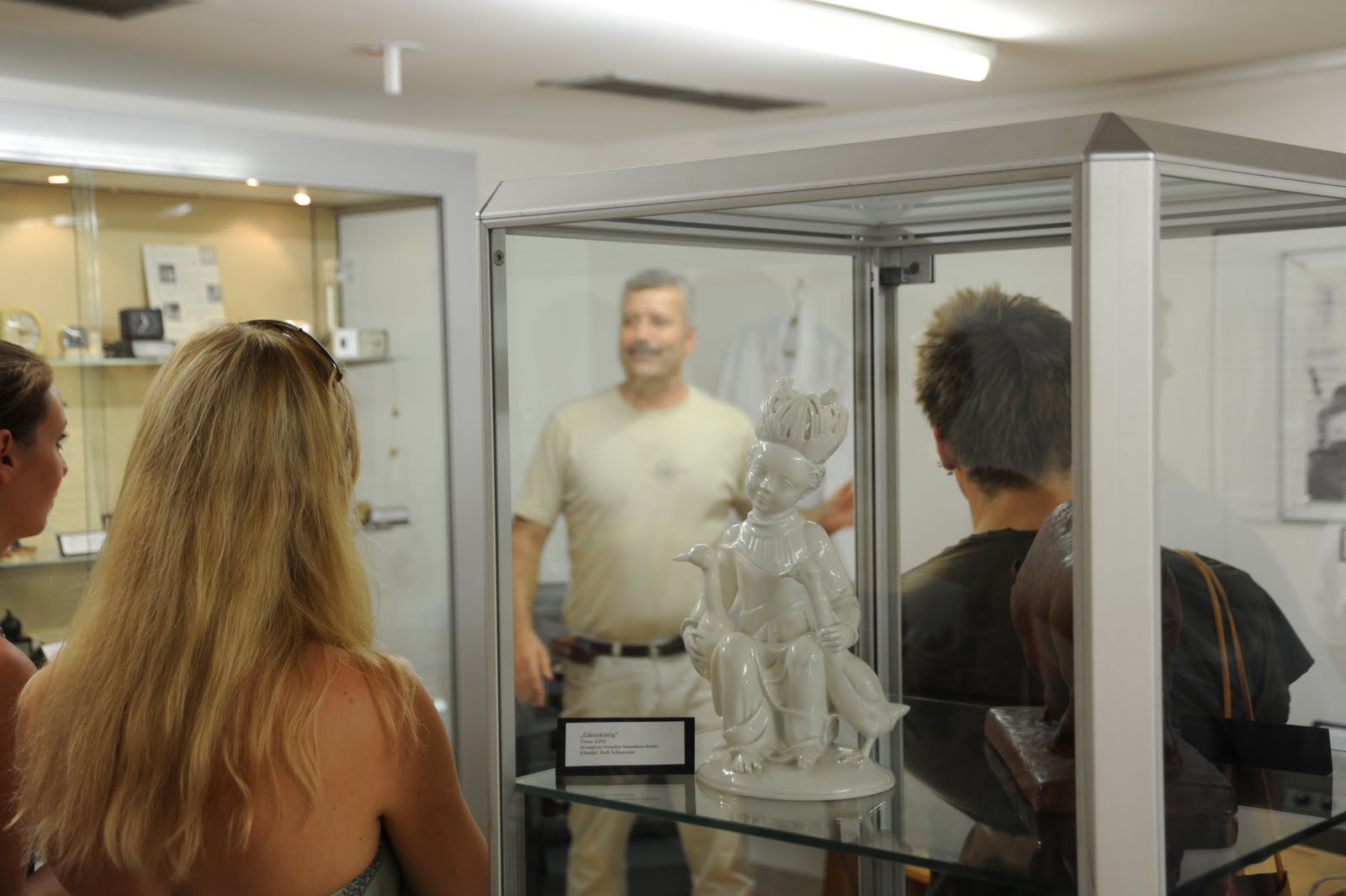


The museum, despite its relatively small size, has many artifacts and exhibitions. I took many photos and am tempted to include them in this post, but in the end I want to encourage people to actually visit the museum and hear Lothar's lectures. The actual experience of being in the place is much richer than an internet encounter. Hopefully this post will give readers an idea of what the place is like and encourage visits. I am also hoping to bring Lothar to Japan so he can lecture about his research. Even though I am leaving Germany soon, I look forward to continued contact, experience and friendship with Lothar and others at the deaf center in Frankfurt. To them I wish to express my deepest gratitude for sharing so much with me and VAOJ.

Tuesday, July 6, 2010

"Paul the 'psychic' octopus tips Spain to beat Germany"

Photo and text borrowed from The Local, 7/6/10.

I saw a picture of this octopus before and my friend Bastian was kind enough to explain the connection between an octopus and the World Cup. I would have thought that such a method of prediction would come from Japan (and maybe Osaka, home of tako yaki, specifically) rather than Germany. Anyway, I hope Paul is wrong this time...

Cries of despair were likely heard across Germany on Tuesday after a "psychic" octopus called Paul tipped Spain to beat Germany in the football World Cup semi-final.

The eight-legged oracle, who has successfully predicted the outcomes of all five of Germany's games in South Africa, carefully weighed up the two teams before plumping for Spain, prompting anguished groans from the assembled media scrum.

Carried live on national television, two plastic boxes, one with a German flag and one with a Spanish, were lowered into Paul's tank at an aquarium in western Germany, each with a tasty morsel of food inside. The box which Paul opens first is adjudged to be his predicted winner.

If Paul's performance is replicated on the pitch, it promises to be an end-to-end thriller. He teased the crowd by initially lingering at the German flag before heading for the Spanish box.

The mollusc medium has shot to fame by defying the odds with a perfect record of picking winners.

Proving he is not just attracted to the colours in the German flag, he rightly foretold Die Mannschaft's shock defeat to Serbia in the group stages.

He then predicted Germany's triumphant drubbing of England in the last-16, provoking accusations of treachery. Paul should by rights be an England fan, having been born in Weymouth on the south English coast.

Confirming his reputation as a prognosticator par-excellence, he kept up his astonishing run of form by tipping Germany to beat highly fancied Argentina in the quarter-finals.

But all is not lost for coach Joachim Löw and his boys as Paul has been wrong before.

In the European Championships in 2008, he had an 80 percent record, getting only one match wrong.

Which one? The final that Germany lost. Against Spain.


Read the story and readers comments:
http://www.thelocal.de/society/20100706-28321.html

Monday, May 31, 2010

Google Street View Problems in Germany

VAOJ has reported on the problems with Google Street View and privacy issues in Japan. There are also problems in Germany as well as other European countries. From The Local - Germany's On-line News in English:

German consumer protection minister Ilse Aigner says that internet giant Google could face "more than 50,000" lawsuits in Germany because of its controversial virtual photo service Street View.

Seems as though Google was not only taking unwanted photos, but gathering people's private internet information as well. From CNN Money.com:

The company is facing criminal charges from Germany related to its Google map feature, Street View. Street View shows 360 degree images of locations all over the globe. To get these images, Google deploys vans, cars and kooky tricycles equipped with cameras and GPS receivers, to collect photos of as many places as possible. Turns out, besides taking snapshots of the local biergarden in Germany, Google's vehicles were also mapping and enumerating the locations of open Wi-Fi networks.

Read the entire articles:

Minister: Google faces 50,000 lawsuits
http://www.thelocal.de/national/20100530-27527.html


Google, feeling lucky, tells German privacy czar to wait
http://money.cnn.com/2010/05/27/news/companies/google_privacy_fortune.fortune/


I am looking forward to investigating privacy issues and public photography in Germany. What kinds of challenges will my new students have in shooting their ethnographic films here? Stay tuned...

Tuesday, June 15, 2010

World Cup Celebrations in Germany


While I am a little disappointed that the Germans are not into baseball at all - and I really miss my Hanshin Tigers - the Germans (along with the rest of the non-USA world) are into football (soccer as it's known in Japan and the USA). The World Cup is happening now, and the matches can be seen at every bar and restaurant. Frankfurt has a big screen set up in the middle of town and I went there last night during Germany's match with Australia. Here are some of the many people out celebrating. (Germany won, 4-0, by the way.)


This morning as I went for my usual walk the owner of the convenience store below my flat told me he was able to find a Japanese flag for me. I bought it, of course - it might be the only Japanese flag in Germany and I might be the only person here rooting for Japan - along with a flag of Germany. Later in the day I heard the Japanese national anthem outside. The convenience store owner has a big screen TV set up outside his store and he was broadcasting the Japan-Cameroon match. Japan just won, 1-0. Time to take my flag out for celebrations...

Wednesday, September 8, 2010

Perspectives of Frankfurt and Goethe

My summer of teaching at Goethe University and living in Frankfurt, Germany was valuable on so many levels. I enjoyed working with the Goethe students and experiencing a language and culture I had virtually no previous knowledge of. I must admit that I have become too comfortable (at times) living in Japan. My summer in Germany shook things up for me, and made me understand a little better what my international exchange students go through here in Japan. I hope the experience has made me a better teacher, anthropologist and photographer. Please excuse this highly reflexive post. But I feel I need to say something now that I have left Germany and am back teaching in Japan. I am not doing this for any sense of closure, because I don't want the experience to end. And in my mind it never will. And so this post, as I told my students at Goethe before I left, is not a sayonara (farewell) but rather a mata ne (see you again).

I went to a lot of places in and around Frankfurt and I took thousands of photos. One might think that seven weeks of this would make me somewhat familiar with Frankfurt. But two things make me question such an idea. Towards the end of my stay my friend Fabian took me on a tour of Frankfurt, beginning with a trip to the top of the Main Tower. Here I was able to see great views and gain a better understanding of the layout of the city. I was surprised at how close certain places were; taking the underground all of the time really distorted my sense of space and time. It seemed crazy that I had to take two different subway lines to get to the university when it was in fact so close to my flat. So I suppose this is a good lesson for anthropologists: get as high as you can to reach better understandings of your environment.

After seven weeks in Frankfurt I left for a three week visit to the United States. Then I returned to Frankfurt (to grade papers and calculate final grades). Upon my return to Frankfurt so many things seemed different. Posters and advertisements in the train stations had changed. Construction had been started or progressed in certain areas. The convenience store below my flat was remodeled. There were enough changes to make me wonder if I had actually lived there for seven weeks. And upon my return, still under the influence of jet lag, one of my students assertively quizzed me about where I had and had not been in Frankfurt. These things made me question the representations of Frankfurt I was making with my photos. Did I really know enough about Frankfurt to post photos on this blog? Did I really have an sort of ethnographic authority to post my photos? Were my Goethe students really justified to be paranoid about me "anthropologizing" them? I will continue to ponder these questions and welcome any thoughts/comments from those reading this post.

Click here to see photos of my friends and students from Frankfurt.

The Ethnology graduate students at Goethe have a tradition of pounding a nail into a special stump after they have finished their degree. Here Bastian looks at the stump in anticipation as he works to finish his Master's Thesis. Oh so many nails sticking out... but not to be hammered down.

Some of the Goethe Ethnology students are doing interesting things with photography. Check out their work below:

Link to Armin's Europott Frankfurt: http://frankfurt.europott.org/#awp::


Link to Armin's fotografie: http://www.arminritter.de/journal/

Link to Daniel's thorpe-d: http://www.thorpe-d.com/index.htm


Link to Annie's Photography: http://photo.net/photos/annie

When trying to come up with a conclusion for this post, the clip on my new Goethe University ball point pen broke off. So much for the stereotype of tough, rugged German products. Much of what I thought I knew about Germany and visual anthropology was challenged during the summer. And I am grateful. Frankfurt: I'll be back. Until then...

Friday, May 21, 2010

VAOJ is going to Germany!

Screen grab from the Institute for Ethnology student blog.
Caption reads: Yea! Fedorowicz is coming to Frankfurt.


In another weird twist of globalization, an American professor is going to Germany to teach German students Japanese Sign Language in English...

I have been invited to teach visual anthropology and Japanese studies at the Institut für Ethnologie at Goethe-Universität (otherwise know as "the Frankfurt school") during the summer. Apparently there is a demand for learning about Japanese culture in Germany; Goethe students promise me they will show me the German take on Japan. The German students also want to learn how to make ethnographic films about Japanese culture and I am expecting some fascinating projects. It should be noted that graduate students at Goethe found me through this blog and petitioned their university to invite me. Many thanks to them, my students in Japan and regular readers of VAOJ for making all of this possible.

So look for some interesting tangents, twists and turns in VAOJ this summer.

For more information about Goethe's Institute for Ethnology's program, check out the student blog (in German):
http://www.ethno-fachschaft.de/


Click here for all of the Germany posts.

Monday, July 5, 2010

German AIDS Public Awareness Campaign

We discussed the HIV/AIDS situation in Japan in the Contemporary Issues/Globalization seminar last week. I was interested in hearing about the German situation, especially after seeing a public service poster at the bus stop near campus. Alas it was changed before I had the chance to photograph it (lesson to visual anthropologists: never put off taking that photo!). My graduate student, Anna, from the seminar was kind enough to do some research, offer comments and translations and forward visual images.

The organization that does the public service is called "Gib AIDS keine Chance" (Don't give AIDS a chance). Their main motto is "mach's mit" (Do it with it). There current series of posters is called "Liebesorte" (Love places). According to Anna, "And so the point is that one has the choice of either having sex and a good time or having sex and to risk AIDS. And of course the condom is always placed on the former."

Each poster photo is accompanied by a title. "The phrases are a little hard to translate because they're colloquial German, but all of them have some sort of sexual connotation in it somehow."

Hanging out


Living out Fantasies


Not getting to know AIDS


Rock and Rollen


Socialize - Making new contacts


Summer night dreaming


Taking a bite

Link to Mach's Mit (in German):
http://www.machsmit.de/


According to one article, HIV/AIDS rates in Germany increased by 20% in 2005.

According to a report from the Robert Koch Institute, the federal government's disease control center, 1,164 Germans were infected in the first half of 2005 with the virus. Almost 60 percent of new infections were among homosexual men. Some 45,000 of the 40 million people living with HIV around the world are German.

Christopher Knoll, a psychologist at Munich's AIDS-Hilfe, an HIV/AIDS support center, said more gay men are being infected because they no longer consider the disease a serious threat.


Link to "Less Fear of HIV is Pushing up Infection Rates Among Gay Men"
http://www.dw-world.de/dw/article/0,,1797615,00.html


According to Avert.com, rates of HIV/AIDS in western Europe have dropped slightly (as opposed to eastern Europe where rates continue to rise).

Link to European HIV and AIDS Statistics:
http://www.avert.org/hiv-aids-europe.htm


A more recent article claims that rates are still increasing and discusses various ad campaigns.

A new campaign to raise awareness about HIV infection uses shock tactics to get its message across. The foundation behind it says the pictures are meant to provoke in order to bring the issue of HIV back into focus.

Link to "New German HIV/AIDS Campaign Pushes the Envelope"
http://www.dw-world.de/dw/article/0,,2426087,00.html

See also "Germany: Hitler AIDS Ad Stirs Controversy"
http://www.thebody.com/content/world/art53666.html


So it seems once again that Japan is not so culturally "unique" in terms of the increasing rates of HIV/AIDS. Germany has to be credited with so many public service announcements. My seminar students all seem dumbfounded by the lack of discourse about sexual education and HIV/AIDS in Japan. But globalization teaches us that so-called national boundaries are meaningless when it comes to illness and disease. HIV/AIDS ignore customs and immigration inspections. This is a global issue that needs a global response. Think/act globally; think/act locally.

Thanks once again, Anna, for sharing this information. And thanks to all of my students for their interest and discussion.

Wednesday, August 25, 2010

"German angst alone cannot stop Google "(Street View)"

More about the controversies of Street View in Germany from today's The Local:

Google Street View is still harmless, says German consumer protection expert Falk Lüke, but that doesn’t mean the current discussion surrounding it is unnecessary. Instead, we should be focused on creating international rules for online privacy.

...

Amid all the classic German angst, good arguments against Street View have been mixed with downright silly ones. The pro-Google camp gleefully quotes its opponent's most absurd comments and stands by the under-fire web company. But that doesn’t change that Google really has done a lot wrong.

The company sent out cars to film the streets from a height of 2.9 metres. This is high – ask someone to sit on your shoulders and this is about the view they would have. Then ask them to tell you whether they can see over walls and hedges.

In many parts of Germany, such barriers are restricted to a height of two metres – often lower. Is there a clearer sign that you would prefer that people didn't see into your property than by building a wall as tall as allowed by the law? I don't believe there is.

Of course, Germany is not the only country that has a problem with Street View. The project was criticised in Switzerland and Greece, among other places, and in 2009 Google was forced to re-photography 20 Japanese towns from a lower angle.

Politicians want Google to obscure car licence plates and people. But what do they mean by obscuring people? So far, Google has only suggested obscuring faces. You don't have to be a criminologist to know that people can be recognised by many other features than their face. If you've seen how poorly Google has tried to make people unrecognisable in other countries you'll know that their standard is unacceptable.


Read the whole story:
http://www.thelocal.de/opinion/20100819-29273.html

Wednesday, August 18, 2010

German Cabinet to consider tougher Street View rules

Image borrowed from The Local.

Another VAOJ update, this one about Google Street View in Germany from The Local:

Coalition politicians are demanding Google be forced to gather residents’ consent to have their homes photographed for Street View rather than wait for them to object, as cabinet prepared Wednesday to discuss changes to the law.

...

Street View is an online service by US internet giant Google that allows users to peruse street-level, panoramic pictures of major cities – a kind of “virtual tour.” The pictures are taken by cameras mounted on cars that drive around the city.

While the service is available in many other countries, it has run into firm opposition in Germany over privacy concerns, forcing Google to offer an “opt-out” system, which was launched yesterday and lets home owners and renters demand that their building be blurred out.

...

Google plans to put Street View online for 20 major German cities by the end of the year
.

Read the whole story:
http://www.thelocal.de/national/20100818-29219.html


See also "Aigner wants longer opt- out limit for Street View:"
http://www.thelocal.de/sci-tech/20100817-29203.html

Saturday, May 23, 2015

Logical Emotion Exhibition


Photo borrowed from Japan Today's Picture of the Day, 5/23/15. Caption reads: Visitors walk through the installation “Love is Calling” (2013) by Yayoi Kusama at the exhibition “Logical Emotion: Contemporary Art from Japan” in the Art Museum Moritzburg in Halle (Saale), central Germany, Friday. The exhibition, which presents the works of 13 Japanese artists, runs through July 26.

Source: http://www.japantoday.com/category/picture-of-the-day/view/art-attack-4

Exhibition description (from Museum of Contemporary Art in Krakow):

The leitmotif of the exhibition can be encapsulated in two concepts – often treated as each other’s antithesis – ‘logic’ and ‘emotion’. The organisers of the exhibition hold that the tension between these concepts is the pivot of contemporary Japanese art. The exhibition aims to discover the essence of the ‘Japanese identity’, presenting it in different contexts and attempting to define distinguishing features of its aesthetics.

At the exhibition we present the works of 13 Japanese artists including an architect and a graphic designer, produced in media such as photography, painting, drawing, manga, sculpture, installation, object, video, ceramic and poster.


Logical Emotion Official Website: http://www.stiftung-moritzburg.de/

I hope my friends in Germany will have a chance to check this out.

Tuesday, June 15, 2010

Weird Japan? How about Weird Germany?

Image borrowed from The Local, 14 June 2010.

OK, this story is so out there, I couldn't resist posting it on the blog. We always hear so much about the weird things Japanese people are doing. Well, there are some weird Germans as well...

Man moons and throws puppy at Hells Angels bikers

A young man in Bavaria who reportedly forgot to take his medication taunted a group of Hell's Angels at their clubhouse over the weekend by dropping his pants, throwing a puppy at the bikers, and then making his getaway in a stolen front loader.

Read the whole story at The Local - Germany's News in English:
http://www.thelocal.de/society/20100614-27841.html

Wednesday, July 21, 2010

VAOJ's first published foto in Europe

Pdf copy of the page from yesterday's (7/20/10) printed edition of Frankfurter Allgemeine Zeitung. My photo is about two thirds of the way down on the right. The story is about a fieldtrip to the German Deaf Museum in Frankfurt I took my students on. Yes, dear VAOJ readers, I have been holding out on you. Of course I have been looking into the deaf scene here in Germany. Please look forward to the future post on this subject. Coming soon...

UPDATE: I was a Visiting Professor during the summer of 2010 at Goethe University in Frankfurt. Just a coincidence (?) that the only Deaf Museum in Germany was close by. Click here for the post on the German Deaf Museum in Frankfurt.

Thursday, January 9, 2014

Nippon Connection 2014


14th Nippon Connection – Japanese Film Festival
May 27 – June 1, 2014, Frankfurt am Main/ Germany


Nippon Connection is the largest showcase of Japanese film worldwide and takes place in Frankfurt/Main, Germany. The festival’s aim is to contribute to the development and promotion of Japanese film culture and it presents the whole range of innovative Japanese film art: blockbusters, dramas, animation and experimental films, documentaries as well as short films. Nippon Connection gives special attention to young and innovative talents and independent productions.

The programme is divided into six sections: Nippon Cinema, Nippon Visions, Nippon Animation, Nippon Retro, Nippon Kids and Nippon Culture. All films are selected by the festival programme committee. Not all selected films take part in the competitions. Accepted films are short and long feature films as well as documentaries, experimental films and music videos.

Festival organizers are looking for films that have been made after 2011 and produced or shot in Japan. All lengths and genres will be considered. Submission deadline: March 15, 2014.


For more information: http://www.nipponconnection.com/

Entry form: http://www.nipponconnection.com/files/downloads/en/NC14-EntryForm-eng.pdf

Sunday, May 30, 2010

Looking for Japan in Germany... and Re-Thinking Orientalism

There certainly seems to be a lot of Japanese influence in Frankfurt. Here is some live sushi all you can eat... I found a sushi shop in the Frankfurt train station yesterday run by a Korean woman (who at least seemed to understand Japanese...). Actually I have been hard-pressed to find "German" food. Lots of kebab, halal and African cuisine, at least in the area close to my flat. Last night the anthro grad students gathered at an Ethiopian restaurant. My flatmate commented for "real German food" I would have to go to Bavaria...

The kinds of pictures I am taking here in Germany are very different from those I take in Japan. Despite living in Japan for almost 13 years now, I am beginning to think that I am (still) an orientalist... I am also appreciating the plight of my exchange students when they first come to Japan. All the seemingly easy advice I give them is actually not so easy. I tell my students to "get lost" and "just jump on a train and see where it takes you." I did just that today... in the rain. I was able to find my way back to my flat and gain some insight into the difficulties of adapting to a new culture. And perhaps a little insight into Frankfurt as well. Stay tuned...

Wednesday, November 24, 2010

New Visual Anthropology Links

One of  the things that continues to amaze me is how this VAOJ blog allows me to meet so many interesting people connected with visual anthropology. I have met fellow anthropologists, filmmakers, artists and have benefited from their own work and advice. And of course this blog project got me the visiting professor gig in Germany over the summer.

Lately I have been fortunate enough to have been contacted by two visual anthropologists who have very interesting blogs. I am happy to add them to the ever growing "Visual (and/or) Anthropology (and/or) Blog Related Links" section.  I am thrilled with this kind of networking and collaboration. Please check out their excellent work.


Visual Culture Blog

Self description: As he reached the finishing line of doing a PhD in Photography Studies at the University of Westminster in October 2010, photographer Marco Bohr began the Visual Culture Blog to vent some ideas that didn’t fit into his thesis. His research is concerned with a new generation of photographers emerging in parallel to an economic, political and social shift in Japan during the 1990s. Born and raised in Germany, studying photography in Canada, living in Japan, and continuing postgraduate studies in the UK, Marco hopes to bring an international perspective to the study of visual culture(s). His essay ‘Photography and Metaphors’ will appear in a Visual Culture Reader edited by James Elkins and published by Routlede in 2011. Marco is a guest lecturer in the Visual Sociology department at Goldsmiths, and the Photography departments at University of Westminster and University of Plymouth.

Link: http://visualcultureblog.com/

EthnoVisions

Self description: Wilton Martinez is a Peruvian visual anthropologist and producer based in Baltimore, Maryland. He holds an M.A. in visual anthropology and a Ph.D. in social anthropology from the University of Southern California. Wilton currently teaches anthropology at the University of Maryland University College and is associate visiting professor with the Pontificia Universidad Católica del Perú. He also works as a visual anthropology consultant and producer in Peru, the U.S. and other countries.

Wilton has conducted research on the educational use and the reception of ethnographic films and published related articles in various countries. His award-winning productions have been created both independently and in collaboration with anthropologists, NGOs, indigenous organizations, and with various institutions and private organizations. Wilton is currently conducting research on the reception of YouTube videos of Andean music by transnational Peruvian migrant communities and the recreation of national identity by means of transnational dialogues. He is also planning, along with anthropologist Paul Gelles, the production of a new documentary, Transnational Fiesta: Twenty Years Later, a “sequel” to the original Transnational Fiesta: 1992.

Link: http://www.ethnovisions.net/EthnoVisions/Home.html

Monday, June 28, 2010

Frankfurt Celebrtes the 4-1 German Victory over England in the World Cup


Germany won another match in the world cup and celebrated heartily. Here in Frankfurt I was able to witness and document celebrations in the business/tourist center of town, Hauptwache. The festivities made me question the craziness of Hanshin Tigers' fans. Everyone was decked out in German soccer attire and the celebrations were wild to say the least: drumming, dancing, singing, drinking... In Visual Anthro class yesterday we watched "War Photographer." Not to make light of the work of James Nachtwey or the serious wars and poverty he documents, I felt like I was in a war-zone today. People pushed and shoved while dancing and/or trying to get in a better position to take photos; beer bottles were thrown to the ground and crushed underfoot; real and large/fluffy soccer balls were flying overhead (I had to dodge and deflect the balls more than once) and explosives (OK, fireworks) were lit in the midst of the crowds. The local TV news crew was there for a while and they were a target of the enthusiastic celebrations; people wanted to be on TV showing their joy of the German victory. The police stood by but seemed unconcerned. I saw one officer playing soccer with children. The only officials to get in the way were street sweepers but they were soon drawn into the celebrations. All this being said, Germany during the world cup is the place to be during the summer of 2010...