Explorations and experiments in visual representations - multimodality, sensory ethnography, reflexivity, autoethnographic vignettes, ethnographic photography and ba...
Showing posts with label ethnographic photography. Show all posts
Friday, April 17, 2026
Wednesday, April 1, 2026
Visual Anthropology in Japan:「The Tachinomi Project」 日本に映像人類学: 「立ち呑みプロジェクト」 @ Salon KGU
Visual Anthropology in Japan:
「The Tachinomi Project」
Abstract:
「The Tachinomi Project」is a visual ethnography based upon the intersections of social science research and contemporary art. The project began with long-term participant-observation and a photographic exhibition featuring a 40-year-old tachinomiya (standing drink bar) in Osaka called Tenbun. The study sought to explore photography in public spaces, privacy and image ethics while showcasing a “grimy” (Farrer 2019) and stimulating atmosphere with colorful characters including the shop owner, employees and regular customers. The interactions with Tenbun collaborators and gallery audience at the exhibition became the first of several post-fieldwork encounters, leading to the re-positioning of the research into wider social and academic contexts during and after the COVID 19 pandemic. This present account utilizes reflexivity, autoethnographic vignettes (Stevens 2013) and photography to explore the intersections of the sensory (Pink 2013 [2009]), multimodal (Collins et al. 2017), and ba (Kajimaru et al. 2021) of Tenbun and other eating and drinking establishments.
Thursday, April 16, 2026
18:30 ~ 20:00
CIE 3rd Floor Seminar Room
日本に映像人類学:
「立ち呑みプロジェクト」
職場の同僚と自分の研究成果を共有する機会…
要旨:
「立ち呑みプロジェクト」は、社会科学的調査と現代美術の交差領域に立脚したビジュアル・エスノグラフィーである。本プロジェクトは、大阪の創業40年の立ち呑み屋「天文」における長期的参与観察、ならびに同店を主題とした写真展を起点に始まった。本研究は、公共空間における写真撮影、プライバシー、および映像倫理を検討することを目的とし、店主や従業員、常連客といった多様な人々が織りなす、「猥雑(grimy)」(Farrer 2019)かつ刺激的な空間の様相を詳らかにするものである。 フィールドワーク後、写真展における「天文」協力者と観覧者とのインターアクションを皮切りに、コロナ禍中またそれ以降のより広範な社会的・学術的文脈で捉え直すこととなった。 本研究では、再帰性、オートエスノグラフィー的ヴィニエット(Stevens 2013)、写真を通し、「天文」をはじめとする飲食施設における感覚(Pink 2013 [2009])、マルチモーダル(Collins et al. 2017)、場(Kajimaru et al. 2021)の交差について論じる。
2026年4月16日(木)
18:30~20:00
CIE 3階 セミナー室
春から初夏にかけてのサロンKGUの全スケジュールはこちらです。
Here is the complete Salon KGU schedule for the spring and early summer:
BONUS! かたの桜 純米吟醸酒 雪の香(ゆきのか) 17度
Katano Sakura Junmai Ginjo Sake Yukinoka (Scent of Snow) 17%
片野桜大吟醸袋吊りしずく(令和7酒造年度) 17度
Katano Sakura Daiginjo Undiluted Brew Genshu (2025) 17%
山野酒造 大阪府交野市
Yamano Sake Brewery Katano City, Osaka Prefecture
URL: https://www.katanosakura.com/
Thursday, February 16, 2023
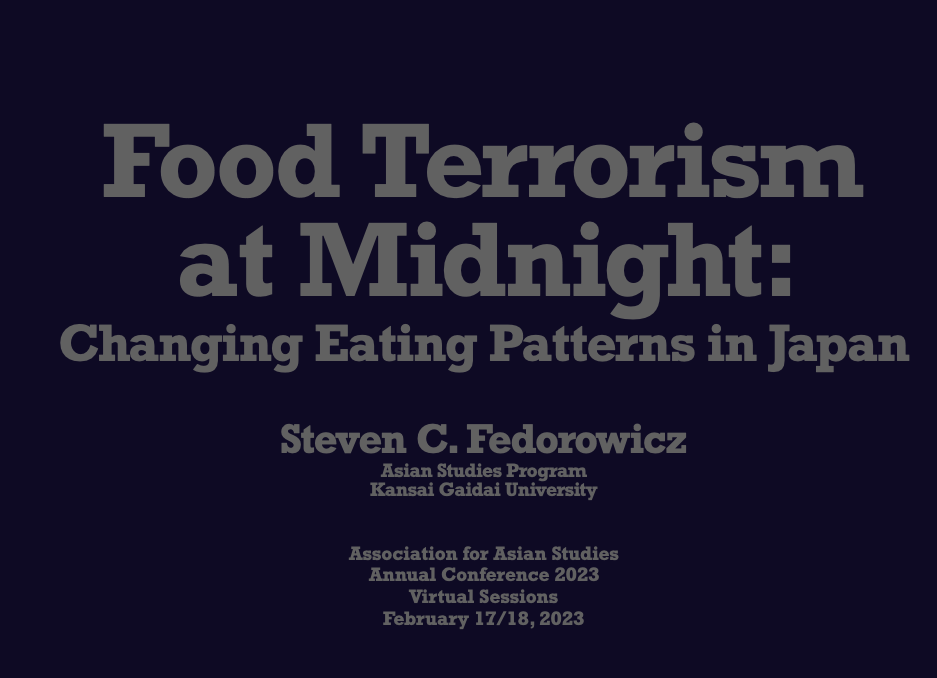
「Food Terrorism at Midnight: Changing Eating Patterns in Japan」@ Association for Asian Studies Annual Conference 2023 Virtual Sessions February 17/18, 2023
I am dedicating this presentation to Dr. Mark Hollstein, who passed away unexpectedly, suddenly and tragically on January 31, 2023. Mark was my friend and colleague for twenty years. We had many things in common - Japan, research, family life, politics, music and Star Trek. We talked almost every day. I was able to show Mark an early draft of this presentation and he gave me lots of good feedback. I miss him so much. Deepest condolences to his wife, son, family, friends and students. Rest in Peace.
See Mark's obituary here: https://www.legacy.com/us/obituaries/saltlaketribune/name/mark-hollstein-obituary?id=40271263
Abstract: In Japan, food and drink are prominent in cooking shows, travel shows, variety shows, dramas, manga, anime, books, magazines, blogs, Facebook and Instagram. The term “food porn” has been used to describe some media due to its sensual presentation intended to provide unattached pleasure or gratification for viewers. Since the 2010s, the Japanese term meshi tero (“food terrorism”) has been used with a meaning similar to “food porn.” However, food terrorism implies a deliberate attack or form of harassment that creates jealousy or resentment, causing victims to run to the kitchen or convenience store for snacks. Late-night food terror is especially insidious. Midnight has become a prime time for the television networks to air new food terrorism dramas. My research builds upon Stalker’s detailed history of the Japanese gourmet boom (2016) and Longcore’s discussion of “ethnographic culinary adventures... for the enjoyment, entertainment, and enlightenment of foodies and anthropologists alike” (2019). Food terrorism became more pronounced in 2020, when the Japanese government imposed restrictions on dining out during the COVID-19 pandemic. People now watch food terrorism with feelings of nostalgia, envy and/or hopefulness about being able to dine out again without concern. This paper examines food terrorism and changing eating patterns in Japan through multimodality (Collins et al. 2017) and sensory ethnographic methodologies (Pink 2009).
Keywords: visual anthropology, ethnographic photography, food porn, food terrorism, Japan
Session: V1-408
Contemporary Japanese and Korean Society
Friday, February 17, 2023, 8:00-9:30 PM (EST)
Saturday, February 18, 2023, 10:00-11:30 AM (Japan time)
For registration and information about the conference: https://www.asianstudies.org/conference/register2023/#
See Mark's obituary here: https://www.legacy.com/us/obituaries/saltlaketribune/name/mark-hollstein-obituary?id=40271263
Food Terrorism at Midnight:
Changing Eating Patterns in Japan
Steven C. Fedorowicz
Asian Studies Program
Kansai Gaidai University
Abstract: In Japan, food and drink are prominent in cooking shows, travel shows, variety shows, dramas, manga, anime, books, magazines, blogs, Facebook and Instagram. The term “food porn” has been used to describe some media due to its sensual presentation intended to provide unattached pleasure or gratification for viewers. Since the 2010s, the Japanese term meshi tero (“food terrorism”) has been used with a meaning similar to “food porn.” However, food terrorism implies a deliberate attack or form of harassment that creates jealousy or resentment, causing victims to run to the kitchen or convenience store for snacks. Late-night food terror is especially insidious. Midnight has become a prime time for the television networks to air new food terrorism dramas. My research builds upon Stalker’s detailed history of the Japanese gourmet boom (2016) and Longcore’s discussion of “ethnographic culinary adventures... for the enjoyment, entertainment, and enlightenment of foodies and anthropologists alike” (2019). Food terrorism became more pronounced in 2020, when the Japanese government imposed restrictions on dining out during the COVID-19 pandemic. People now watch food terrorism with feelings of nostalgia, envy and/or hopefulness about being able to dine out again without concern. This paper examines food terrorism and changing eating patterns in Japan through multimodality (Collins et al. 2017) and sensory ethnographic methodologies (Pink 2009).
Keywords: visual anthropology, ethnographic photography, food porn, food terrorism, Japan
Session: V1-408
Contemporary Japanese and Korean Society
Friday, February 17, 2023, 8:00-9:30 PM (EST)
Saturday, February 18, 2023, 10:00-11:30 AM (Japan time)
For registration and information about the conference: https://www.asianstudies.org/conference/register2023/#
Subscribe to:
Posts (Atom)