Showing posts with label announcement. Show all posts

Saturday, July 25, 2026

New Book!「The Art of Getting By: Wisdom and Resilience from China’s Migrant Women」by Kevin Ming

My friend and colleague Kevin Ming has published his new book, The Art of Getting By: Wisdom and Resilience from China’s Migrant Women (Algora Publishing 2026). Here is a brief description from the publisher:

Sound Bite

A work that is simultaneously ethnographic fieldwork, social theory, and intimate portraiture, The Art of Getting By takes us into a hidden world and nestles in, learning some of the ways people keep themselves intact in tough circumstances.

Introduction

The Art of Getting By: Wisdom and Resilience from China's Migrant Women invites readers into the disappearing alleyways and vibrant communities of southern China's urban villages, offering an intimate look at the lives of poor migrant women navigating worlds of exposure and exploitation. Through what Kevin David Ming calls a "vagrant anthropology," this book chronicles two decades of walking, listening, and storying with women who work in the sexual labor industry, primarily in falang (hair salon brothels), but also beyond, in China, Malaysia, and Thailand.

This unique narrative gathers fragments of life—snatches of song, shared meals, daily gossip, and poignant personal histories—to illuminate the ingenuity, resilience, and complex desires of its subjects. We meet Wangjing, whose dreams of a modern kitchen reflect aspirations for respectability and security for her family. We learn from Qi Qi about the careful art of "fishing" for customers in upscale hotel bars, a delicate dance of observation and performance. Christine's story reveals a love for literature and a quiet determination to write her own future, even amidst challenging circumstances. These women, often dismissed or stereotyped, are shown to be adept at forming connections and finding temporary inhabitance in worlds designed for their estrangement.

Beyond individual portraits, the book uncovers the broader forces shaping these lives: the relentless pace of urban development that obliterates communities, the "cannibalizing capitalist present" that scavenges on networks of care, and the enduring weight of filial obligations. It challenges conventional notions of hope, offering instead a vision of "present hope"—an energetic continuance born from struggle and the indeterminacy of an uncertain future.


For more information: https://www.algora.com/product/the-art-of-getting-by/

Wednesday, July 8, 2026

"EveryBody: An Artifact History of Disability in America" // Exhibition @ Smithsonian National Museum of American History


Thanks to Mori Soya Sensei for sharing information about this exhibition from Corbett OToole's FB post:

Disability History is under attack Right Now.
There’s a new White House report stating that only some Americans should be represented at the Smithsonian Museum of American History.
The ONLY comprehensive collection of disability history in the US is at that museum.
If the White House wins, we all lose access to histories of disabled people and all Americans stories and materials. The only materials allowed with be White House approved perspectives (i.e. white privileged)


Links:

EveryBody: An Artifact History of Disability in America: https://americanhistory.si.edu/explore/stories/everybody-artifact-history-disability-america

Quote:

People with disabilities have been present throughout American history, but rarely appear in textbooks or shared public memories. Curator Katherine Ott introduces a new online exhibition that helps us understand the American experience and reveals how complicated history really is.

Over 100 years ago, an African American woman named Sarah Savage did something that caused her to be institutionalized at Central State Hospital, a "lunatic asylum" in Milledgeville, Georgia. She died there in 1882. Little else is known about her—when and where she was born, who she loved and who loved her, how she died, and what got her locked up. We don't even know if marker #72 belongs to her or a white man named Nathaniel Cowart—the cemetery was segregated and burial numbers used twice.

In the 1860s or 1870s, Benjamin Franklin was caught in a freezing storm in the Dakota Territory, lost his hands and feet to frostbite, and afterwards made a living selling cartes-de-visite (small photographs printed on thick paper cards) of himself.

There are thousands upon thousands of such stories about people with disabilities that never make it into the history books. To broaden the familiar narratives of American history and give presence to some of the "disappeared" in American history, we created an online exhibition about disability drawn from the museum's collections. The online exhibition is at the center of the museum's work in unraveling the intricate ways in which stigma, rights, and everyday realities intertwine.

The museum has dozens of photographic images of people with disabilities. We know neither the name nor circumstances of most of them. Being anonymous or forgotten does not mean that you are invisible. We can piece together past experiences by combining what the image tells us (about age, clothing, location, era, activity) with what we know about the history of disability in America. Such things as surfaced roads, escalators and elevators, the internet, as well as the closing of asylums and even the availability of inexpensive eye-glasses and a host of medical treatments have created circumstances that enabled political and social change. Our artifacts can explain events such as protests, hospitalization, first communion, and grad
uation and what they meant in the lives of people. Artifacts give shape and substance to historical experiences in ways that retrieve stories of those who did not have the resources, support, or power to leave a mark.

EveryBody: An Artifact History of Disability in America: https://americanhistory.si.edu/explore/exhibitions/everybody

Quote:

Many stories and events related to people with disabilities never make it into the history books or shared public memories. Familiar concepts and events such as citizenship, work, and wars become more complicated, challenge our assumptions about what counts as history, and transform our connection with each other when viewed from the historical perspective of people with disabilities, America’s largest minority.

Knowing these histories deepens understanding of the American experience and reveals how complicated history really is. In addition, when history comes through artifacts, distinct themes emerge—for example, the significance of place, relationships, and technology—that are less apparent when only books and words are used.

The EveryBody online exhibition is an introduction to the history of disability in America, covering politics, relationships, work, technology, health and more. Just as language about disability has changed (with movement away from stigmatizing terms such as crippled, handicapped, or invalid), so has understanding of it, with civil rights becoming paramount.


Check this out! Lots of good and important things to see!

Monday, May 25, 2026

!Special Lecture「Japanese Culture」In Three Case Studies… Or, “So, what`s it like to live in Japan?”

Student and faculty guests from the College of Charleston are visiting our university this week. We have a very long, close and important reltionship with this college, so the Center for International Education is rolling out the red carpet and pulling out the top guns for a sample Japanese class, lecture on Japanese business and lecture on Japnese culture. I have been tasked with the last. So how am I supposed to explain the complexities of Japanese culture in 90 minutes? To be honest, the longer I have been in Japan, the less I seem to understand.
Around the time I was conscripted for this lecture, I had the pleasure of meeting my cousin's daughter's husband (or first cousin once removed-in-law), Preston. After talking for a while, Preston asked me, "so, what's it like to live in Japan?" I was taken back by this question, no one has asked me this in a long time. I tried to briefly explain my family, neighborhood, job and research. Then it dawned on me, why not organize my lecture in a similar way and call them case studies. So I will be talking about my neighborhood (with a focus on my research of its fall festival), my major research subject (Deaf communities and sign language) and my passion (the Hanshin Tigers).

Thanks, Preston!

I am providing some resources below for my lecture audience (and others who might be interested) with more details about the case studies.
1) My Neighborhood (in Kadoma-shi): Focus on the Fall Festival

Sources:

祭り Matsuri Photo Exhibition 写真展: https://visualanthropologyofjapan.blogspot.com/2024/01/matsuri-photo-exhibition.html

Japanese Anthropology Workshop (JAWS) Newsletter No. 53: https://visualanthropologyofjapan.blogspot.com/2025/04/announcement-new-jaws-newsletter.html

Distributed Multimodalities: Ethnographic Experiments in Memory and Performance: https://distributedmultimodalities.carrd.co/

Distributed Multimodalities on VAoJ: https://visualanthropologyofjapan.blogspot.com/search?q=Distributed+Multimodalities%3A+Ethnographic+Experiments+in+Memory+and+Performance

Fall Festival on VAoJ: https://visualanthropologyofjapan.blogspot.com/search?q=fall+festival
2) My Primary Research: Deaf Communities and Sign Language

Sources:

「A Primer on Deaf Communities in Japan: Identity, Sign Language and Diversity」@YCAPS, Getting to Know Japan Webinar (2024): https://visualanthropologyofjapan.blogspot.com/2024/06/announcementa-primer-on-deaf.html

The Embodiment of the Deaf in Japan: A Set of Heuristic Models for Identity, Belonging and Sign Language Use (2023): https://visualanthropologyofjapan.blogspot.com/2024/01/theres-nothing-like-holding-real-book.html

Sign language, what is it? An ESCAP guide towards legal recognition of sign languages in Asia and the Pacific (2022): https://visualanthropologyofjapan.blogspot.com/2023/05/new-publication-from-united-nations.html

Representations of Deaf People in Japan: Inspiration, Outrage and Real Life (2021): https://visualanthropologyofjapan.blogspot.com/2021/05/representations-of-deaf-people-in-japan.html

Barrier-Free Communication for the Deaf in Japan: A Local Initiative for Medical Interpretation Services in Japanese Sign Language (2021): https://kansaigaidai.repo.nii.ac.jp/?action=repository_uri&item_id=8036&file_id=19&file_no=1

Performance, Sign Language, and Deaf Identity in Japan (2019): https://www.anthropology-news.org/articles/performance-sign-language-and-deaf-identity-in-japan/

Living Partial Truths: HIV/AIDS in the Japanese Deaf World (2006): https://visualanthropologyofjapan.blogspot.com/2007/08/hivaids-in-japan.html

Deaf and Sign Language on VAoJ: https://visualanthropologyofjapan.blogspot.com/search?q=deaf+sign+language

3) My Passion: Hanshin Tigers

Sources:

Hanshin Tigers Webpage (in Japanese): https://hanshintigers.jp/

Food Terrorism and Japanese Baseball: A Hanshin Tigers Case Study@SWCAS 11/4/23: https://visualanthropologyofjapan.blogspot.com/2023/11/food-terrorism-and-japanese-baseball.html

Hanshin Tigers on VAoJ: https://visualanthropologyofjapan.blogspot.com/search?q=hanshin+tigers

Saturday, May 23, 2026

The Department of East Asian Studies - Japanese Studies at the University of Vienna - u:japan lectures - Greg Poole: "In the Shadow of a Mountain: A Community School Coordinator and the Politics of Survival in Rural Japan"

I am very happy to pass on this announcement about a lecture by my friend and colleague, Greg Poole, from Doshisha University:
CLICK on the photos to get a clear image to read.
| Date & Time |

u:japan lecture | s12e08
Thursday 2026-05-28, 18:00~19:30 (CET, UTC +1h)
***This is 1:00 - 2:30 AM on Friday, 2026-05-29 in Japan***

| Place |

LIVE @ Campus of the University of Vienna 18:00~19:30 (CET, UTC +1h)
Department of East Asian Studies, Japanese Studies
Seminarraum JAP 1, 2K-EG-21, Ground floor to the left
Spitalgasse 2, Hof 2.4 (Campus), 1090 Vienna, Austria

| Platform & Link |

https://univienna.zoom.us/j/65583867108?pwd=rydxHuWoGcGIV6FFJdrLghDwpucRHd.1
Meeting-ID: 655 8386 7108 | Passcode: 794196
This lecture will not be recorded.


For more information: https://japanologie.univie.ac.at/startseite/einzelnews/news/in-the-shadow-of-a-mountain-a-community-school-coordinator-and-the-politics-of-survival-in-rural-ja/

Wednesday, April 1, 2026

Visual Anthropology in Japan:「The Tachinomi Project」 日本に映像人類学: 「立ち呑みプロジェクト」 @ Salon KGU

Visual Anthropology in Japan:
「The Tachinomi Project」

A chance to share my research with colleagues at work...

Abstract:

「The Tachinomi Project」is a visual ethnography based upon the intersections of social science research and contemporary art. The project began with long-term participant-observation and a photographic exhibition featuring a 40-year-old tachinomiya (standing drink bar) in Osaka called Tenbun. The study sought to explore photography in public spaces, privacy and image ethics while showcasing a “grimy” (Farrer 2019) and stimulating atmosphere with colorful characters including the shop owner, employees and regular customers. The interactions with Tenbun collaborators and gallery audience at the exhibition became the first of several post-fieldwork encounters, leading to the re-positioning of the research into wider social and academic contexts during and after the COVID 19 pandemic. This present account utilizes reflexivity, autoethnographic vignettes (Stevens 2013) and photography to explore the intersections of the sensory (Pink 2013 [2009]), multimodal (Collins et al. 2017), and ba (Kajimaru et al. 2021) of Tenbun and other eating and drinking establishments.

Thursday, April 16, 2026
18:30 ~ 20:00
CIE 3rd Floor Seminar Room


日本に映像人類学:
「立ち呑みプロジェクト」

職場の同僚と自分の研究成果を共有する機会…

要旨:

「立ち呑みプロジェクト」は、社会科学的調査と現代美術の交差領域に立脚したビジュアル・エスノグラフィーである。本プロジェクトは、大阪の創業40年の立ち呑み屋「天文」における長期的参与観察、ならびに同店を主題とした写真展を起点に始まった。本研究は、公共空間における写真撮影、プライバシー、および映像倫理を検討することを目的とし、店主や従業員、常連客といった多様な人々が織りなす、「猥雑(grimy)」(Farrer 2019)かつ刺激的な空間の様相を詳らかにするものである。 フィールドワーク後、写真展における「天文」協力者と観覧者とのインターアクションを皮切りに、コロナ禍中またそれ以降のより広範な社会的・学術的文脈で捉え直すこととなった。 本研究では、再帰性、オートエスノグラフィー的ヴィニエット(Stevens 2013)、写真を通し、「天文」をはじめとする飲食施設における感覚(Pink 2013 [2009])、マルチモーダル(Collins et al. 2017)、場(Kajimaru et al. 2021)の交差について論じる。

2026年4月16日(木)
18:30~20:00
CIE 3階 セミナー室


春から初夏にかけてのサロンKGUの全スケジュールはこちらです。
Here is the complete Salon KGU schedule for the spring and early summer:

BONUS!
かたの桜 純米吟醸酒 雪の香(ゆきのか) 17度
Katano Sakura Junmai Ginjo Sake Yukinoka (Scent of Snow) 17%

片野桜大吟醸袋吊りしずく(令和7酒造年度) 17度
Katano Sakura Daiginjo Undiluted Brew Genshu (2025) 17%


山野酒造 大阪府交野市
Yamano Sake Brewery Katano City, Osaka Prefecture


URL: https://www.katanosakura.com/

Wednesday, December 17, 2025

2025年度第24回手話言語研究セミナー The 24rd Sign Language Research Seminar「Memories of the Deaf Evoked by Home Movies」

Seems to be a perfect match for VAoJ! Sign language and home movies...

The Japan Institute for Sign Language Studies (JISLS) held its first "Sign Language Research Seminar" in 2000 with the aim of deepening the understanding of sign language research by exchanging opinions among participants from various fields such as sign language, sign language interpreting, welfare, and education. From FY2021, the seminar is being held as part of the "Sign Language Research and Dissemination Project" commissioned by the Ministry of Health, Labour and Welfare.

In 2025, the theme will be "Memories of the Deaf Evoked by Home Movies," and we will discuss the importance of preserving old footage related to sign language, share the status of domestic and international research (Part 1) , and present research findings in 2025 (Part 2).


For more information and registration: https://jisls.com-sagano.com/seminar/

Tuesday, November 18, 2025

CFP: 2026 AJJ Annual Conference @ Akita University, May 23-24th, 2026

2026 AJJ Annual Conference
May 23-24th, 2026
Akita University

Conference Theme

Entanglements and Embodiments: Anthropology, Ethnography and Sensing Japan

Location

The conference will be held at Akita University’s Tegata Campus (walking distance from Akita Station and bus station with a convenient bus connection from Akita Airport)

Keynote Address

“Anthropology of Japan in Japanese Anthropology before and after AJJ”
delivered by Nakamaki Hirochika, Professor Emeritus, National Museum of Ethnology (Minpaku)

Call for Papers

The theme for this year’s AJJ meeting is influenced by the work of phenomenologically oriented anthropologists such as Tim Ingold, Paul Stoller, and Thomas Csordas. In differing ways, they are all anthropologists who place perception and interpretation at the core of their ethnographic writing and theoretical explorations. However, as is AJJ tradition, one need not be limited to their work or interpretations to submit a panel or paper.

Overall, we would like to invite reflections on how anthropologists of Japan are impacted by their idiosyncratic and inimitable connections to this country and their chosen field sites. This may include inquiry into the social, physical, political, or affective dimensions that any given anthropologist or folklorist has experienced. Some core considerations might include:

・How do personal experiences influence the selection of a specific location within Japan as a site, a research topic, theoretical frameworks, methods, writing styles, or approaches?
・How does an anthropologist’s sensory engagement mediate the process of interpreting cultural phenomena?
・How is this process consciously suppressed or supported in their analytical writing?

Submitting a Panel or Paper

Panel slots will be 90 minutes, usually divided along the lines of 3 papers, 20 minutes each, then 30 minutes of discussion (though there is some flexibility here if needed).

Full panels are given preference, but please feel free to apply with individual paper proposals.

Papers that clearly relate to the conference theme will be given preference, but others will also be considered.

The application deadline is January 15th 2026. We aim to reply to applicants by February 1st 2026.

Fees for the conference and reception (including food and drinks) will be as follows:

Tenured Faculty: ¥5000 conference fee and ¥3000 reception fee.
Employed but not tenured: ¥3000 / 2000
Graduate Students: ¥2000 / 1000
There is no conference fee for undergraduates; however the reception will cost ¥1000.


Prizes

The Befu Prize and Bookman Prize will be awarded at the end of the conference. For details on the rules for the two prizes, see the following links:

https://www.ajj-online.net/the-harumi-befu-prize/

https://www.ajj-online.net/the-mark-bookman-prize/

**Any paper by a non-tenured scholar or student that is accepted for the conference will be eligible for entry to the prize competitions. Eligible candidates will be asked to supply a 5-minute video summarizing their presentation to assist us in organizing the judging process.


For more information: https://www.ajj-online.net/2025/11/02/cfp-2026-ajj-annual-conference/

Tuesday, October 21, 2025

Announcement: A screening of a documentary film "Kitaushima" (North Cormorant Island)

Produced, Directed and Written by John Williams
Co-Producer and Co-Director: Yu Iwasaki
2024/86 min./Japan/Bilingual version (Japanese with English subtitles, English with Japanese subtitles)

November 12, 2025
18:30 to 20:30 (Doors Open at 18:00,Screening from 18:30)
Room L-821, 8F, Library building, Sophia University
No registration necessary / Free of charge

North Cormorant Island was filmed over ten years (between 2014 and 2024) in the remote fishing village of Kitaushima (which means North Cormorant Island), on Sado Island, Japan. Until the 1960’s the village was only accessible by boat, but a couple of hundred people lived there, rice-farming, fishing and raising cattle. After a road was built, young people began to drift to the cities and now there are less than thirty residents, most of them over seventy years old. The film blends observational documentary, following the everyday life of the village, the rituals, customs and work of the people who live there with a personal, poetic reflection on the director’s childhood in his father’s village in Wales. It is a film about time, place, mortality and human relationships with the land and the sea.

The film was awarded the Audience Award at Tokyo Documentary Film Festival, 2024.


Trailer: https://youtu.be/vm7UQ7CNgo8

This event is part one of the Sophia Symposium 2025 “Exploring a Japanese Fishing Village through Art” organized by John Williams and the ICC Collaborative Research Unit with the JSPS Scientific Research (C) 24K03565 Art, Environment and Sustainable Futures.

Symposium Part two: November 15th / 18:30 to 19:30 (Doors Open at 18:00) Performance of a Play “The Blue Tanuki Dreams of a Two-Moon Night.” (In Japanese with English text explanation.)

Symposium Part three: November 16th / 10:00 to 18:40 Symposium with guest speakers reflecting on similar projects in villages in Brazil, Norway and the UK.


***

北鵜島

監督:ジョン・ウィリアムズ、岩崎裕
2024年/86分/日本/バイリンガル版(日本語に英語字幕、英語に日本語字幕が付きます)

11月12日
18:30-20:30(開場18:00、上映開始18:30)
上智大学図書館 8階 L-821会議室
事前登録不要/入場無料

佐渡島にある海辺の小さな集落、北鵜島。その素朴さと美しさに魅了された、英国ウェールズ出身の監督が10年にわたり東京からかの地へ通い、人々と風土を記録する。中世から続く神事「車田植」などの風習や、山海の恵みと厳しさと共に生きる人々の知恵や精神に触れるなかで、監督は故郷ウェールズでの思い出や、海洋学者だった父の最期に思いを馳せる。さまざまな歴史や記憶が重なり、やがて鮮やかな人間賛歌へと結実していく。(2024年東京ドキュメンタリー映画祭観客賞受賞作品)

Source: https://www.icc-sophia.com/post/a-screening-of-a-documentary-film-kitaushima-north-cormorant-island/

Tuesday, August 19, 2025

"Taking Pictures of Snakes at Midnight: An Anthropological Perspective" - An Anthropological Talk by Ryan Xin XIE

"Taking Pictures of Snakes at Midnight: An Anthropological Perspective" on the relation between snakes and humans, and nature and humans, in Hong Kong, by Ryan Xin Xie.
Venue: Hong Kong Museum of History on Friday, August 22, 2025 at 7:00 p.m.

For more information: https://www.arts.cuhk.edu.hk/~ant/hkas/current_event.htm

Monday, August 18, 2025

"Light Leak as Method: Theorizing a Photographic Accident" - Essay on American Anthropologist by Myriam Amri

ABSTRACT: This project began as a 35 mm film photography collection to document the presence of waste in the Northwest border of Tunisia, as the materiality of waste, its existence “everywhere,” has become a medium through which people in the region understand their positions at the margins of the nation-state. Yet after months, I realized that a light leak had marked all of my photographs. Taking the accident as a chance encounter, I produced a collection of images that articulate the gap between their intended effects, of visualizing waste, and their final rendering, images marked by a light leak. In this essay, I trace the project's process from my initial intentions of photographing waste to the light leak accident, to the final rendering into a visual booklet. In doing so, I foreground the light leak as an accident that became a generative method to examine the spills, leaks, and overflows of wasteful landscapes in North Africa.

Access article: https://anthrosource.onlinelibrary.wiley.com/doi/10.1111/aman.28101

This article is part of the special section of American Anthropologist titled “On Vanishing Fieldsites.” The multimodal accompaniment to this article is available at https://simplebooklet.com/lightleak

Tuesday, May 27, 2025

Workshop on Scholarly Communication: “The Art of Herding Cats: Reimagining Classroom Lectures and Conference Presentations” (a continuation of a series at Harvard) June 24, 2025 @ Doshisha University, Kyoto

This workshop brings together presenters from four universities to explore innovative approaches to scholarly communication. Moving beyond conventional formats, the event highlights alternative, dynamic ways to engage audiences. We invite participants to rethink the possibilities for sharing knowledge with both colleagues and students across diverse academic settings.

Hosted by The Institute for the Liberal Arts, Doshisha University


DATE: June 24 (Tuesday) 2025
TIME: 12:00 - 2:00 pm
LOCATION: Doshisha University, Imadegawa, Muromachi Campus
Kambaikan 6F Main Conference Room (寒梅館6階大会議室)
103 Gosho Yahata-cho, Kamidachiuri-sagaru, Karasuma-dori, Kamigyo-ku, Kyoto-shi


Register by June 15, 2025 via the QR code on the flyer or at this link: https://forms.gle/HHLVs2AsbrStfHtE9

Wednesday, May 14, 2025

Presentation Announcement:「The “Crisis” of Sociality: Caring for the Dead Otherwise with Anne Allison」

May 23, 2025 / 6:00pm -7:30pm / Room 301, Building 10, Sophia University / In person only / No registration required

Responding to the record low birthrate and population decline of the year before, Prime Minister Fumio Kishida declared Japan “on the brink of not being able to maintain social functions” in 2023. Seeing this as a crisis of social reproduction, he announced policies to incentivize young people into having and raising children—to reembrace the family as the center of life/livelihood. For youth themselves, however, this is a model declining in both viability and appeal. This talk addresses a different contingency; as sociality continues to downsize in Japan—to single households, solo lifestyles, childless futures—what are the effects on the elderly who once counted on “the family” to both care for and bury them? This is another dimension to the “crisis” in sociality today: the post-(re)productive who increasingly find themselves “without anyone else to depend upon” (miyori ga nai) in what some call Japan’s “era of family-less dead” (ienaki jidai no shisha). Facing all-aloneness as they age and enter the grave, seniors—and Japan itself—must confront a model of (reproductive) sociality that is not only being rejected by youth but sentencing the elderly to a wastebin of neglect. Looking at moves that are arising to both avoid and anticipate such an end, the talk considers what any of these new “ending” trends portend for a post-familial future as mapped by caring otherwise for the dead.

For more information: https://www.icc-sophia.com/post/the-crisis-of-sociality-caring-for-the-dead-otherwise-with-anne-allison

Wednesday, April 30, 2025

Announcement: 「Reading Family Albums: Indian Immigrants in Tokyo, 1976 - 2010」 Presentation by Bakirathi Mani @ Sophia University

May 14, 2025 / 18:30-20:00
Room 301, 3F Building 10, Sophia University
In Person only / No registration required

Abstract: How do we enter into, look at, and make sense of family albums? In this talk, I examine archival practices that emerge out of working with a repository of albums that documents my own family's life as Indian immigrants in Japan between 1976 and 2010. These albums and the photographs they contain operate as material and ethnographic objects that decay over time. Writing about these albums demands that I occupy shifting positions: as a subject and critic of these images; as an archivist who preserves the albums; and a daughter inheriting the photographs, who has herself migrated. As the albums travel between Japan, India and the United States, I consider what it means to dwell within these familiar archives, reflecting on methods of reading and writing about images that are among the most intimate representations of selfhood and community that I have encountered.

For more info: https://www.icc-sophia.com/post/reading-family-albums-indian-immigrants-in-tokyo-1976-2010

Friday, April 11, 2025

Announcement: KG+ Photo Exhibition in Kyoto April 12 ~ May 11

“KG+” is a public art festival that first started in 2013 with the aim of discovering and supporting upcoming photographers and curators with 2025 being the 13th anniversary of this festival. We strive to present the state-of-the-art skills of upcoming photographers widely enlisted here in Kyoto to around the globe. In cooperation with “KYOTOGRAPHIE Kyoto International Photography Festival”, we give upcoming photographers and curators participating in KG+ opportunities to talk and collaborate with world-renowned curators and gallerists from Japan and around the world.

“KG+ SELECT” is another exhibition, where 10 artists out of the participants of “KG+” are selected to exhibit their work by judges working at an international degree. KG+SELECT Award 2025 Winner is held between the selected 10 artists, with the winner given the invitation to exhibit their work in the official KYOTOGRAPHIE program next year in 2026.


For more information: https://kgplus.kyotographie.jp/

Monday, April 7, 2025

Announcement: New JAWS Newsletter released (and check out the cover! AGAIN!)

Congratulations and many thanks to the co-editors, Jennifer McGuire and Christopher Tso, on putting together and releasing the Japan Anthropology Workshop Newsletter (#53) "...continuing with our refreshed newsletter design and second cover photo by visual anthropologist and JAWS member Steven C. Fedorowicz..."

Available at:

https://japananthropologyworkshop.org/wp-content/uploads/2025/04/JAWS-Newsletter-2023.pdf

「Push-Pulling the Danjiri」

Residents of Shirogaki-cho in Kadoma-shi, Osaka push and pull a large wooden cart called a danjiri through the district’s streets as a part of the annual Fall Festival (October) and Kadoma-shi 60th Anniversary Culture Festival (November) in 2023. Navigating the danjiri is hard work, because the cart is heavy and awkward to steer through the narrow and winding streets. Shirogaki-cho’s danjiri, parts of which were made in the Edo period, is over 7 meters long, 4 meters high at its tallest point and weighs over 3.2 tons. Even before the COVID-19 pandemic, participation by neighbors in these events has been decreasing over the years because of demographic changes: Japan’s aging society, the falling birthrate, and gentrification as traditional homes are torn down and replaced with apartments making the area into a bed-town of strangers. But a core of diehard and friendly residents take part every year to parade the danjiri with the temporarily installed deity from the local shrine throughout the parish to bestow its blessings to the neighbors, encourage cooperation, and promote continued good community relations. Ihave been photographing, researching, and pushing in the fall festival for over 15 years.

Thursday, April 3, 2025

The Visual Anthropology of Japan: In and Outside the Classroom, Revisited

JAWS / AJJ Joint Conference 2025
Session 14 - Reflecting and Revisiting「Teaching Japan」
University of Hyogo - Kobe Campus for Commerce
Building 5
April 5, 2025, 15:40 - 17:10

Campus access: https://www.u-hyogo.ac.jp/english/access/#id01

Campus map: https://www.u-hyogo.ac.jp/about/access/kobeshoka/

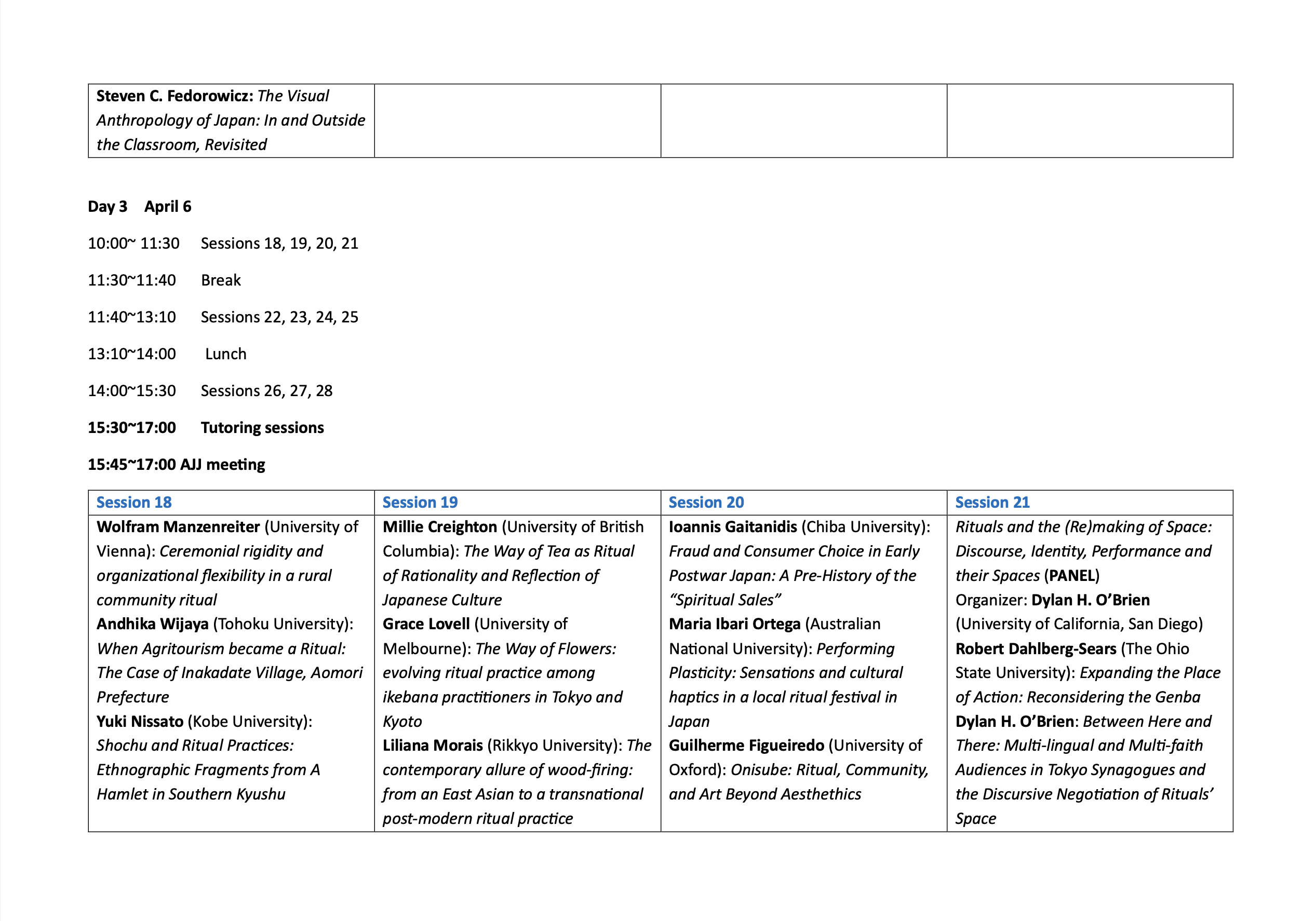
Paper 4: The Visual Anthropology of Japan: In and Outside the Classroom, Revisited
Steven C. Fedorowicz, Professor, Kansai Gaidai University

Abstract: My chapter describes teaching a class comprised of international exchange students from many different countries alongside local students preparing for their study-abroad programs called “Visual Anthropology of Japan” at a Japanese university from 2006 to 2014. Topically, the course was about the presentation and representation of culture through film, photography, and other visual communication arts within the shifting anthropological ecologies of media, methods, and theory. Teaching “Japan” in this context required several balances of instruction and guidance for students of different academic levels, backgrounds, language skills and expectations studying together in the same class. Because of my training and background in cultural anthropology and visual anthropology, I do not consider my text as a theoretical treatise on pedagogy per se. Rather it is closer to an ethnographic—sometimes autoethnographic—account based on the fieldwork of teaching this course under certain conditions at a global educational setting. In my presentation, I will revisit this setting through the reflexive lens of ba (Kajimaru, Coker and Kazuma 2021), specifically, the convergence of players, place and performance during the period of the multimodal turn in visual anthropology that coincided with the class. This reminiscent revisit reaffirms the potential and possibility for a more active student learning environment and further course development to make a new and improved version of the course.

For more details about the conference and panel: https://visualanthropologyofjapan.blogspot.com/2025/02/announcement-jawsajj-joint-conference.html

Thursday, February 27, 2025

Announcement: JAWS/AJJ Joint Conference 2025 @ University of Hyogo

The Japan Anthropology Workshop (JAWS) and the Anthropology of Japan in Japan (AJJ) joint conference will be held in Kobe from April 4th (Friday) to April 6th (Sunday), 2025. The conference will take place in person, focusing on the theme: Ritual Practices and Daily Rituals in Japanese Society.

Venue: University of Hyogo, Kobe Campus for Commerce, Kobe, Japan


Ritual Practices and Daily Rituals in Japanese Society

The 21st century began as one of the most prosperous periods in human history, only to be profoundly affected by a pandemic and multiple wars, which have had a deep impact on society as a whole. As anthropologists, our role is to document, interpret, and possibly offer solutions for a better future. A significant part of understanding human behavior is the analysis of ritual and ritual practices.

In this edition of the JAWS/AJJ Conference, we aim to explore the role of ritual practices in Japanese society from various perspectives. Rituals can be sacred or social, serving as a form of cultural communication that transmits the cognitive categories and dispositions that shape people’s perceptions of reality (Bell 2009). By analyzing the underlying mechanisms of rituals, we can gain a deeper understanding of human society, as well as the universal and culturally specific aspects that define our communities.

As Joy Hendry suggests, “In many anthropological studies, ritual and religion are closely related, although in complex societies, there is often no particular connection between them, and the term ‘ritual’ may also refer to behavior, like etiquette, that is determined by society and where individuals have little choice in its execution.”

Rituals have always been a key focus for anthropologists, both globally and in Japan. While rituals are not difficult to identify, they are open to numerous interpretations and approaches, drawing interest from social psychologists, folklorists, scholars of religion, communication, the performing arts, and more. We do not seek to impose a specific definition of ritual, as this could be contentious. Instead, we encourage participants to focus on the concept of change. How would you define ‘ritual’ in your research? How has it evolved? This is the central debate we wish to foster, with the goal of deepening our understanding of modern Japan and inspiring broader discussions within world anthropology.


Schedule:
Of special note to visual anthropologist is Session 14 on Saturday, April 5, 15:40-17:10.

Panel: Reflecting and Revisiting「Teaching Japan」
Chair and Organizer: Steven C. Fedorowicz, Professor, Kansai Gaidai University
Discussants: Ioannis Gaitanidis (Associate Professor, Chiba University) and Greg Poole (Professor, Doshisha University)

Panel Abstract:

Teaching Japan: A Handbook (Gaitanidis and Poole 2024) was launched and introduced at the Anthropology of Japan in Japan 2023 Annual Meeting. In their opening chapter, co-editors Gaitanidis and Poole discussed the logic behind the book, “…despite the rich history of critical discussion around ‘researching Japan,’ there is not yet a comprehensive guide for taking these scholarly debates into the undergraduate, and (often) non-Japanese Studies, classroom. This then was the impetus for this forthcoming interdisciplinary collection of pedagogical case studies…” The book launch was a year and a half ago, and the book chapters were written long before that. This panel strives to continue the discussion that Teaching Japan began through a revisit of our chapters, to rethink, reflect, self-criticize and/or build upon our original ideas. In his presentation, McMorran asks critical questions about ethnographies in/about Japan to further explore the validity and value of collaborative ethnographic research beyond the borders of Japan. Fassbender rethinks teaching methods and approaches to counteract the influence of social media that limits students in their understanding of complicated and multifaceted issues surrounding gender and reproductive politics. McGuire reassesses teaching methods and approaches to explore the complexities of social inequality through intersectionality and reflects on the inclusion of literature that looks beyond Japanese society. Fedorowicz revisits the potential for a more active student learning environment and further course development amidst the current multimodal turn in and outside the classroom to make a new version of his course. Discussion and feedback are especially encouraged.

Paper 1: Japan All Around: Teaching about Japanese Society in Singapore
Chris McMorran, Associate Professor, National University of Singapore

In my chapter in Teaching Japan: A Handbook, I discussed disciplinary shifts in anthropology toward studies that are multi-sited and unbounded by national borders. Despite admitting the importance of such geographically promiscuous research, however, I shared my rather conservative approach to teaching about Japan through ethnography, specifically ethnographies based in Japan. I concluded my chapter by asking about the risks and potential rewards of using ethnography to move beyond a Japan-centered understanding of Japanese society. In this presentation, I introduce an ongoing pedagogical effort to answer this question. I outline a course I teach in Singapore that includes students in qualitative research among Japanese citizens residing in the small city-state. Despite its dry title, “Japanese Political Economy” approaches the subject from a distinctly human angle, by focusing on the ways Japan’s political economy has impacted the work lives and family lives of Japanese citizens residing in Singapore. In my presentation, I share the course aims, the research assignment, and the insights gained from several years of teaching the course. What have students learned about Japan and Japanese society by examining the work lives and family lives of those who reside outside its borders? Finally, despite their physical distance from Japan, how can students be inspired by anthropology to see, and investigate, Japan all around them?

Paper 2: How to Unlearn Reproductive Politics in the Classroom
Isabel Fassbender, Assistant Professor, Kansai Gaidai University

Building on my chapter, Teaching Gender and the Politics of Reproduction in Japan: Self-Government as a Theoretical Reference Point, recent experiences and observations in a course offered to mostly one-semester foreign exchange students inform this presentation about challenges and opportunities in teaching reproductive politics in university. It discusses classroom strategies to create a space to learn about reproductive politics in Japan and at the same time consider biomedical ethical questions detached from social ideologies or political partisanship for students that come from a background where these issues are often highly politicized. Contents of the course focus on historical circumstances and contemporary debates surrounding population control and reproduction in Japan (including pregnancy, birth, reproductive technologies, and contraception). However, as a matter of course, ideological and political frameworks that shape current debates in Western contexts often circumscribe the scope within which students access legal and ethical questions surrounding these issues. Not rarely in today’s media landscape, opinions are significantly conditioned through social media channels, which can be simplified and/or biased. It is thus crucial to provide students with opportunities to unlearn or question their preconceptions along with factual knowledge. Teaching methods that emphasize particular historical, socio-political, and cultural circumstances in Japan, as well as presenting diverse viewpoints and theories beyond neoliberal and capitalist approaches that automatically equate developments in science and technology with moral and ethical progress, have proven to be effective in broadening the scope of possible class debates in the context of reproductive politics.

Paper 3: How (un)equal is Japanese Society: Thinking with Intersectionality in the Classroom
Jennifer M. McGuire, Associate Professor, Doshisha University

Understanding inequality in Japan requires moving beyond single-axis frameworks. To fully grasp the causes and consequences of social inequalities, we need tools that delve into the complexity of oppression and power. In this presentation, I discuss how I use intersectionality as a provisional concept and analytical tool in an advanced level course in an English-taught program at a Japanese university. I argue that despite significant obstacles to its use in a university course, including a relative lack of English-language sources about Japan, it is crucial to view and interpret Japanese society through an intersectional lens to challenge assumptions and develop a more nuanced understanding of social inequalities. I analyze data collected in the classroom, particularly class discussions and students’ written responses, focusing on how gender intersects with class and disability to produce inequalities and discrimination. Additionally, I examine the need for heightened sensitivity and awareness when teaching in a multidisciplinary, multilingual setting where students’ positionalities and subjectivities can result in particularly complex relationships to Japan. While I argue that intersectionality helps us move beyond stereotypical and superficial understandings of marginalized social groups, I also reflect on the significant challenges of applying a framework that originated in Black feminism in the United States to a society with a vastly different sociopolitical and historical context.

Paper 4: The Visual Anthropology of Japan: In and Outside the Classroom, Revisited
Steven C. Fedorowicz, Professor, Kansai Gaidai University

My chapter describes teaching a class comprised of international exchange students from many different countries alongside local students preparing for their study-abroad programs called “Visual Anthropology of Japan” at a Japanese university from 2006 to 2014. Topically, the course was about the presentation and representation of culture through film, photography, and other visual communication arts within the shifting anthropological ecologies of media, methods, and theory. Teaching “Japan” in this context required several balances of instruction and guidance for students of different academic levels, backgrounds, language skills and expectations studying together in the same class. Because of my training and background in cultural anthropology and visual anthropology, I do not consider my text as a theoretical treatise on pedagogy per se. Rather it is closer to an ethnographic—sometimes autoethnographic—account based on the fieldwork of teaching this course under certain conditions at a global educational setting. In my presentation, I will revisit this setting through the reflexive lens of ba (Kajimaru, Coker and Kazuma 2021), specifically, the convergence of players, place and performance during the period of the multimodal turn in visual anthropology that coincided with the class. This reminiscent revisit reaffirms the potential and possibility for a more active student learning environment and further course development to make a new and improved version of the course.

Thursday, December 5, 2024

Announcement:「ONLINE SYMPOSIUM: REPHOTOGRAPHY × TOHOKU’S RECOVERING COAST, December 14, 2024 」

Announcement from SSJ-Forum:

Produced by members of the rephoto lab at University of Tsukuba. The symposium and accompanying exhibition are funded by a Graphic Culture Research Grant from the DNP Foundation for Cultural Promotion.

Rephotography is the collective name for photographic practices that involve identifying locations in previously made images and photographing them again. Following the 2011 Great East Japan Earthquake and Tsunami, various rephotography projects appeared along the east coast of Tohoku. Many such projects have immediate value for illustrating recovery and reconstruction, but recent scholarship suggests they can go beyond 'before and after' comparisons to examine also how that change is understood.

The objective of this symposium is to discuss the value and future of rephotography along Tohoku’s recovering coast. As rephotography of the recovering coast of Tohoku extends into a fourteenth year, now is a good time to discuss change in representations of change, and to consider how such changes can continue to be represented as visual culture navigates a post-AI future. For the symposium, we will hear from photographers and institutions who have chosen to revisit a relationship with the recovering region.

PROGRAM (Japanese–English consecutive translation is provided)

16:00-16:05 Opening remarksーWILLIAM ANDREWS (Sofia University)
16:05-16:20 Introduction to rephotography一GARY McLEOD (University of Tsukuba)
16:20-16:40 Speaker 1一MAYUMI SUZUKI
16:40-17:00 Speaker 2一SHIN TOMINAGA
17:05-17:25 Speaker 3一SENDAI MEDIATHEQUE
17:25-17:45 Speaker 4一PENGKUEI BEN HUANG
17:45-18:05 Speaker 5一TOSHIYA WATANABE
18:15-18:55 Moderated discussion一all speakers
18:55-19:00 Closing remarksーGARY McLEOD (University of Tsukuba)

***All times are Japan Standard Time***

Held via Zoom. All are welcome. Participation is free, advance registration required.
Registration deadline is Thursday, December 12th.
To register, click here: https://forms.office.com/r/Er4Nu1f3jp

An exhibition related to the symposium is being held at University of Tsukuba until December 26th. A digital twin of the exhibition can be visited here: https://matterport.com/discover/space/ufxNpg62oGA

Wednesday, October 30, 2024

Announcement of Conference Presentation:「Intersectionality in Japanese Deaf Communities」

「Intersectionality in Japanese Deaf Communities」

Abstract: Are Deaf people in Japan simply disabled, or a linguistic minority, or both? Various physical conditions and individual situations combine to determine access to social welfare, attitudes, identities and language use. Not all deaf people are the same. And Japan itself is not as homogeneous as many believe it to be. An estimated 5 percent of Japan’s population belong to minority groups that suffer from societal oppression. What happens when a deaf individual belongs to one or more of these other minorities? Intersectionality, which emerged from Black feminists in the United States, is a framework that acknowledges and explores concurrent identities and ensuing injustices: racism, sexism, gender discrimination, ableism and other inequalities. This presentation, based upon academic theories, the efforts of activists and my own years of fieldwork, will describe diversity and intersectionality found in deaf communities in Japan, specifically Deaf/LGBTQ+, Deaf/Zainichi Korean and Deaf/Blind groups.

SouthWest Conference on Asian Studies
Stephen F. Austin State University
Panel V 4.5: “Community and Memory in East Asia”
Saturday, November 2, 8:45 am – 10:00 am (10:45 pm – 12:00 am in Osaka, Japan)

Conference program here: https://www.swcas.net/