The Japan Anthropology Workshop (JAWS) and the Anthropology of Japan in Japan (AJJ) joint conference will be held in Kobe from April 4th (Friday) to April 6th (Sunday), 2025. The conference will take place in person, focusing on the theme: Ritual Practices and Daily Rituals in Japanese Society.
Venue: University of Hyogo, Kobe Campus for Commerce, Kobe, Japan
Ritual Practices and Daily Rituals in Japanese Society
The 21st century began as one of the most prosperous periods in human history, only to be profoundly affected by a pandemic and multiple wars, which have had a deep impact on society as a whole. As anthropologists, our role is to document, interpret, and possibly offer solutions for a better future. A significant part of understanding human behavior is the analysis of ritual and ritual practices.
In this edition of the JAWS/AJJ Conference, we aim to explore the role of ritual practices in Japanese society from various perspectives. Rituals can be sacred or social, serving as a form of cultural communication that transmits the cognitive categories and dispositions that shape people’s perceptions of reality (Bell 2009). By analyzing the underlying mechanisms of rituals, we can gain a deeper understanding of human society, as well as the universal and culturally specific aspects that define our communities.
As Joy Hendry suggests, “In many anthropological studies, ritual and religion are closely related, although in complex societies, there is often no particular connection between them, and the term ‘ritual’ may also refer to behavior, like etiquette, that is determined by society and where individuals have little choice in its execution.”
Rituals have always been a key focus for anthropologists, both globally and in Japan. While rituals are not difficult to identify, they are open to numerous interpretations and approaches, drawing interest from social psychologists, folklorists, scholars of religion, communication, the performing arts, and more. We do not seek to impose a specific definition of ritual, as this could be contentious. Instead, we encourage participants to focus on the concept of change. How would you define ‘ritual’ in your research? How has it evolved? This is the central debate we wish to foster, with the goal of deepening our understanding of modern Japan and inspiring broader discussions within world anthropology.
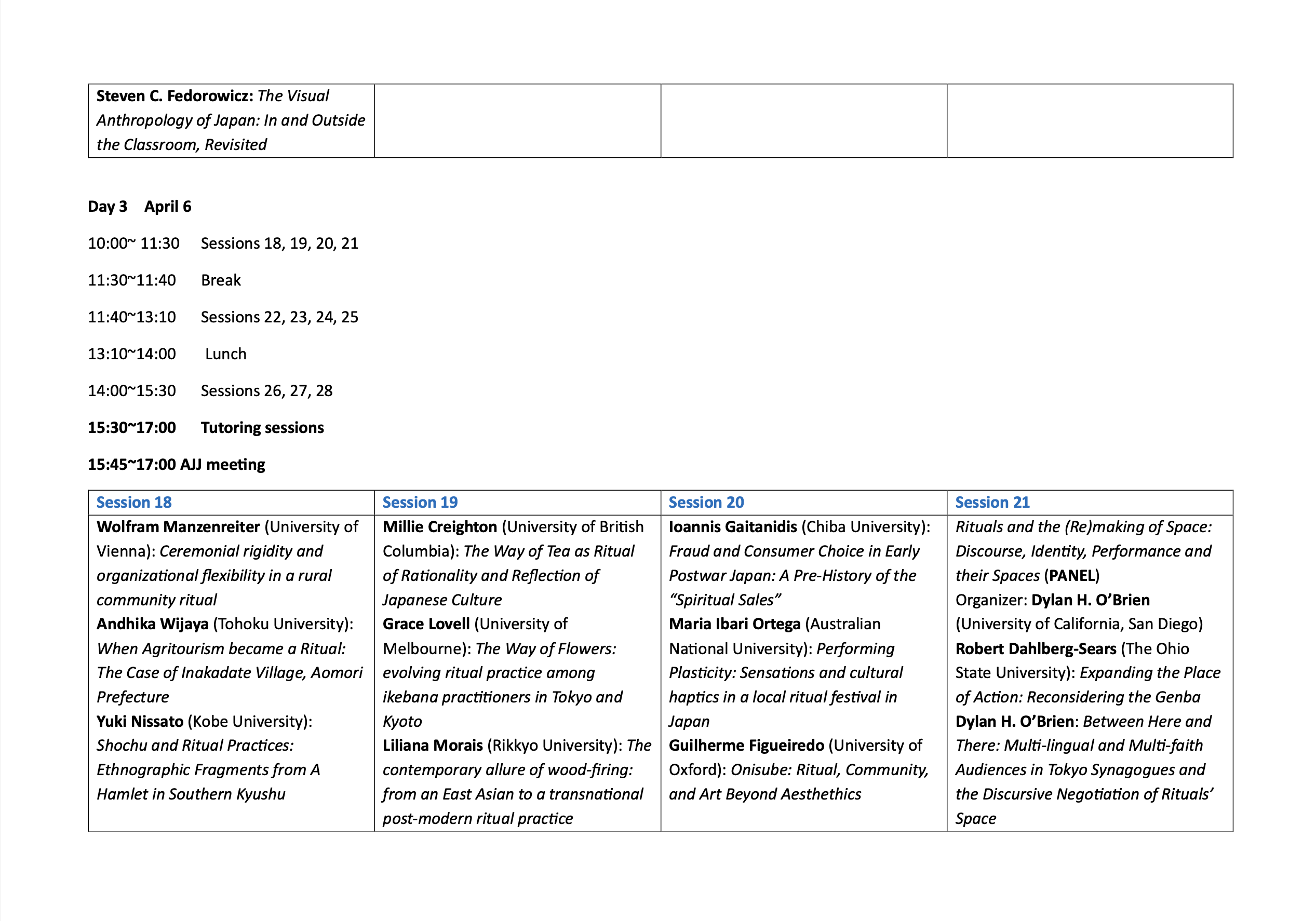
Schedule:
Of special note to visual anthropologist is Session 14 on Saturday, April 5, 15:40-17:10.
Panel: Reflecting and Revisiting「Teaching Japan」
Chair and Organizer: Steven C. Fedorowicz, Professor, Kansai Gaidai University
Discussants: Ioannis Gaitanidis (Associate Professor, Chiba University) and Greg Poole (Professor, Doshisha University)
Panel Abstract:
Teaching Japan: A Handbook (Gaitanidis and Poole 2024) was launched and introduced at the Anthropology of Japan in Japan 2023 Annual Meeting. In their opening chapter, co-editors Gaitanidis and Poole discussed the logic behind the book, “…despite the rich history of critical discussion around ‘researching Japan,’ there is not yet a comprehensive guide for taking these scholarly debates into the undergraduate, and (often) non-Japanese Studies, classroom. This then was the impetus for this forthcoming interdisciplinary collection of pedagogical case studies…” The book launch was a year and a half ago, and the book chapters were written long before that. This panel strives to continue the discussion that Teaching Japan began through a revisit of our chapters, to rethink, reflect, self-criticize and/or build upon our original ideas. In his presentation, McMorran asks critical questions about ethnographies in/about Japan to further explore the validity and value of collaborative ethnographic research beyond the borders of Japan. Fassbender rethinks teaching methods and approaches to counteract the influence of social media that limits students in their understanding of complicated and multifaceted issues surrounding gender and reproductive politics. McGuire reassesses teaching methods and approaches to explore the complexities of social inequality through intersectionality and reflects on the inclusion of literature that looks beyond Japanese society. Fedorowicz revisits the potential for a more active student learning environment and further course development amidst the current multimodal turn in and outside the classroom to make a new version of his course. Discussion and feedback are especially encouraged.
Paper 1: Japan All Around: Teaching about Japanese Society in Singapore
Chris McMorran, Associate Professor, National University of Singapore
In my chapter in Teaching Japan: A Handbook, I discussed disciplinary shifts in anthropology toward studies that are multi-sited and unbounded by national borders. Despite admitting the importance of such geographically promiscuous research, however, I shared my rather conservative approach to teaching about Japan through ethnography, specifically ethnographies based in Japan. I concluded my chapter by asking about the risks and potential rewards of using ethnography to move beyond a Japan-centered understanding of Japanese society. In this presentation, I introduce an ongoing pedagogical effort to answer this question. I outline a course I teach in Singapore that includes students in qualitative research among Japanese citizens residing in the small city-state. Despite its dry title, “Japanese Political Economy” approaches the subject from a distinctly human angle, by focusing on the ways Japan’s political economy has impacted the work lives and family lives of Japanese citizens residing in Singapore. In my presentation, I share the course aims, the research assignment, and the insights gained from several years of teaching the course. What have students learned about Japan and Japanese society by examining the work lives and family lives of those who reside outside its borders? Finally, despite their physical distance from Japan, how can students be inspired by anthropology to see, and investigate, Japan all around them?
Paper 2: How to Unlearn Reproductive Politics in the Classroom
Isabel Fassbender, Assistant Professor, Kansai Gaidai University
Building on my chapter, Teaching Gender and the Politics of Reproduction in Japan: Self-Government as a Theoretical Reference Point, recent experiences and observations in a course offered to mostly one-semester foreign exchange students inform this presentation about challenges and opportunities in teaching reproductive politics in university. It discusses classroom strategies to create a space to learn about reproductive politics in Japan and at the same time consider biomedical ethical questions detached from social ideologies or political partisanship for students that come from a background where these issues are often highly politicized. Contents of the course focus on historical circumstances and contemporary debates surrounding population control and reproduction in Japan (including pregnancy, birth, reproductive technologies, and contraception). However, as a matter of course, ideological and political frameworks that shape current debates in Western contexts often circumscribe the scope within which students access legal and ethical questions surrounding these issues. Not rarely in today’s media landscape, opinions are significantly conditioned through social media channels, which can be simplified and/or biased. It is thus crucial to provide students with opportunities to unlearn or question their preconceptions along with factual knowledge. Teaching methods that emphasize particular historical, socio-political, and cultural circumstances in Japan, as well as presenting diverse viewpoints and theories beyond neoliberal and capitalist approaches that automatically equate developments in science and technology with moral and ethical progress, have proven to be effective in broadening the scope of possible class debates in the context of reproductive politics.
Paper 3: How (un)equal is Japanese Society: Thinking with Intersectionality in the Classroom
Jennifer M. McGuire, Associate Professor, Doshisha University
Understanding inequality in Japan requires moving beyond single-axis frameworks. To fully grasp the causes and consequences of social inequalities, we need tools that delve into the complexity of oppression and power. In this presentation, I discuss how I use intersectionality as a provisional concept and analytical tool in an advanced level course in an English-taught program at a Japanese university. I argue that despite significant obstacles to its use in a university course, including a relative lack of English-language sources about Japan, it is crucial to view and interpret Japanese society through an intersectional lens to challenge assumptions and develop a more nuanced understanding of social inequalities. I analyze data collected in the classroom, particularly class discussions and students’ written responses, focusing on how gender intersects with class and disability to produce inequalities and discrimination. Additionally, I examine the need for heightened sensitivity and awareness when teaching in a multidisciplinary, multilingual setting where students’ positionalities and subjectivities can result in particularly complex relationships to Japan. While I argue that intersectionality helps us move beyond stereotypical and superficial understandings of marginalized social groups, I also reflect on the significant challenges of applying a framework that originated in Black feminism in the United States to a society with a vastly different sociopolitical and historical context.
Paper 4: The Visual Anthropology of Japan: In and Outside the Classroom, Revisited
Steven C. Fedorowicz, Professor, Kansai Gaidai University
My chapter describes teaching a class comprised of international exchange students from many different countries alongside local students preparing for their study-abroad programs called “Visual Anthropology of Japan” at a Japanese university from 2006 to 2014. Topically, the course was about the presentation and representation of culture through film, photography, and other visual communication arts within the shifting anthropological ecologies of media, methods, and theory. Teaching “Japan” in this context required several balances of instruction and guidance for students of different academic levels, backgrounds, language skills and expectations studying together in the same class. Because of my training and background in cultural anthropology and visual anthropology, I do not consider my text as a theoretical treatise on pedagogy per se. Rather it is closer to an ethnographic—sometimes autoethnographic—account based on the fieldwork of teaching this course under certain conditions at a global educational setting. In my presentation, I will revisit this setting through the reflexive lens of ba (Kajimaru, Coker and Kazuma 2021), specifically, the convergence of players, place and performance during the period of the multimodal turn in visual anthropology that coincided with the class. This reminiscent revisit reaffirms the potential and possibility for a more active student learning environment and further course development to make a new and improved version of the course.