(Announcement from H-Japan)
Date: 4 Feb 2010 - 5 Feb 2010
Venue: Asia Research Institute, National University of Singapore
The notion of ‘space’ has become a key subject in many disciplines ranging from its more physical and material relationship to architecture and geography, for example, to its discussion in fields as diverse as philosophy, film, theatre, literature, history, cultural studies and art history. In the latter disciplines, space is variously interpreted in its metaphorical, psychoanalytic, emotional, cultural and social registers.
Likewise, the notion of performance has also been widely re-appropriated by various disciplines. ‘Performance’, traditionally defined as a mode of entertainment or ritual, is also increasingly understood now as a critical methodology enabling an interpretation of cultural behavioural patterns. All performance is ultimately framed by space. Different spatial typologies – institutional, civic, domestic, liminal, ceremonial, or religious, for example – orchestrate sets of culturally recognized and appropriate forms of behaviour. As such, space is instrumental to the codification of socially acceptable patterns of actions, and conversely to the enactment of performances, which either reinforce or contest such patterns.
The application of performance and the performative as a methodological tool for understanding space is critical. This concept exposes the constructed nature of space, reinforcing the argument that space cannot be essentialized. This non-essentialized point of view is particularly relevant to recent studies focusing on Asian spaces, where there are tendencies to oversimplify Asian identity simply by suggesting a binary relationship to the West. Through this critical lens, the broad questions like ‘What is Asian space?’ can be refined as ‘How is Asian space constructed?‘Who are its producers/ protagonists?’
Developing the multivalent perspectives of space, this workshop is structured around the performative potential of space in Asian films. Of interest is how space serves as more than context or setting in a film’s mise-en-scène, but also how space is called upon to construct and reconstruct particular forms of identities, meanings and interactions. Here, space may be variously perceived as, but not limited to, physical, psychological, subjective, narrative and/or cinematic.
For our purposes, film is also adopted not as a strictly mimetic medium but one that can engage other epistemic modes of identity – bodily, emotional, experiential. We suggest that film in its various formats – feature, shorts, propaganda, documentary, experimental, and amateur – and through the application of cinematic styles and conventions, offers performances that reveal how spaces are reflected, constructed, and how they may be performative, that is, transformed or transgressed.
‘Performing Space in Asian Film’ attempts to address several questions: Is there a distinctive way in which Asian spaces are performed? Are these distinctions specific to particular modes of Asian cinematic practice or in the work of particular filmmakers? How are these spaces performatively re-negotiated through/in film? What is the role of space in Asian film? Responses to these questions may be routed through more precise topics of spatial representation related, for example, to notions of authorship, genre studies, popular culture, national cinema, nationalism, immigrant discourses, migrant culture, diaspora, transnationalism, gender, ethnicity, class, and globalization.
The aim is to bring together different readings of Asian spaces embedded in film, enriched by disciplinary concerns from within the fields of architecture, urban studies, film and theatre studies, performance studies, history, anthropology, geography, cultural studies, and literature. In such instances, film is also revitalized differently as a ‘text’, which adheres to the disciplinary limits of each field. Ultimately, the intention is to approximate an understanding not only of what makes Asian space, but also how it operates and how identities and meanings may be contested or embodied through its performances.
Accepted papers will be presented in an interdisciplinary workshop hosted and supported by the Asia Research Institute, National University of Singapore, in February 2010. The papers will be published as part of the conference proceedings’ Working Papers. A special journal issue or edited book featuring the developed papers is planned following the event.
For more information, check out the event web page:
http://www.ari.nus.edu.sg/events_categorydetails.asp?categoryid=6&eventid=969

Showing posts with label theatre. Show all posts
Showing posts with label theatre. Show all posts
Wednesday, September 16, 2009

Thursday, February 26, 2009
Japanese Jesus Christ Superstar
 (Image borrowed from Japan Today, 2/26/09.)
Here's some visual globalization for you.
Japan Today text: The actor in the role of Jesus Christ performs at the final dress rehearsal of the kabuki version of “Jesus Christ Superstar” in Tokyo. A rickshaw, women in elaborate brocade kimonos, the echo of bamboo flutes, and Jesus of Nazareth, his face painted white with the flaring red lines, all share the stage at Gekidan Shiki, one of Japan’s best-known theater troupes, in its revival of the hit rock opera “Jesus Christ Superstar“—with some very Japanese twists.
Want more information?
Link to "Jesus Christ goes kabuki in Japan 'Superstar' play" at Reuters India:
http://in.reuters.com/article/lifestyleMolt/idINTRE51J0QN20090220
Link to Japanese Jesus Christ Superstar webpage:
http://www.shiki.gr.jp/applause/jesus/
And here's a YouTube clip from a previous production.
Christianity hasn't been so successful in Japan, but what about this production? The story of Jesus becomes glocalized? Comments, visual or otherwise?
Monday, April 21, 2008
Noh and Kyogen Presentation in Kyoto
Another announcement from H-Japan...
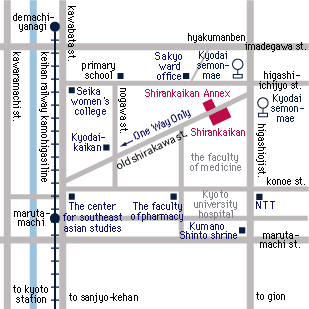
The upcoming Kyoto Asian Studies Group meeting will be held on Tuesday, May 20, 2008 from 6 p.m. to 8 p.m. in Room 217 at Kyodai Kaikan. Our speaker will be Jonah Salz (Professor of Comparative Theatre at Ryukoku University and Co-founder and director of the Noho Theatre Group and Traditional Theatre Training). His paper title is "Virtual noh: negotiating the authentic with the fascinating in introducing noh to foreign audiences" (see below for abstract).
Sponsored by the Kyoto Consortium for Japanese Studies
For information on access:
http://www.kyodaikaikan.jp/access.html
http://www.shirankai.or.jp/facilities/access/image/map3_e.gif
Please remember that you may bring only bottled drinks (with caps), no food.
Abstract:
Noh and kyogen has aimed to enlist foreign patrons in its striving for recognition abroad and at home as the highest of human artistic achievements. First in translations, then in performances for invited foreign dignitaries, finally in tours abroad, noh managed to become well-known among students of Japan and theatre.
In the past few decades, NHK, noh producers, and foreign academics have produced internet sites, video, dvd, and cd-rom aimed at non-Japanese audiences. This lecture examines the various means to present noh virtually, including explanatory tracks, subtitles, documentary, voiceovers, and "behind the scenes" views. At the same time, the power relationships between noh performers and these mediating media will be explored.
The upcoming Kyoto Asian Studies Group meeting will be held on Tuesday, May 20, 2008 from 6 p.m. to 8 p.m. in Room 217 at Kyodai Kaikan. Our speaker will be Jonah Salz (Professor of Comparative Theatre at Ryukoku University and Co-founder and director of the Noho Theatre Group and Traditional Theatre Training). His paper title is "Virtual noh: negotiating the authentic with the fascinating in introducing noh to foreign audiences" (see below for abstract).
Sponsored by the Kyoto Consortium for Japanese Studies
For information on access:
http://www.kyodaikaikan.jp/access.html
http://www.shirankai.or.jp/facilities/access/image/map3_e.gif
Please remember that you may bring only bottled drinks (with caps), no food.
Abstract:
Noh and kyogen has aimed to enlist foreign patrons in its striving for recognition abroad and at home as the highest of human artistic achievements. First in translations, then in performances for invited foreign dignitaries, finally in tours abroad, noh managed to become well-known among students of Japan and theatre.
In the past few decades, NHK, noh producers, and foreign academics have produced internet sites, video, dvd, and cd-rom aimed at non-Japanese audiences. This lecture examines the various means to present noh virtually, including explanatory tracks, subtitles, documentary, voiceovers, and "behind the scenes" views. At the same time, the power relationships between noh performers and these mediating media will be explored.
Subscribe to:
Posts (Atom)