A Multimodal Special Bonus
Here's some more information about this post-fieldwork event: behind the scenes secrets, out-takes, bonus photos and dissemination of data.
I. The Performance
I have received some good feedback after the presentation. One colleague wrote, "I enjoyed also the performative moment when you drank "sake"—not sure whether everyone noticed."
Oh that was real sake I tell you. Gonzo Anthropology. I bought a small bottle just for the session. Tasty. I also hung the piece of the noren I received after Tenbun closed behind me but it didn't look so great in the background onscreen. So I used a virtual picture instead. But soon the room smelled like grease and tobacco as the noren hadn't been washed in well over a year. So with those smells, the grease remaining on my fingers and the taste of the sake, it was real sensory ethnography during this post-fieldwork event...
There were also comments about the emotion of the presentation. I am really glad that people felt it. I have presented "The End" segment a few times at conferences and classes and I always get choked up.
II. Cut For Time - Methodology
I usually went to Tenbun without much stuff, just my trusty Nikon D700 and its 24-120 VR lens kit. When I wasn't shooting I left it on the bar. I wanted people to get used to me and the camera. The first night of the final week I brought only my camera but the battery died very quickly. So I had to use my back-up: the camera on my iPhone 7 plus. The next night I decided I needed to be better prepared, so I brought a big bag full of equipment (pictured above). Luckily there was room in my bag for the big bottle of sake and glasses Tencho gave me.
The morning of the last night I tried to replace the SD card in my Nikon. But some of the small pins in the narrow slot were bent and I couldn't fix it. So for the final night I used my new(er) Panosonic Lumix G9 Pro. I am still not so used to using it but it is very light due to being mirrorless and got the job done. Still, I am sad at the passing of my D700...
III. Cut For Time - COVID-19 and Social Distance Concerns
Tenbun's last week was after my university suspended face-to-face classes and went remote but before the Japanese government called for the country-wide state of emergency. You can see from the photos and video that there were few masks at Tenbun and no social distancing. People were shaking hands, putting their arms around one another, hugging... On the last night I was at the crowded bar standing next to a regular customer of over 20 years who is a medical doctor. I commented to him that we were probbaly being very stupid and careless. He agreed, but then said that no matter what, he had to be there. "If I get sick and die, so be it. I have to be here now." He explained when he graduated from medical school he had trouble finding a job and was very depressed. The only support he got was from going to Tenbun and Tencho. He said he would always be grateful to Tencho and referred to him as his onjin (roughly translated, benefactor). I haven't heard this term for a long time. I wonder if people still use the term.
IV. Project Links - General
Click on the links below for more on the Tachinomiya Project.
Photo Exhibition and Visual Ethnography - "Tachinomiya: There Are Two Sides to Every Noren"
"Tachinomiya" Photo Exhibition and Visual Ethnography: The First Week
"Tachinomiya" - A Successful and Memorable Photo Exhibition/Event/Research Method
Happy Tachinomiya Halloween - and - (Pre-)Announcement: AJJ Presentation in December: "Tachinomiya: Photo Exhibition as Research Method"
AJJ Presentation - Tachinomiya: Photo Exhibition as Research Method
ANNOUNCEMENT:「Tachinomiya: Photo Exhibition as Post-Fieldwork Encounter」- Society for East Asian Anthropology Regional Conference 2019 in Tokyo
Tenbun Closing 「天文のれんを下ろす」Paper/Presentation at 2020 AJJ Annual Meeting
V. Project Links -「Tenbun Closing」
Click on the links below for more on 「Tenbun Closing」.
Sad News for VAOJ and Many Others: Tenbun Closing - Leading to a Week of Intensive Photography and Salvage Ethnography
「Tenbun Closing」- Leading to a Week of Intensive Photography and Salvage Ethnography pt.2 - posing for pictures, sharing drinks with the staff, farewell handshakes and hugs, reminiscing with old photos and having your favorite sake for the last time...
「Tenbun Closing」- Leading to a Week of Intensive Photography and Salvage Ethnography pt.3 - "...and how do you feel about Tenbun closing, Tani-san?"
「Tenbun Closing」- Leading to a Week of Intensive Photography and Salvage Ethnography pt.4 - What's in my bag?
「Tenbun Closing」- Leading to a Week of Intensive Photography and Salvage Ethnography pt.5 - Raw Data of the Last Night
「Tenbun Closing」- Leading to a Week of Intensive Photography and Salvage Ethnography pt.6 - The Shutters Are Drawn And The Noren Is Taken Down
VI. Future Tenbun Projects
Well, I can't give it all away. Stay tuned to VAOJ for more!
Tenbun Lives! Post-Producing Forever!
Explorations and experiments in visual representations - multimodality, sensory ethnography, reflexivity, autoethnographic vignettes, ethnographic photography and ba...
Showing posts sorted by relevance for query tenbun. Sort by date Show all posts
Wednesday, December 9, 2020
Sunday, March 28, 2021
「Tenbun Closing」One Year Anniversary, pt. 1: Empty Space
March 28, 2020 was Tenbun's last day of business. One year later the location of Tenbun is empty space. The red circles on the floor guide for エルくずは (Elle Kuzuha) show where Tenbun was (lot 5) and that no new shop has opened there.
The Norengai is no more (only two shops seem to have a small noren now). This shot was taken at 5:30 PM last Thursday. The renamed エルくずは is no longer a busy and popular corridor like it once was. The demise was likely caused by the refurbishment/gentrification of the area by Keihan Densha, higher rents, more chain restauraunts, the close of the pachinko parlour and finally the close of Tenbun. COVID-19 was the last nail in the coffin. In all, three shops have gone out of business and remain vacant. At least one shop seems to be at least temporarily closed. Shuttered and closed. But not forgotten...
For more information on Tenbun and the project: 「Behind the Scenes:「Tenbun Closing」Presentation @ Anthropology of Japan in Japan Annual Meeting 2020」
http://visualanthropologyofjapan.blogspot.com/2020/12/behind-scenestenbun-closingpresentation.html
「Eat, Drink, and Stand in Japan」at Anthropology News (oneline version)
https://www.anthropology-news.org/index.php/2021/01/08/eat-drink-and-stand-in-japan/
Thursday, December 3, 2020
Tenbun Closing 「天文のれんを下ろす」Paper/Presentation at 2020 AJJ Annual Meeting
「Tenbun Closing」
「天文のれんを下ろす」
Abstract:
This visual-ethnography presentation is the latest chapter of the saga of Tenbun, a tachinomiya (“standing bar”) in Osaka, Japan; the focus will be the shop’s final days. Tenbun, with its long counter and blue noren curtains, has a lively atmosphere and plenty of colorful characters, including the owner, employees and regular customers. Based on my years of patronage, nearly two years of dedicated participant-observation and photography, a photo exhibition and other post-fieldwork encounters, the project has examined in the Japanese context the complexities of personal privacy in public spaces, and the intersection of food anthropology, multimodal research methods, recent research on drinking establishments and the plethora of “foodie” media productions.
In March 2020, Tenbun’s noren came down for the final time, after 40 years of business (for reasons unrelated to coronavirus). During Tenbun’s last week, customers rushed to visit the bar, taking a break from earlier attempts at social distancing. For me, it was a period of intense photography and salvage ethnography. I could not unobtrusively capture the natural setting, or rely upon the serendipity of street photography (Luvaas 2017), as I had previously. The owner called me his personal photographer, and he and others wanted posed photos. Margaret Mead wrote about the importance of salvage ethnography through visual anthropology methodology (1967). Out of necessity, eating and drinking behavior has changed and many izakaya, tachinomiya and restaurants have been forced to close. My photographs not only preserve Tenbun but also document the eating, drinking and socializing habits of Japan before the COVID-19 pandemic.
AJJ (Anthropology of Japan in Japan) 2020 Annual Meeting
Sunday, December 6, 2020 @ 10:00 AM (Japan time)
The conference is online and free. Participants must register. For registration, schedule and more information:
https://tinyurl.com/AJJ2020
See also:
Photo Exhibition and Visual Ethnography - "Tachinomiya: There Are Two Sides to Every Noren"
AJJ Presentation - Tachinomiya: Photo Exhibition as Research Method
「Tachinomiya: Photo Exhibition as Post-Fieldwork Encounter」- Society for East Asian Anthropology Regional Conference 2019 in Tokyo
Saturday, January 28, 2023
This is what replaced Tenbun:「"Takoyaki/side dishes standing bar Peke x Peke"」
Tenbun closed on March 28, 2020. The space it occupied was empty for a year and a half. Then on October 10, 2021, a new shop opened, Peke x Peke. I walked by the new shop a few times but never felt right about going in. But a couple weeks ago I went there to take photos and I did go in for a drink. Of course, it just wasn't the same. It seemed (bias warning) too new, artificial, cheap, trying too hard to be hip and stripped of any tradition and personality. I couldn't believe they tore out the beautiful old counter and replaced it with what they did. There weren't many customers (but it was a Monday evening) and none of the old Tenbun regulars were there. Replacing old shops with new chain stores is a part of the gentrification process going on at Keihan line train stations. Peke x Peke is not a chain. The manager told me that this is the only location with this particular configuration. But the owner has multiple shops.
You can get a good idea of the new configuration in my photos and then with photos from a web site I include below. Scroll to the end of this post for a link to see our beloved Tenbun.
Photos that accompnaied the announcement of the new shop on "Ko-shin," the Hirakata-shi Featured Event (i.e. advertisements) website.
https://www.hira2.jp/open-close/batubatu-20211018.html
Congratulatory flowers in front of the shop when it opened.
The new layout, counter, big screen TV...
Seating...
Take-out window.
Here's where to go to see Tenbun:
https://visualanthropologyofjapan.blogspot.com/2020/12/behind-scenestenbun-closingpresentation.html
Tuesday, September 28, 2021
「Tenbun’s Last Call: Drinking Establishments in Japan Before and During COVID-19」@ New York Conference on Asian Studies 2021, Oct. 1-2
Abstract: This presentation is a multimodal visual ethnography of drinking establishments such as izakaya (“Japanese pubs”) and tachinomiya (“standing bars”) in Japan before and during the COVID-19 pandemic. The focus will be on a 40-year-old standing bar in Osaka called Tenbun. Tenbun serves many kinds of alcohol and food items and has a lively atmosphere with plenty of colorful characters, including the owner, employees and regular customers. Not only is it a popular place to eat and drink, it is an important setting for socialization. This study is based upon over two years of dedicated participant-observation and photography, a photo exhibition and other post-fieldwork encounters. COVID-19 has brought changes for eating and drinking establishments in terms of safety precautions and consumption behavior; many shops have been forced to close. Tenbun closed shop in March, 2020. This research project examines the intersection of food anthropology, multimodal research methods, recent research on drinking establishments and the plethora of “foodie” media productions. It has also become a form of salvage ethnography. My data and photographs not only preserve Tenbun but also document the eating, drinking and socializing habits of Japan before the COVID-19 pandemic.
https://www.brockport.edu/academics/conferences/new_york_asian_studies/
SUNY Brockport, Brockport, New York
October 1, 2021 - Session A1
11:00 AM - 12:30 PM EDT (12:00 - 1:30 AM, Oct. 2 Japan time)
via Zoom (conference registration required)
For information on the conference and program:
https://www.brockport.edu/academics/conferences/new_york_asian_studies/
Tuesday, February 16, 2016
"Tachinomiya" - A Successful and Memorable Photo Exhibition/Event/Research Method
The exhibition/event "Tachinomiya" finished on a high note on Sunday after a two week run, proving to be an interesting and valuable research method. Thank you to all who came - Tenbun workers and patrons, university colleagues, students and former students, family, friends and new friends I had the pleasure of meeting for the first time. I received lots of good wishes and gifts as well as insightful comments and feedback. The Tenbun crowd examined the photographs intensely, pointed out new details and shared several suggestions for future research. Other visitors asked about theory, methods and techniques providing more inspiration. Thank you to Hoshigaoka Gakuen Head master and staff and Sewing Gallery staff for assistance and support.
There were many spontaneous happenings that added to the event including a visiting sketch artists who made drawing of people at the exhibition and a closing reception on Sunday. Extradiegetic elements added to the scene - the funky nature of the gallery itself, a music soundtrack comprised mostly of old American blues music inspired by drink (an a couple of new David Bowie songs from the Blackstar album) and six 1.8 liter bottles of sake donated by Tencho (they ran out by Sunday afternoon prompting visitors to go out and buy more...).
This exhibition was primarily for the benefit of the Tenbun crowd - as my thanks to them for their incredible cooperation and contributions. I found out during the exhibition that a regular Tenbun customer in a displayed portrait had recently passed away and that a woman appearing in a couple of photos was pregnant. This sadness and joy is a reminder that anthropology is about real lives and real people.
This exhibition in part started as a result of the "Shooting Culture in Japan" research dealing with photo methodologies, rules and etiquette; I was able to apply these things to create the beginnings of a visual ethnography of Tenbun, tachinomiya and Japan. This project will continue. Stay tuned to VAOJ for more news of future exhibitions, presentations and publications. For now, I need to catch up with work and sleep...
Tuesday, June 14, 2022
VAoJ is going to Lithuania (at least virtually) with「Tenbun: The Intersections of Performance, Place and Ethnographer in a Japanese Standing Bar」
Abstract:
Gerald Berreman describes a dilemma within ethnography: “how to be scientific and at the same time retain the humanistic insights—the human relevance—without which no account of human beings makes sense” (1966: 346). He suggests that, rather than choosing one or the other, ethnographers should develop a methodology that is both insightful and scientific. How to accomplish this in practice is still a question for ethnographers today.
This presentation is a visual ethnography of a tachinomiya (standing drink bar) in Osaka, Japan, called Tenbun. The bar features many kinds of food and drink in a “grimy” (Farrer 2019) and lively atmosphere, populated with an array of colorful characters. Following the recent work of Kajimaru et al. on the concept of ba (place, space), this research describes Tenbun as more than a location. Rather, it is “a co-emergence of performance, place and peoples” (2021: x). The ethnographer plays a dual role as an immersed participant at Tenbun and later as a distanced cultural analyst. My attempt to describe Tenbun in both insightful and scientific ways uses multimodality (Collins et al. 2017), sensory ethnography (Pink 2009) and photography.
Conference Information:
Old Discipline, New Trajectories: Theories, Methods and Practices in Anthropology
Hosted by Faculty of Philosophy at Vilnius University
Vilnius, Lithuania June 16-18, 2022
Webpage: https://www.sasciconf2021.fsf.vu.lt/
My paper is in Panel session no.2, ANTHROPOLOGICAL EXPLORATION OF ART AND PERFORMATIVE PRACTICES.
JUNE 16, 2022 (Thursday), 13:00-15:00 local time.
Japan time: JUNE 16, 2022 (Thursday), 19:00.
Special Bonus Photo:
Monday, January 11, 2021
「Eat, Drink, and Stand in Japan」featuring the tachinomiya Tenbun is the cover story for the print version of Anthropology News (November/December 2020)
Also available online: https://www.anthropology-news.org/articles/eat-drink-and-stand-in-japan/
My text was severely edited (for brevity and to appeal to a wider audience I suppose) but I think the photos look great! I like the layout in the print version better. Send me an e-mail if you want a pdf copy.
The original pitch:
In Japan, food is prominent in documentaries, cooking shows, travel shows, variety shows, dramas, manga, anime, books, magazines, blogs, Facebook and Instagram. This food, not eaten but consumed, provides entertainment, enjoyment and knowledge. Many of these presentations are set in izakaya (Japanese-style pub) and tachinomiya (Japanese standing bar) located in shitamachi (“lower city” associated with common people) neighborhoods that serve B-kyu gurume (B-rank food)—comfort food and/or local food. These are fascinating shops and sites to explore the production (cooking) and consumption (eating) of food. The portrayals themselves are another form of production, that of knowledge and enjoyment that is “good to think” (Levi-Strauss 1962), “communicated” (Barthes 1966; Dusselier 2009) and “shared among people” (Cheung 2002).
This photo essay is a multimodal visual ethnography of a 40-year-old tachinomiya in Osaka called Tenbun. Tenbun features many kinds of food and drink, a lively and relaxed atmosphere and plenty of colorful characters including the owner, employees and regular customers. Based upon over two years of participant-observation and photography, a photo exhibition and other post-fieldwork encounters, the text and images explore the intersection of food anthropology, recent research on drinking establishments in Japan and the plethora of “foodie” media productions.
The Tenbun/tachinomiya project: http://visualanthropologyofjapan.blogspot.com/2020/12/behind-scenestenbun-closingpresentation.html
Sunday, July 7, 2024
Standing Drink Bar「Tenbun」Old Boys Reunion 立ち呑みの居酒屋「天文」O.B. 会
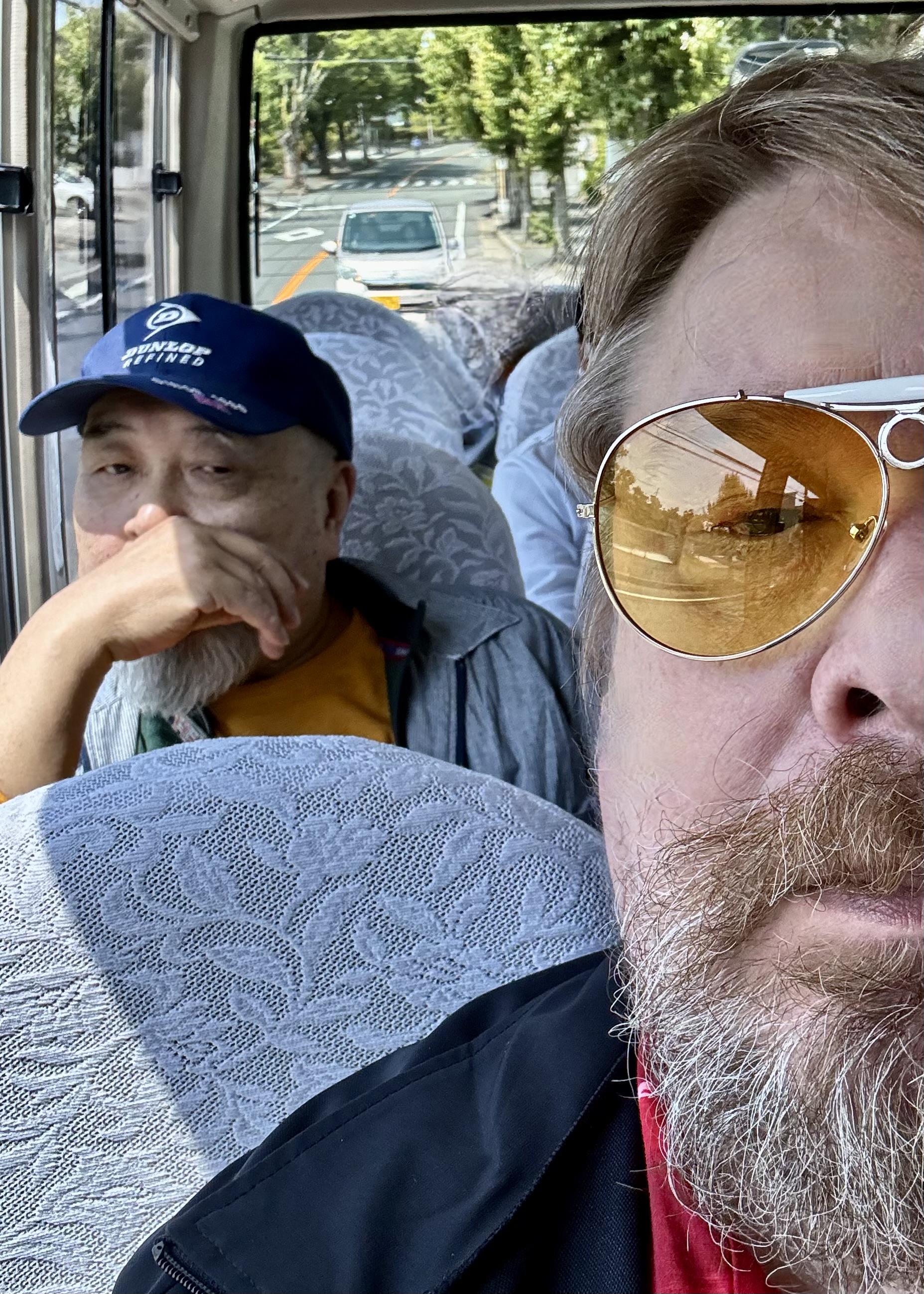
We were on the bus, traveling through the borderlands between Osaka and Kyoto Prefectures when the imojōchū began to kick in.
We had just finished an hour-and-a-half of “all you can eat/all you can drink” at a traditional izakaya banquet. This kind of gluttonous binging and imbibing pushes participants, especially those on a pensioner’s budget with little left over after pachinko and horse race betting activities, to extremes, to make sure they get their money’s worth. Since the food turned out to be only standard fare, we concentrated on the drinking: beer, sake (nihonshu) and sweet potato distilled liquor (imojōchū; usually 25-35% alcohol). A half hour in we were getting livelier and louder, and receiving dirty looks and disapproving frowns from the shop staff and other customers. Our severs were stingy, only allowing us to order a new drink after giving up the empty vessel from the previous beverage. Some of us countered this policy by pouring alcohol into PET bottles and plastic bags for secret take-out. We drank steadily until the last order. Somehow, we all were able to stand, pay our portions of the bill, use the toilet and stumble to the return bus without too much trouble. What started out as a gathering of long-lost friends taking a short trip on a privately rented bus with quiet small talk of recent illnesses, hospitalizations and deceased drinking companions, was now a drunken cacophony of laughing, shouting, quiz games and attempts at singing enka. We exited the bus at the Keihan Kuzuha train station, took a memorial photo and made our way to the shopping arcade, formerly the aged, everyman Norengai (“Noren Street”), home to several traditional eating and drinking establishments. Recently this arcade was gentrified and renamed “El Kuzuha.” The older shops, many of which closed due to COVID-19, were conveniently replaced with fashionable chain restaurants. We wandered through the corridors until deciding on an acceptable pub for our continued revelry. This post-fieldwork encounter chronicles a reunion of the owner and regular customers (the O.B.s or Old Boys) of a 40-year-old tachinomiya (“standing drink bar”) in Osaka called Tenbun, that closed in 2020.
Imojōchū has a strong taste and pungent smell, even when mixed with ice and water. For me, drinking it results in a contemplative body buzz; but when combined with beer and sake, the odoriferous contemplation turns into a gregarious stupidity. Nonetheless, this can be fun with the right people at the right time.
The Tenbun O.B. reunion was such a righteous group and occasion. After all, we were trying to resurrect something. Not a specific time, place, feeling, memory or dream. Something more, perhaps a sort of fluid liminal communitas (and I do not use these terms lightly) that, in the past, we could enter at will, or at least between Tenbun’s usual business hours Monday through Saturday. The hour of day (or night), people, circumstances, jokes, arguments, daily specials and drinks always varied and at the same time enmeshed to create this familiar something. Looking back, I can see how we took it for granted, the longest-term customers for as long as 40 years. But now we missed it. And we wanted it back, even if only for this one day.
Of course, none of the O.B.s explained the reunion in these terms, except for the over-analyzing anthropologist with a camera, soaking in another post-fieldwork experience. Ba…
To be continued…
Monday, March 29, 2021
「Tenbun Closing」One Year Anniversary, pt. 2: Tenbun People See the Photo Essay (the subjects become the audience once again)
The gang got together for the first time in months. Some have gone through hardships and losses. But it was good to get together at this Italian restaurant. Everyone was happy and thrilled with the photo essay!
For more information on Tenbun and the project: 「Behind the Scenes:「Tenbun Closing」Presentation @ Anthropology of Japan in Japan Annual Meeting 2020」
http://visualanthropologyofjapan.blogspot.com/2020/12/behind-scenestenbun-closingpresentation.html
「Eat, Drink, and Stand in Japan」at Anthropology News (oneline version)
https://www.anthropology-news.org/index.php/2021/01/08/eat-drink-and-stand-in-japan/
http://visualanthropologyofjapan.blogspot.com/2020/12/behind-scenestenbun-closingpresentation.html
「Eat, Drink, and Stand in Japan」at Anthropology News (oneline version)
https://www.anthropology-news.org/index.php/2021/01/08/eat-drink-and-stand-in-japan/
Thursday, April 22, 2021
「The Last Call: A Visual Ethnography of Drinking Establishments in Japan Before and During COVID-19」Presentation at the Central States Anthropological Society Virtual Annual Meeting
The Last Call: A Visual Ethnography of Drinking Establishments in Japan Before and During COVID-19
Steven C. Fedorowicz
Asian Studies Program
Kansai Gaidai University
This presentation will be in session 2-08 on Sunday, April 25, 2021. Session time slot is 4:45-6:30 Central Daylight Time.
(Monday, April 26, 2021, 6:45-8:30 AM in Japan.)
For information about the CSAS Annual Meeting: http://csas.americananthro.org/annual-meeting/
Saturday, April 18, 2020
Sad News for VAOJ and Many Others: Tenbun Closing - Leading to a Week of Intensive Photography and Salvage Ethnography
The tachinomiya Tenbun has closed. Tenbun has been an important research subject and site for me for the last several years. And my personal history with the shop goes back over 22 years. I can't thank Tencho, shop employees and regular customers enough for their service, friendship and teaching me so much about Japanese culture.
For more background:
Photo Exhibition and Visual Ethnography - "Tachinomiya: There Are Two Sides to Every Noren"
"Tachinomiya" Photo Exhibition and Visual Ethnography: The First Week
"Tachinomiya" - A Successful and Memorable Photo Exhibition/Event/Research Method
AJJ Presentation - Tachinomiya: Photo Exhibition as Research Method
「Tachinomiya: Photo Exhibition as Post-Fieldwork Encounter」- Society for East Asian Anthropology Regional Conference 2019 in Tokyo
For now, here are a few shots from the last few days as I continue to deal with my shock and sorrow. More to come in the near future.
"Tencho I."
Notification of closing (rough translation from the Japanese):
Thank you for visiting us regularly. We feel sorry to announce this but we are closing the shop on March 28th, 2020. For 40 years we have really appreciated your support. We hope you understand it was a really difficult decision for us. Until then, our shop will be open as usual. It will be a short time until then but we hope you can visit us.
"Tencho II."
Messages of thanks and gratitude from customers.
One of the first shots I took a couple of years ago for the photo exhibition. It seems appropriate here...
Subscribe to:
Posts (Atom)