Thursday, August 22, 2019

Tsukiji Fish Market Circa 2011


OOPS! I thought I already posted these pics of Tsukiji Market. But when putting together my new post for my recent trip to the new Toyosu Fish Market I couldn't find these on the blog. So here is a giant photo dump of my most pleasant trip to Tsukiji in 2011.

Here's some general info about Tsukiji if you don 't know about it:

https://tokyocheapo.com/entertainment/things-you-should-know-before-visiting-the-tsukiji-fish-market-tuna-auction/

And another one if you didn't know about the controversial move of the fish market to a new, possibly contaminated plot of land:

https://www.economist.com/asia/2018/10/11/one-of-japans-great-institutions-makes-way-for-a-car-park

And so here are my pics...


Look for Toyosu tomorrow...

Wednesday, August 21, 2019

Katsuya Yamashita RIP


We are saddened by the passing away of Katsuya Yamashita on August 14, 2019. He was 81. Originally from Kyushu, he moved with his wife to Nagoya and started his family life with a daughter and a son. Mr. Yamashita was my father-in-law and we had many common interests including motorcycles (he rode a Harley!), jazz music (he had a killer reel-to-reel player as well as a huge collection of LPs), photography and baseball (and I forgive him for being a Giants fan). I very much regret not being able to share these activities with him as he was severely injured in a motorcycle accident over 20 years ago leaving him paralyzed below the waist, bedridden and in need of an almost constant caretaker. His wife served in this capacity for over 15 years while still working full time (this is the kind of Japanese superwoman we don't hear about enough in the media and academia). I wish I could have known him better. Ride your Harley to heaven on the big typhoon and rest in peace.

Related note: I was surprised that the funeral industry in Japan is so professional - and by this I mean cold. On the very afternoon he passed, his nursing home called his grieving wife and asked to remove his items from his room. The wake and funeral were held in a large funeral home chain - very basic. The funeral home staff approached my wife 15 minutes before the funeral and asked her to fill out a form regarding her co-payment of the funeral. There was no personal eulogy but rather a taped speech by a woman with very polite comments about how we would all miss the deceased backed by sad background music. Immediately after the funeral the body was cremated. It is customary for the family members to place the deceased's bones into an urn. As the burner was still hot a staff member removed the bones first, commenting what part of the body they were from, size and quality. My wife found this very offensive. When we were done with the bones we were handed the urn, the deceased's portrait and a small statues with his name and promptly ushered outside. I guess we were done. Yes, funerals are big business in Japan...

Sunday, August 11, 2019

Izakaya 「Daruma」in Monzen-Nakacho


My Tachinomiya research has been greatly influenced by Yoshida Rui and especially his Sakaba Hourouki TV show on the TBS networks. Yoshida calls himself a 「酒場ライタ」 or "Tavern writer." In a typical 15 minute show he starts out at an easily accessible train station, explores local landmarks and/or rare shops in the area before arriving at an izakaya or "traditional Japanese pub." Here he drinks, eats, interacts with the owner of the shop and regular customers, typically getting a little drunk in the process. While Japanese TV is full of food shows, Yoshida's approach is interesting/entertaining and real. He then leaves the izakaya with some final comments and then presents a haiku about his adventures that day. Remember, this is all in a 15 minute show. He's been doing it since 2003 and he is still popular. I have called his approach ethnographic, in the spirit of autoethnography and Gonzo Anthropology.


So, before my recent trip to Tokyo I researched the records of all the izakaya that Yoshida has visited in Tokyo. I have never had any luck finding a good place (in terms of good food, good drink, friendly atmosphere) in Tokyo as opposed to my many successes in Osaka. I remembered one episode in particular about a shop called Daruma in Monzen-Nakacho. It was featured on episode #226 first aired on December 3, 2007. It seemed to meet all of my criteria so I went to check it out.


And it was great! All that I wanted! Everyone was very nice and friendly. Lots of regulars were there. The place was packed on an early Monday evening. It was like a big family.


I tried Hoppy for the first time. Hoppy tastes like beer but is considered a nonalcoholic beverage. You are supposed to mix it with shochu (which is usually 25-30% alcohol). Hoppy is popular at izakayas in Tokyo. I have never seen it in Osaka. If you like beer, you should like Hoppy...


I left Daruma both happy and sad. Happy that I finally found a great izakaya in Tokyo and that I made new friends there. But I was sad to leave. I was sad that I didn't go to Daruma earlier in my visit (and then return every night). As I walked to the train station I looked down a few narrow streets and saw lots of interesting looking izakaya, tachinomiya and other shops. As it turns out (I didn't see it during my trip) The Japan Times ran a story about Mozen-Nakacho while I was in Tokyo.

"The little curiosities of Monzen-Nakacho," The Japan Times, 8/2/19.
url: https://www.japantimes.co.jp/life/2019/08/02/travel/little-curiosities-monzen-nakacho/

Monzen-Nakacho is considered to be a shitamachi, an area not destroyed in the war, are associated with common people and have a retro feel. To me, this is the real Japan. So much to explore in this area...

See also "Exploring Old Tokyo: 4 Best Areas to Experience a Different Side of Japan! - Kiyosumi-Shirakawa and Monzen-Nakacho"
url: https://livejapan.com/en/in-tokyo/in-pref-tokyo/in-ueno/article-a0001610/

When I have to return to Tokyo, this is the area where I will stay.

Saturday, August 10, 2019

FUJIYA Tenugui (hand towel) Shop - Art/Encyclopedia


Several years ago, somewhere (I suspect perhaps on Yoshida Rui's Sakaba Hourouki TV show) I saw a design on a hand towel that seemed to symbolize the kind of privacy issues I was exploring in my Tachinomiya/noren project. With some research on the internet I was able to get limited information on the image and the shop where the hand towel was made. My visit there was a highlight of my recent Tokyo trip. I was able to meet the current owner (third generation) of the 74 year old shop. He gave me access to a couple of articles and a book with more specific information on the image. And I could purchase the hand towel as well. I am not sure how or if the image will be used in my research but the owner agreed to let me use it for academic purposes. So I want to give full credit to the shop that is full of wonderful art and serves as an "encyclopedia" of hand towel designs from the Edo period. And I recommend a visit to this charming and friendly place.

Address: 2 Chome-2-15 Asakusa, Taito City, Tokyo 111-0032
Phone: 03-3841-2283
https://www.instagram.com/tenuguifujiya/
Open 10:00-18:00, closed on Thursday


The image is that of a young man poking his head through a stage curtain. The young man is a character in a play by Santou Kyouden, "The Edo-Born Adulterous Vendor of Grilled Eels." Santou Kyouden was a noted poet, writer and artist from the Edo period.


Friday, August 9, 2019

Post-Conference Blues -and- Dealing with the Best and Worst of Tokyo...


The SEAA is over. It was my first time to Waseda University - who would have thought it was so big? After much wandering through the campus and extreme heat I finally found the venue and could enjoy some interesting presentations and discussions. Our session on Saturday went very well. I was happy to meet old and new colleagues.

In the next few days I will deal with my post-conference blues and Tokyo culture shock with posts about some of my adventures.

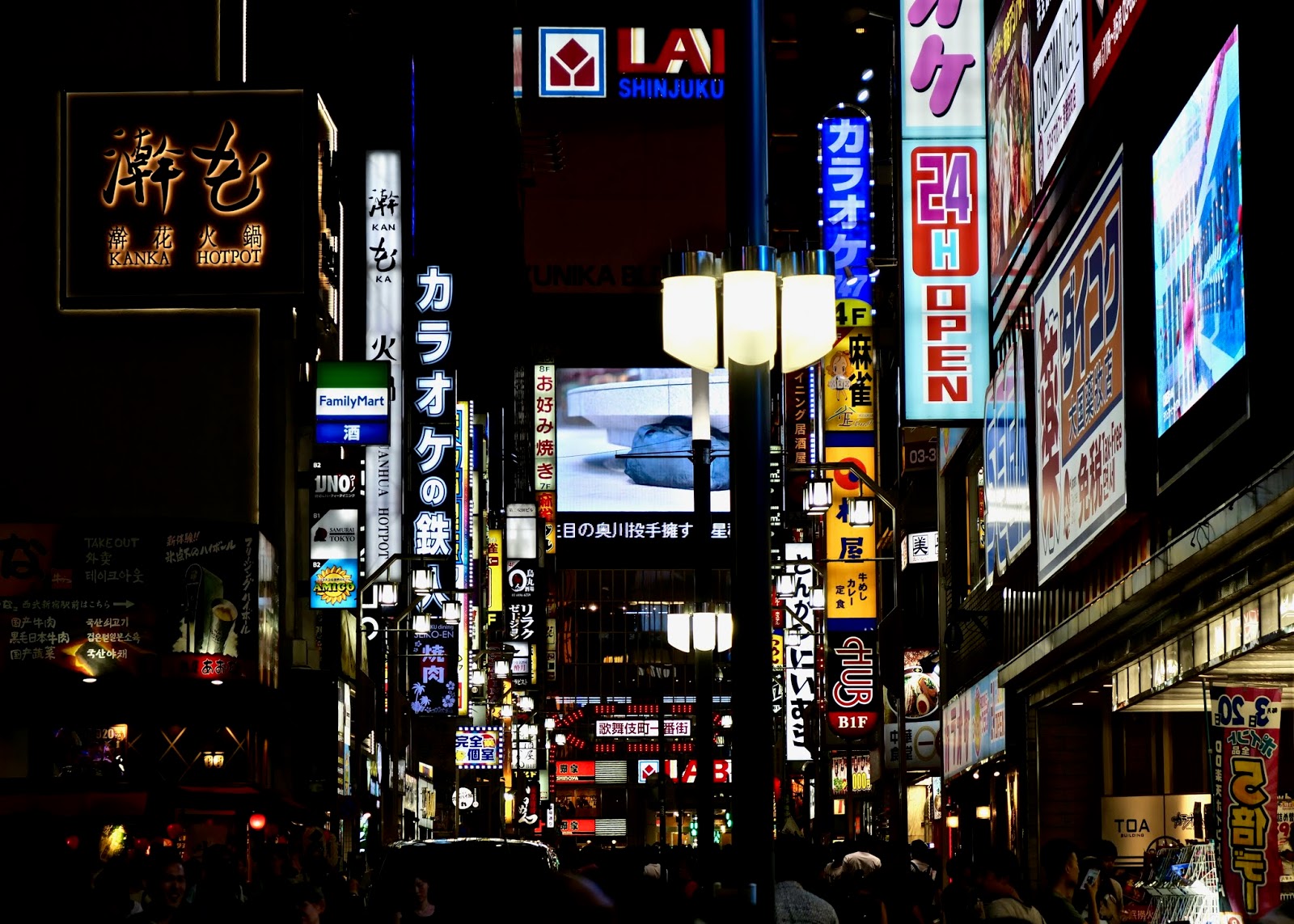
But Tokyo did not start out well. I made the mistake of getting a hotel room in Shinjuku...


Big, intimidating, hot and crowded... Not knowing much about the area, all of the shops and restaurants looked suspicious. But I was able to find a little respite at a nearby English-style pub that was showing the Hanshin Tigers baseball game (and the return of pitcher Fujinami!).


But unfortunately the pub was not smoke-free...

And worse yet I had to return to my hotel room. The biggest mistake I made was booking a room at an APA hotel. It was inexpensive and conveniently located (or so I thought) - what could go wrong?


I was aware of the problematic politics of the owner of the hotel chain, his ultranationalistic right wing opinions and his tendency to place a certain kind of "literature" (right wing ethnocentric propaganda), including books he wrote, in all of the hotel rooms (and on display at the front desk). But surely after this was exposed in the news with great controversy this practice had stopped. Nope.

"Despite calls for boycott, Apa hotel chain will keep books denying Nanking Massacre," The Japan Times, 1/25/17.
url: https://www.japantimes.co.jp/news/2017/01/25/national/despite-calls-boycott-apa-hotel-chain-will-keep-books-denying-nanking-massacre/

"Apa hotels won't remove books that deny 1937 Rape of Nanking for Olympics," The Japan Times, 6/3/17.
url: https://www.japantimes.co.jp/news/2017/06/03/national/apa-hotels-wont-remove-books-deny-1937-rape-nanking-olympics/

Here is what I found in my room.


There were a lot of foreign, especially Chinese, guests staying at the hotel... How about not insulting your customers? And where was the omotenashi?


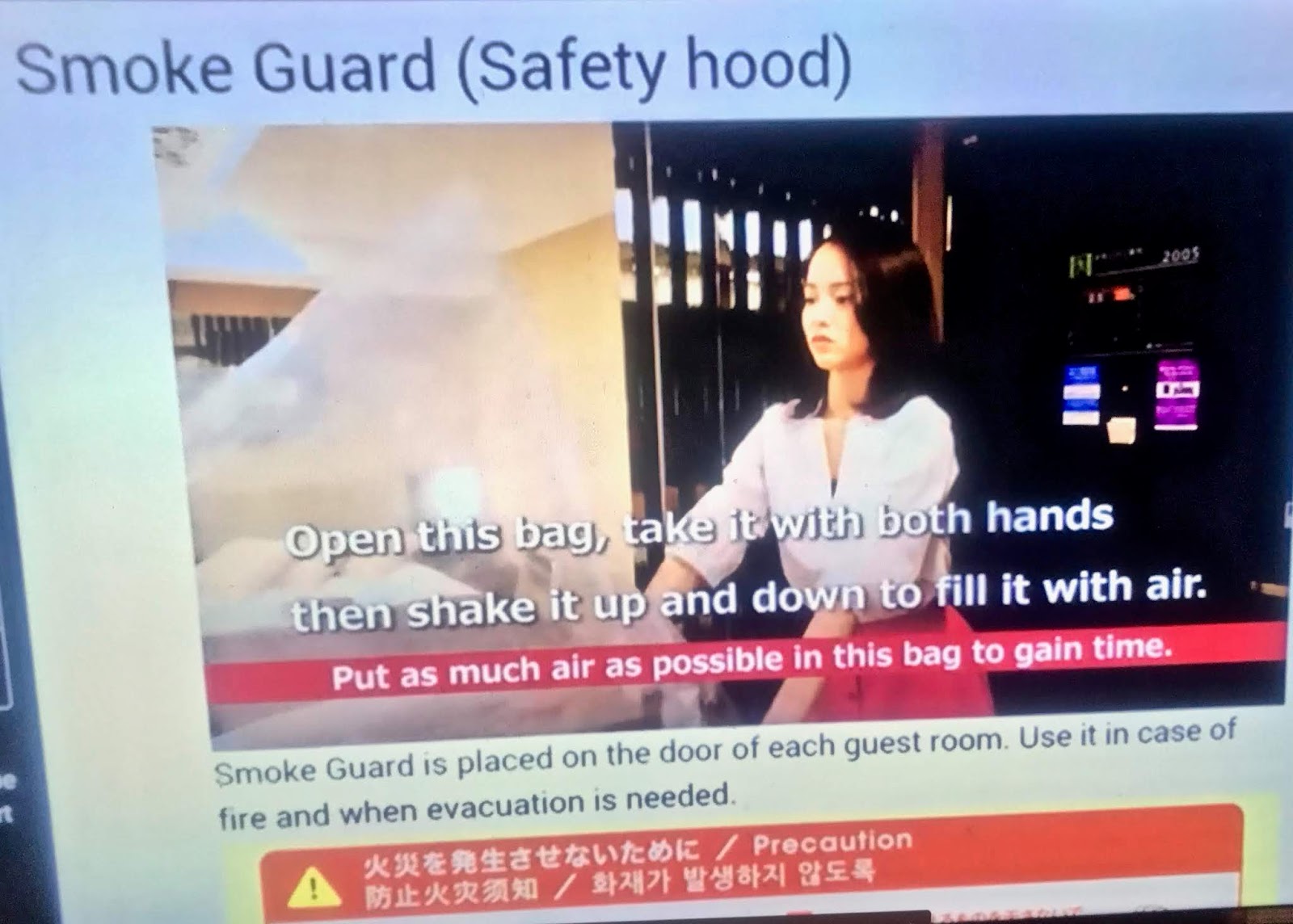
Perhaps I shouldn't complain about the small room (very different than the picture on their website), unfriendly staff, broken air conditioner/television/toilet, slow elevators and poor barrier-free facilities. After all, this is not a hotel review (but I do hope you can find mine on a certain hotel reservation website titled WORST HOTEL EXPERIENCE EVER!). But I do want to mention the fire alarm that went off around midnight on the 24th floor. I was staying on the 25th floor. We were told to stay in our rooms until the staff could determine what was going on. I watched staff members going from room to room on the 24th floor. One room didn't answer and they merely skipped it and moved on to the next room. After almost an hour we were given the all clear signal - false alarm. Safe. But it did make me wonder about their fire safety and evacuation procedures. And there it was on the hotel tv monitor. Check out these crappy screen captures from their "for your safety" presentation.


Here is the actual safety hood.


The safety instructions continue...


Feeling safe?

To end on a positive note, the hotel does feature a public bath on the top (28th) floor. It might be the safest place in the building...


Ah Tokyo... and oh yeah, there was an earthquake during my trip as well...

I have an obvious bias against Tokyo. But there are a lot of great things there if you can find them. I will try to focus on some of those in the next posts...