Showing posts with label Japanese Sign Language. Show all posts

Wednesday, August 6, 2025

Hiroshima Peace Park: Photographs and JSL Video Testimonies

My research trip this summer was to Hiroshima. The first place I went to was the Hiroshima Memorial Peace Park and Museum. I have been there before, on August 6, 1997. My companion was a proud Hawaiian-American of Japanese descent. He expressed many mixed emotions about our visit. I remember being overwhelmed with disbelief, sadness, anger... How could this have ever happened? (Why didn't I learn much about this in my history classes?) How can we prevent this from happening again? The artifacts, photographs and artwork were moving and powerful. Everyone, no matter what their politics or thoughts about WWII, needs to see this, to experience this.

On my second trip, after I purchased my ticket I asked if I could take photographs of the exhibition. The answer was yes, as long as I didn't use flash or anything else distracting. As I entered, I asked myself, why do I want to take pictures here? What would I do with them? Pictures of pictures taken out of the context of the reserved and solemn whole of the presentation would gut the experience. So I put my cameras away. Other visitors were snapping away on their smart phones - I wondered how they decided to choose which shots they took.

As I was leaving the museum, I realized I had seen these photos before. I am not talking about my trip 28 years ago, but what I see on the TV news and social media every day: Gaza, Ukraine, Syria, Iraq, Somalia, Ethiopia, Haiti... the list goes on and on. The contexts and situations are different. But they are sites of massive poverty, death, devastation and stupid, unnecessary violence utilizing advanced technological weapons (and some old-fashioned tactics as well). The power of photography is waning. These scenes are just not shocking to many people these days. So I wonder what kind of impact a visit to the Hiroshima Peace Museum would have on my students today. (This is the seed of a future class lecture; any input or suggestions are welcome.)

Still, I urge my students and everyone to go.

One thing I noticed this time, and I don't remember seeing it 28 years ago, was the use of monitors that had videos explaining some of the exhibition in Japanese Sign Language. That the museum seems concerned with barrier-free and accessibility must be noted. According to their website, they offer human interpreters for two languages: English and JSL. They also have video exhibitions of hibakusha (surviving victims of the atomic bombs). Here are some examples that can be found on YouTube:

Sign Language Testimony of Hiroshima by Tomoe Kurokawa: https://www.youtube.com/watch?v=ZxR540tLiT8

Sign Language Testimony of Hiroshima - Mr. Toshihisa Nakata: https://www.youtube.com/watch?v=mK5igwUPLjg

Sign Language Testimony of Hiroshima – Mr. Katsumi Takabu: https://www.youtube.com/watch?v=MhUyLIdOA9U

And here is some visual history from today's Newe York Times:
80 Years Ago, Nuclear Annihilation Came to Japan. What the world’s only atomic bombings, carried out by Americans, did to Hiroshima and Nagasaki.
URL: https://www.nytimes.com/2025/08/05/world/asia/hiroshima-nagasaki-japan-nuclear-photos.html

Here are some of my photos from the Peace Park, the kind you have seen before because everybody takes the same or similar shots...
The next post of the VAoJ Hiroshima Research Trip Arc will be on traditional Hiroshima-style okonomiyaki and the Ekinishi drinking area.

Friday, November 15, 2024

Japan Economic Foundation's Japan SPOTLIGHT (#158) Special Interview: "Intersection Between Language & Culture: Probing Japan’s Deaf/deaf Society"

Japan SPOTLIGHT, November/December 2024 Issue #258 Vo. 43 No. 6

Link: https://www.jef.or.jp/jspotlight/backnumber/detail/258/

Click the link above and scroll down to:
Click, or follow the link below for the whole special interview: https://www.jef.or.jp/journal/pdf/258th_Special_Interview.pdf
The Japan Economic Foundation (JEF) was established in July 1981 with authorization from the Japanese Ministry of International Trade and Industry (MITI) to deepen mutual understanding between Japan and other countries through activities aimed at promoting economic and technological exchanges. With this goal in mind, JEF engages in a broad range of activities; it provides information about Japan and arranges opportunities to exchange ideas among opinion leaders from many countries in such fields as industry, government administration, academia and politics in order to break down the barriers to mutual understanding.

Link: https://www.jef.or.jp/en/

VAoJ is grateful for the JEF interview and the opportunity to bring the Japanese Deaf research to a broader audience.

Tuesday, June 11, 2024

Announcement:「A Primer on Deaf Communities in Japan: Identity, Sign Language and Diversity」@YCAPS, Getting to Know Japan Webinar (via Zoom) -- Thursday, June 20, 2024 at 19:00 (JST)

Accesss the meeting link here: https://www.ycaps.org/gtkj-a-primer-on-deaf-communities-japan

The program format is 30 minutes of lecture and 30 minutes of discussion. Of course it will be impossible to cover everything about this topic in such a short time. So the reading list below might be helpful.

Abstract: Are deaf people in Japan considered to be simply disabled, or an oppressed linguistic minority, or both? Specific recent actions, events and moments have greatly influenced and shed light on societal views and attitudes regarding deafness and disability such as the Tottori Prefecture ordinance recognizing and promoting sign language (2013), successful elections of deaf (2015) and disabled (2019, 2022) politicians, the Law to Eliminate Discrimination against People with Disabilities (2016), the Sagamihara care home massacre (2016) and the Paralympics in Japan (originally scheduled for 2020). How have deaf people themselves contributed or reacted to these happenings? This presentation, based on 25 years of ethnographic research, will be a brief overview of the situation(s) of contemporary deaf communities in Japan, with discussions of academic and social welfare models (deficit and cultural), identity (Deaf and deaf), intersectionality (diversity) and sign language use (Japanese Sign Language).

Keywords: Deaf/deaf, Japanese Sign Language, cultural model, deficit model, intersectionality

Suggested Reading List:

Fedorowicz, Steven C. 2023. “The Embodiment of the Deaf in Japan: A Set of Heuristic Models for Identity, Belonging and Sign Language Use.” In Anthropology through the Experience of the Physical Body, edited by K. Fushiki and R. Sakurada. Singapore: Springer. DOI: 10.1007/978-981-99-5724-8_4.

Fedorowicz, Steven C. 2021. “Barrier-Free Communication for the Deaf in Japan: A Local Initiative for Medical Interpretation Services in Japanese Sign Language.” Journal of Inquiry and Research 11: 319-337.

Available online: https://kansaigaidai.repo.nii.ac.jp/records/8036

Fedorowicz, Steven C. 2019. “Performance, Sign Language, and Deaf Identity in Japan.” Anthropology News website. DOI: 10.1111/AN.1182.

Available online: https://www.anthropology-news.org/articles/performance-sign-language-and-deaf-identity-in-japan/

Fedorowicz, Steven C. 2013. “How to Play Deaf in Japan” The Journal of Intercultural Studies 38: 17-25.

Fedorowicz, Steven C. 2006. “Living Partial Truths: HIV/AIDS in the Japanese Deaf World.” Deaf Worlds 22, Number 1 (Special Focused Edition: HIV/AIDS and Deaf Communities, edited by C. Schmaling and L. Monaghan): 197-221.

Mori, Soya and Atsubumi Sugimoto. 2019. “Progress and Problems in the Campaign for Sign Language Recognition in Japan.” In The Legal Recognition of Sign Languages, edited by M. De Meulder , J. J. Murray and R.L. McKeep. Bristol, Blue Ridge Summit: Multilingual Matters. DOI: 10.21832/9781788924016-008.

Nakamura, Karen. 2006. Deaf in Japan: Signing and the Politics of Identity. Ithaca: Cornell University Press.

United Nations Economic and Social Commission For Asia and the Pacific. 2023 Sign Language, What Is It? An ESCAP Guide towards Legal Recognition of Sign Languages in Asia and the Pacific. Bangkok: United Nations.

Available online: https://www.unescap.org/kp/2022/sign-language-what-it-escap-guide-towards-legal-recognition-sign-languages-asia-and-pacific#

Sunday, January 21, 2024

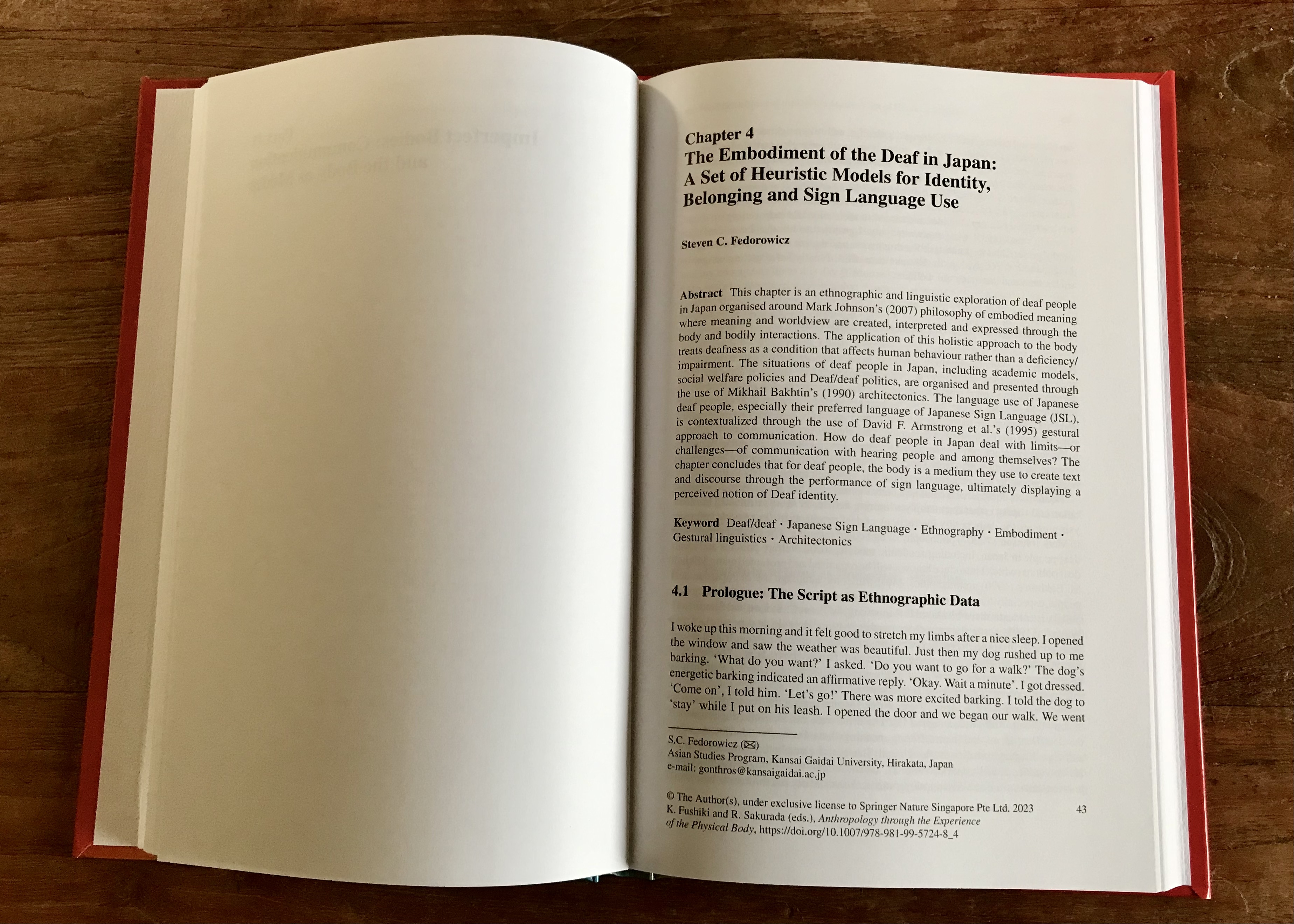
「Anthropology through the Experience of the Physical Body 」There's nothing like holding the real book for the first time...

Anthropology through the Experience of the Physical Body
Editors: Kaori Fushiki, Ryoko Sakurada
(2023)

Book information: https://link.springer.com/book/10.1007/978-981-99-5724-8

See also: http://visualanthropologyofjapan.blogspot.com/2023/12/new-book-announcement-long-time-in.html

Chapter 4, p. 42-60

The Embodiment of the Deaf in Japan: A Set of Heuristic Models for Identity, Belonging and Sign Language Use

Steven C. Fedorowicz


Abstract: This chapter is an ethnographic and linguistic exploration of deaf people in Japan organised around Mark Johnson’s (2007) philosophy of embodied meaning where meaning and worldview are created, interpreted and expressed through the body and bodily interactions. The application of this holistic approach to the body treats deafness as a condition that affects human behaviour rather than a deficiency/impairment. The situations of deaf people in Japan, including academic models, social welfare policies and Deaf/deaf politics, are organised and presented through the use of Mikhail Bakhtin’s (1990) architectonics. The language use of Japanese deaf people, especially their preferred language of Japanese Sign Language (JSL), is contextualized through the use of David F. Armstrong et al.’s (1995) gestural approach to communication. How do deaf people in Japan deal with limits—or challenges—of communication with hearing people and among themselves? The chapter concludes that for deaf people, the body is a medium they use to create text and discourse through the performance of sign language, ultimately displaying a perceived notion of Deaf identity.

Keywords: Deaf/deaf, Japanese Sign Language, Ethnography, Embodiment, Gestural linguistics, Architectonics

Monday, September 27, 2021

New Publication:「Barrier-Free Communication for the Deaf in Japan: A Local Initiative for Medical Interpretation Services in Japanese Sign Language」

Fedorowicz, S.C., “Barrier-Free Communication for the Deaf in Japan: A Local Initiative for Medical Interpretation Services in Japanese Sign Language.” Journal of Inquiry and Research, Volume 114. Kansai Gaidai University, (2021): 319-337.

Abstract: A new city hospital in Hirakata, Osaka opened in 2014. In 2011, a small group of deaf citizens requested a much-needed service at the new hospital: on-site, full-time medical interpretation in Japanese Sign Language (JSL). The group sought to strengthen their position by aligning themselves with foreign residents in the city. The Hirakata Initiative for Medical Interpretation Services for Deaf People and Foreign Residents set out “to change the city to be friendly to every citizen with a secured and comfortable life… [and] to ensure easy access for the hearing impaired and foreign residents to medical care.” Public forums were scheduled featuring doctors, professors, interpreters and other specialists to discuss the needs and future prospects of medical interpretation. Initially there were feelings of optimism that policies and services crafted locally would ultimately serve as a template for medical interpretation in other areas in Japan. Although the group disbanded before realizing their ultimate goals, their activities were still worthwhile and beneficial. By analyzing the achievements and failures of the initiative, important lessons can be learned for future deaf activism. This paper, through multimodal and autoethnographic techniques, explores how the pluralistic dynamic efforts of local grassroots organizations are often the most successful in improving cultural, linguistic and personal accessibility for deaf communities in Japan (Mori 2011).

Key words: Deaf / Japanese Sign Language / barrier-free / medical interpretation / ethnography

For more information: https://kansaigaidai.repo.nii.ac.jp/?action=pages_view_main&active_action=repository_view_main_item_detail&item_id=8036&item_no=1&page_id=13&block_id=21

Download pdf: https://kansaigaidai.repo.nii.ac.jp/?action=repository_uri&item_id=8036&file_id=19&file_no=1

Tuesday, April 7, 2020

New Publication: "Deaf Bodies: Toward a Holistic Ethnography of Deaf People in Japan"


Fedorowicz, S.C., “Deaf Bodies: Toward a Holistic Ethnography of Deaf People in Japan.” Journal of Inquiry and Research, Volume 111. Kansai Gaidai University, (2020): 269-286.

Abstract: This essay is an ethnographic exploration of deaf people in Japan, applying a holistic approach to the body. Deafness is considered as a condition that affects human behavior in terms of adaptation and coping rather than as simply a limiting deficiency/impairment. The bodily interactions of deaf people in their daily lives will be presented as the framework for this paper though Mark Johnson’s philosophy of embodied meaning (2007). The general situation of deaf people in Japan, including academic models, social welfare policies and Deaf/deaf politics, will be organized and presented through the use of Mikhail Bakhtin’s architectonics (1990). The language use of Japanese deaf people, especially their preferred language of Japanese Sign Language (JSL), will be contextualized through the use of Armstrong, Stokoe and Wilcox’s gestural approach to communication (1995). This research is a culmination of extensive long-term participant-observation, language study and data gathering through questionnaires, interviews and photography. How do deaf people in Japan deal with limits – or challenges – of communication with hearing people and among themselves? The paper concludes that for deaf people, the body is a media they use to create text and discourse through the performance of sign language, ultimately displaying a perceived notion of Deaf identity.

Key words: Deaf-deaf, Japanese Sign Language, Signed Japanese, holistic, ethnography

For more information: https://kansaigaidai.repo.nii.ac.jp/?action=pages_view_main&active_action=repository_view_main_item_detail&item_id=7946&item_no=1&page_id=15&block_id=22

Or download it for free as a pdf: https://kansaigaidai.repo.nii.ac.jp/?action=repository_uri&item_id=7946&file_id=19&file_no=1