Monday, August 16, 2021

「Food and Drink at a Japanese Standing Bar: An Appetizing Production」@ ICAS 12 - August 28, 2021 (and video on-demand)

I will be presenting at the 12th International Convention of Asian Scholars (ICAS), held August 24-28, 2021. The host is Kyoto Seika University but it will be a virtual event. The presentations have two parts. The first part is a pre-recorded 15-minute lecture available on-demand at the ICAS website (you must be registered for the conference to view the lectures). The second part is a live discussion session. While my paper has changed a bit since I submitted my proposal, here is the original abstract:

In Japan, food is prominent in documentaries, cooking shows, travel shows, variety shows, dramas, manga, anime, books, magazines, blogs, Facebook and Instagram. This food, not eaten but consumed, provides gratification and knowledge. Many of these media descriptions are set in izakaya (Japanese-style pub) and tachinomiya (Japanese standing bar) that serve B-kyu gurume (B-rank food)—comfort food and/or local food. These are fascinating shops and sites to explore the production (cooking) and consumption (eating) of food.

This presentation is a multimodal visual ethnography of a 40-year-old tachinomiya in Osaka called Tenbun. Tenbun features many kinds of food and drink, a lively and relaxed atmosphere and plenty of colorful characters including the owner, employees and regular customers. Based upon long-term patronage, focused participant-observation and photography, a photo exhibition and other post-fieldwork encounters, my analysis positions the research within the intersection of food anthropology and the popular Japanese “foodie” media. Matthew Longcore discusses how Anthony Bourdain, Gordon Ramsey and other Western food experts feature “ethnographic culinary adventures [that] bring food and film together for the enjoyment, entertainment, and enlightenment of foodies and anthropologists alike” (2019). Current popular TV series about food and drink including Yoshida Rui’s Sakaba hōrō-ki (“Bar Hopping Report,” BS-TBS) and Kodoku no Gurume (“The Solitary Gourmet,” TV Tokyo), and others, will be described and analyzed to show that media portrayals are another form of production, that of information and recreation, that is “good to think” (Levi-Strauss 1962), “communicated” (Barthes 1966; Dusselier 2009) and “shared among people” (Cheung 2002).
My video: available on demand before, during and after the conference until October 15.

My discussion session: Food, Taste and Memory
Saturday, August 28, 2021, 17:15-18:15 (Japan time).


Chair: Floper Gershwin Manuel, Assistant Professor, Central Luzon State University, Philippines

Food and Drink at a Japanese Standing Bar: An Appetizing Production
Presenter: Steven C. Fedorowicz – Kansai Gaidai University

White Rice vs. Dark Bread: Inheriting and Crafting Rural Identity, Local Heritage and Sustainable Future in China and Estonia
Presenter: Siyun Wu – Leiden University - Institute of Cultural Anthropology and Development Sociology

Farming Conditions of Draught Cattle in Western Japan During 19th Century
Presenter: Akiyo HERLEDANT-KUBO – INALCO

Conference information and a complete program schedule can be found at the ICAS website.

url: https://www.eventscribe.net/2021/ICAS12/

For more information about the Tenbun/tachinomiya project:

url: http://visualanthropologyofjapan.blogspot.com/2016/01/photo-exhibition-and-visual-ethnography.html

Even more on the project: https://visualanthropologyofjapan.blogspot.com/2020/12/behind-scenestenbun-closingpresentation.html

Friday, August 13, 2021

"When anthropological fieldwork is interrupted by a pandemic, what new opportunities arise from other avenues of inquiry?" (part 3) -and- "The Art of Conversation" / Tachinomiya for the common people

Matthew Demaio, in his recent article, Lenticular Research and the Possibilities of Digital Archival Methods, writes, "There is a mode of producing dual holographic images that give a viewer the impression of depth and movement called “lenticular printing.” To make lenticular images, you must first capture two images with a special lens and then print each on a sheet of plastic that has a series of lenses on the reverse..."

"I start with lenticular printing as a way to think about the possibilities and limits of anthropological research in contexts of instability and uncertainty. What does an anthropological inquiry look like when it is suddenly and unexpectedly bifurcated by a period of enforced distance and isolation?"

DeMaio, Matthew. 2021. “Lenticular Research and the Possibilities of Digital Archival Methods.” Anthropology News website, July 30, 2021.

url: https://www.anthropology-news.org/articles/lenticular-research-and-the-possibilities-of-digital-archival-methods/

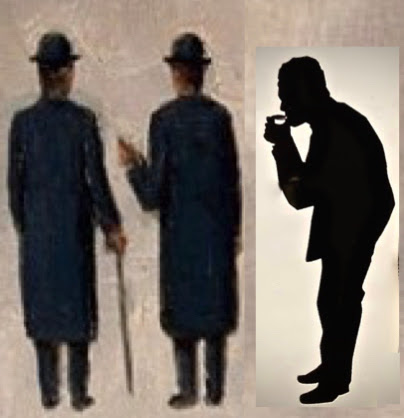
Those of us who are not so high tech might come up with stuff like this...

In the spirit of fair use and creative commons, I am borrowing the image on the left ("The Art of Conversation" - original title "L’Art de la Conversation" 1963 by Belgian surrealist artist René Magritte) from the following source:

url: https://www.facebook.com/JadedInJapan/posts/3737914866308621

The image on the right is the (flipped) logo for the sign at 立ち呑み 庶民 (Tachi nomi shomin), "Tachinomi for common people."

url: http://tachinomishomin.com/index.html

As seen on a recent post on 大阪立ち呑み研究会 (Osaka Tachinomi Study Group on Facebook).

This VAoJ post is related to the Tenbun/tachinomiya project.

url: http://visualanthropologyofjapan.blogspot.com/2016/01/photo-exhibition-and-visual-ethnography.html

More on the project: https://visualanthropologyofjapan.blogspot.com/2020/12/behind-scenestenbun-closingpresentation.html

Special preview: I will be presenting more about the Tenbun/tachinomiya project at the upcoming 12th International Convention of Asia Scholars, August 24-28. More details to follow...

Wednesday, August 11, 2021

"When anthropological fieldwork is interrupted by a pandemic, what new opportunities arise from other avenues of inquiry?" (part 2) -and- Tachinomiya and noren for the common people...

Matthew Demaio, in his recent article, Lenticular Research and the Possibilities of Digital Archival Methods, writes, "There is a mode of producing dual holographic images that give a viewer the impression of depth and movement called “lenticular printing.” To make lenticular images, you must first capture two images with a special lens and then print each on a sheet of plastic that has a series of lenses on the reverse..."

"I start with lenticular printing as a way to think about the possibilities and limits of anthropological research in contexts of instability and uncertainty. What does an anthropological inquiry look like when it is suddenly and unexpectedly bifurcated by a period of enforced distance and isolation?"

DeMaio, Matthew. 2021. “Lenticular Research and the Possibilities of Digital Archival Methods.” Anthropology News website, July 30, 2021.

url: https://www.anthropology-news.org/articles/lenticular-research-and-the-possibilities-of-digital-archival-methods/

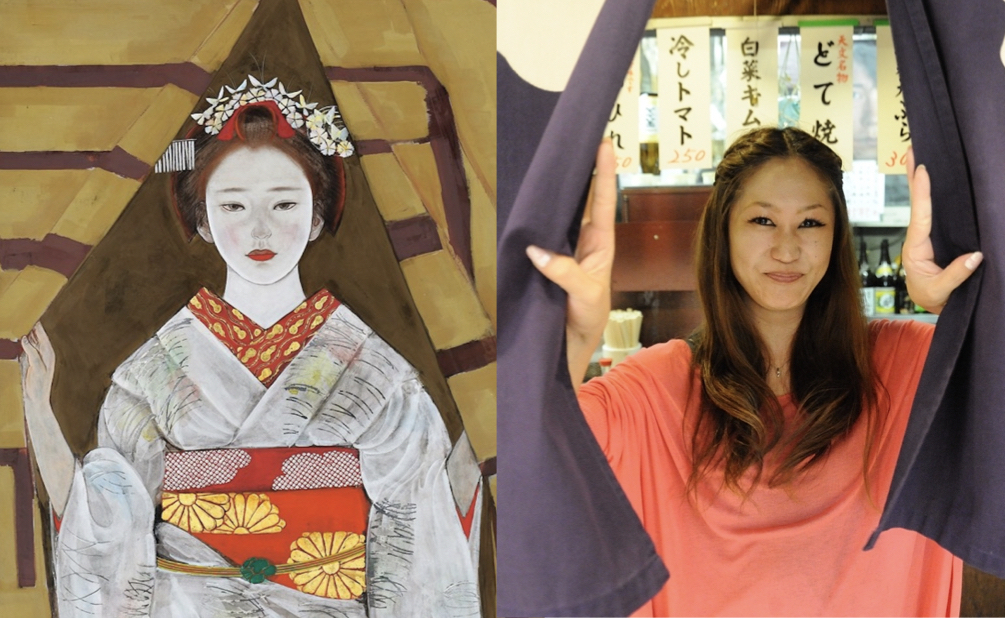
Those of us who are not so high tech might come up with stuff like this...

In the spirit of fair use and creative commons, I am borrowing the image on the right (Ishimoto Sho "Noren" Showa 45 [1970]) from the following source:

Sekisho Art Museum: 100th Anniversary Retrospective Exhibition Sho Ishimoto

url: http://www.sekisho-art-museum.jp/seitan100ishimoto?fbclid=IwAR0cfCMgukwkt3VDTPdGRewNalnxeejvf41FEiPx1Ui3HUba1uud81h0fFo

Flyer for the exhibition: http://www.sekisho-art-museum.jp/wp-content/uploads/2020/11/%E7%94%9F%E8%AA%95100%E5%B9%B4%E7%9F%B3%E6%9C%AC%E6%AD%A3%E4%BA%88%E5%91%8A%E3%83%81%E3%83%A9%E3%82%B7.pdf

The image on the left is the logo for the sign at 立ち呑み 庶民 (Tachi nomi shomin), "Tachinomi for common people."

url: http://tachinomishomin.com/index.html

As seen on a recent post on 大阪立ち呑み研究会 (Osaka Tachinomi Study Group on Facebook).

This VAoJ post is related to the Tenbun/tachinomiya project.

url: http://visualanthropologyofjapan.blogspot.com/2016/01/photo-exhibition-and-visual-ethnography.html

More on the project: https://visualanthropologyofjapan.blogspot.com/2020/12/behind-scenestenbun-closingpresentation.html
Special preview: I will be presenting more about the Tenbun/tachinomiya project at the upcoming 12th International Convention of Asia Scholars, August 24-28. More details to follow...

Tuesday, August 3, 2021

"When anthropological fieldwork is interrupted by a pandemic, what new opportunities arise from other avenues of inquiry?" (part 1) -and- Through the noren, then and now...

Matthew Demaio, in his recent article, Lenticular Research and the Possibilities of Digital Archival Methods, writes, "There is a mode of producing dual holographic images that give a viewer the impression of depth and movement called “lenticular printing.” To make lenticular images, you must first capture two images with a special lens and then print each on a sheet of plastic that has a series of lenses on the reverse..."

"I start with lenticular printing as a way to think about the possibilities and limits of anthropological research in contexts of instability and uncertainty. What does an anthropological inquiry look like when it is suddenly and unexpectedly bifurcated by a period of enforced distance and isolation?"

DeMaio, Matthew. 2021. “Lenticular Research and the Possibilities of Digital Archival Methods.” Anthropology News website, July 30, 2021.

url: https://www.anthropology-news.org/articles/lenticular-research-and-the-possibilities-of-digital-archival-methods/

Those of us who are not so high tech might come up with something like this...

In the spirit of fair use and creative commons, I am borrowing the image on the left (Ishimoto Sho "Noren" Showa 45 [1970]) from the following source:

Sekisho Art Museum: 100th Anniversary Retrospective Exhibition Sho Ishimoto

url: http://www.sekisho-art-museum.jp/seitan100ishimoto?fbclid=IwAR0cfCMgukwkt3VDTPdGRewNalnxeejvf41FEiPx1Ui3HUba1uud81h0fFo

Flyer for the exhibition: http://www.sekisho-art-museum.jp/wp-content/uploads/2020/11/%E7%94%9F%E8%AA%95100%E5%B9%B4%E7%9F%B3%E6%9C%AC%E6%AD%A3%E4%BA%88%E5%91%8A%E3%83%81%E3%83%A9%E3%82%B7.pdf

The image from the right (appearing for the first time online) is my own photograph from the Tenbun/tachinomiya project.

url: http://visualanthropologyofjapan.blogspot.com/2016/01/photo-exhibition-and-visual-ethnography.html

More on the project: https://visualanthropologyofjapan.blogspot.com/2020/12/behind-scenestenbun-closingpresentation.html

Special preview: I will be presenting more about the Tenbun/tachinomiya project at the upcoming 12th International Convention of Asia Scholars, August 24-28. More details to follow...

Tuesday, July 27, 2021

Felinization -or- "Sushi for Cats"


Source: JunsKitchen
URL: https://www.youtube.com/watch?v=zGcYabz3hYg&t=194s

I'm not sure how I missed this. But as I am immersed in social media in my latest research, I am coming across many interesting things. I hope this form of felinization (glocalization for cats) is not offensive to anyone. I am sure the cats and their owner are not racist nor are they trying to appropriate Japanese culture.

Wednesday, July 21, 2021

It's a pretty picture, but I still can't get a COVID vaccination in one of the world's richest countries...

Sunrise in Osaka 4:30 AM.

Spikes! 313 new COVID cases in Osaka yesterday. 1,397 new COVID cases in Tokyo yesterday. 79 reported COVID cases related to the Olympics before it even starts on Friday.

And my family and I are unable to get vaccinations. Maybe 20% of the population here has been fully vaccinated. Japan has not purchased enough Pfizer vaccinations to be distributed through local governments. My city cannot tell us when we can get vaccinated. Japan has not purchased enough Moderna vaccinations to be distributed through large companies and universities. My university cannot tell us when we can get vaccinated. (Japan has apparently secured Moderna to be available in 2022). But Japan purchased a lot of the AstraZeneca vaccine and now it is giving it to Indonesia, Malaysia, the Philippines and Thailand. Japan also seems to be waiting for their own domestic company's vaccine to be fast-tracked and available sometime this year... Despite being in a (quasi-) state of emergency and the Delta variant, my university is requiring faculty to teach hybrid/in-person classes; although there is a published safety procedure, I witness everyday how it is ignored.

This is our reality. Don't believe the token so-called foreign experts in Japan on CNN who claim Japanese people have a vaccine hesitancy. This is not true for most of us here (I do have informed and intelligent friends with personal situations who question the safety of vaccines and I respect their concerns.). This is not political or cultural; this is not the red & blue USA that offers beer, marijuana, money and guns as incentives to get the jabs. The Japanese government has strange priorities (don't get me started about the Olympic super-spreader, no alcohol and condoms meant not to be used in Japan...) and incompetent policies.

以上です。

Wednesday, June 30, 2021

"Disability activists push for more inclusive Pride celebrations"

Story by Zoe Christen Jones, June 30, 2021, (CBS News via msn)

Read the whole story: https://www.msn.com/en-us/news/us/disability-activists-push-for-more-inclusive-pride-celebrations/ar-AALAVxG?ocid=mailsignout&li=BBnb7Kz

Not Japan related, but it is an intersection between my recent projects dealing with disability and gastronomy. This is the part I like:
© Provided by CBS News Alexis Hillyard / Credit: Kevin Tuong

Alexis Hillyard, a YouTuber who was born without her left hand, said it's freeing when she's in a space where she and her disability are accepted.

"Accessibility means that people are able to move through and exist in spaces they deserve to be a part of without feeling like they need to change who they are, make themselves smaller and make sacrifices to be able to be in that space," the 39-year-old said. "It's like being able to be and exist in your full self, as you are, without having to change or adapt to the world around you."

On her cooking channel, StumpKitchen, Hillyard explains how her disability is an important tool she uses every day and an integral aspect of her life. She's also deliberate in making her videos as accessible to her viewers as possible.

"I didn't realize before how much I would subconsciously hide my arm or wonder if people were staring or wondering what they were thinking about me or feeling sorry for me," Hillyard said. "It was a beautiful surprise and just an awareness and release of tension you were feeling that you didn't realize that you had."


Monday, May 24, 2021

"Unsound: The Legacy of Alexander Graham Bell" (in ASL, English and English closed captions)


Description: American Sign Language interpretation of Unsound, a radio documentary from IDEAS exploring the legacy of Alexander Graham Bell and his role in a movement called oralism, and the harmful legacy that still reverberates today.

The great project of Alexander Graham Bell's life was not, perhaps surprisingly, the telephone.

His life's true passion, and the project he focused on his entire life and funded with his earnings from the telephone, was the 'education' of deaf people. He was part of a movement called oralism and believed all deaf people should learn to lipread and speak rather than use sign language.

But not all deaf people can learn to speak. Or believe they should. And the harm of oralism still reverberates today.


This is a great interpretation from a Deaf perspective. Watch in full screen and hit the CC button for captions.

Radio show source: https://www.cbc.ca/radio/ideas/unsound-the-legacy-of-alexander-graham-bell-1.6020596

Video source: https://www.cbc.ca/player/play/1894072899880

For English transcript: https://www.cbc.ca/radio/ideas/transcript-unsound-the-legacy-of-alexander-graham-bell-1.5998768