Showing posts with label photo project. Show all posts

Wednesday, June 26, 2019

The Neko Project

Photo borrowed from Neko Project/Yuko FUKAGAWA

Project synopsis (from the website):

IN THE OLD DAYS, A MAN WAS TAUGHT TO FORGET HIMSELF. TODAY IT IS QUITE DIFFERENT: HE IS TAUGHT NOT TO FORGET HIMSELF AND HE ACCORDINGLY SPENDS HIS DAYS AND NIGHTS IN ENDLESS SELF-REGARD. WHO CAN POSSIBLY KNOW PEACE IN SUCH AN ETERNALLY BURNING HELL? THE APPARENT REALITIES OF THIS AWFUL WORLD, EVEN THE BEAST LINES OF BEING, ARE ALL SYMPTOMS OF THAT SICKNESS FOR WHICH THE ONLY CURE LIES IN LEARNING TO FORGET THE SELF.

SOSEKI NATSUME, I AM A CAT

This anthology I am a cat of Soseki in the Japanese literature reveals the importance and the necessity to sometimes have cat’s point of view on our crazy world. Cats have been significant in Japanese culture from Hello Kitty to the maneki-neko, from A Cat, A Man, and Two Women written by Jun’ichiro Tanizaki to The cat returns from Ghibli Studio, from Chiro, Nobuyoshi Araki’s cat to Sasuke, Masahisa Fukase’s cat, cats are omnipresent. When visiting Japan, no one could ignore cats everywhere in the streets but also their representations in bars or restaurants next to the tanuki.

This project is to offer Japanese photographers a challenge within the framework of an open call: to propose a series of very personal photographs on the theme of cat but with their own language, their own style, their own techniques.

A jury (described in the pages of this site) will meet in May 2018 to select all the series that will be published in a book – Neko Project Book (The release will be scheduled for 2019) by the publisher iKi.

In addition, this Neko project will lead to various proposals: different types of exhibitions, conferences and workshops, throughout Europe to express the important place of Japanese photography in worldwide photography expression.


URL: http://neko-project.com/about/

You can still see some exhibitions: http://neko-project.com/partnership/

Thanks to LD for the heads-up on this project.

Monday, November 12, 2018

"The standing bars of Osaka: Cheap, cheerful and nostalgic" & The Beginning of a New Tachinomiya Project

Unbeknownst to the visual anthropologist, he is caught in the act 
of research. Photo by his significant other parked across the street.

One of my tachinomiya field sites is closing at the end of this month so I have been rushing to do some salvage ethnography, trying to record the unique shop before it closes. I have no concrete plans for the research data and photos at this time (a few ideas though) but the rush is on.

A recent article in The Japan Times by Matt Kaufman seems to confirm the relevance of tachinomiya to contemporary Japanese society and validate my research. Read on and continue to check out VAOJ for the results of the new project. 

"The standing bars of Osaka: Cheap, cheerful and nostalgic" in The Japan Times, 11/10/18:

Across Japan, tucked down quiet alleyways or occupying the corner shops at busy intersections, you’ll see tachinomiya. Often translated a “standing bar,” there are two very distinct types of tachinomiya: licensed restaurants and small, privately owned liquor shops (sakeya no tachinomi).

The origin of the latter tachinomi can be traced to the Edo Period (1603-1868), when sake shops started offering customers a quick tipple from square wooden measuring cups known as masu.

These shops evolved into modern liquor stores during the Meiji Era (1868-1912) when they started selling beer, wine and spirits such as whisky, and installed makeshift counters, often made by balancing a slab of wood on stacks of empty beer crates.

Different regions have their own names for these shops. In Tohoku they are called mokkiri and in eastern Japan they are known as tachikyū. But, in recent years kaku-uchi, the type of tachinomi that originated in Kitakyushu and spread to Tokyo during the industrial revolution, has become the catch-all term used to describe these shops.

Some are well over 100 years old: Matsugawa Saketen in Kyoto has been owned by the same family since the beginning of the Meiji Era; in Osaka, there is an old liquor shop named Shibacho that has been in the same spot for 152 years; and in Tokyo, you can drink at Suzuden, which dates back to 1853.

After World War II, thousands of unlicensed tachinomiya started appearing across the country. In 1949, the government reclassified tachinomiya as restaurants in order to collect taxes. Liquor shops with standing bars were not licensed to cook food on the premises, but canned food and snacks such as dried squid were permitted to be served.

Owners also found loopholes to get around the rules, especially in Osaka. Food is brought in from outside, and nowadays it is easily heated up in the microwave. Chairs are still prohibited, but mismatched stools are kept scattered about just in case an elderly customer with a “bad leg” needs to sit down for a minute.


The author goes on to provide brief snapshot descriptions of three famous local shops. Check out the whole story at the source.

Source: https://www.japantimes.co.jp/life/2018/11/10/food/standing-bars-osaka-cheap-cheerful-nostalgic/

Related VAOJ posts:

Photo Exhibition and Visual Ethnography - "Tachinomiya: There Are Two Sides to Every Noren"
https://visualanthropologyofjapan.blogspot.com/2016/01/photo-exhibition-and-visual-ethnography.html

AJJ Presentation - Tachinomiya: Photo Exhibition as Research Method
https://visualanthropologyofjapan.blogspot.com/2017/12/ajj-presentation-tachinomiya-photo.html

Shooting Culture in Japan Series
http://visualanthropologyofjapan.blogspot.com/2009/02/ethics-of-visual-anthropology-in-japan_12.html

Friday, October 12, 2018

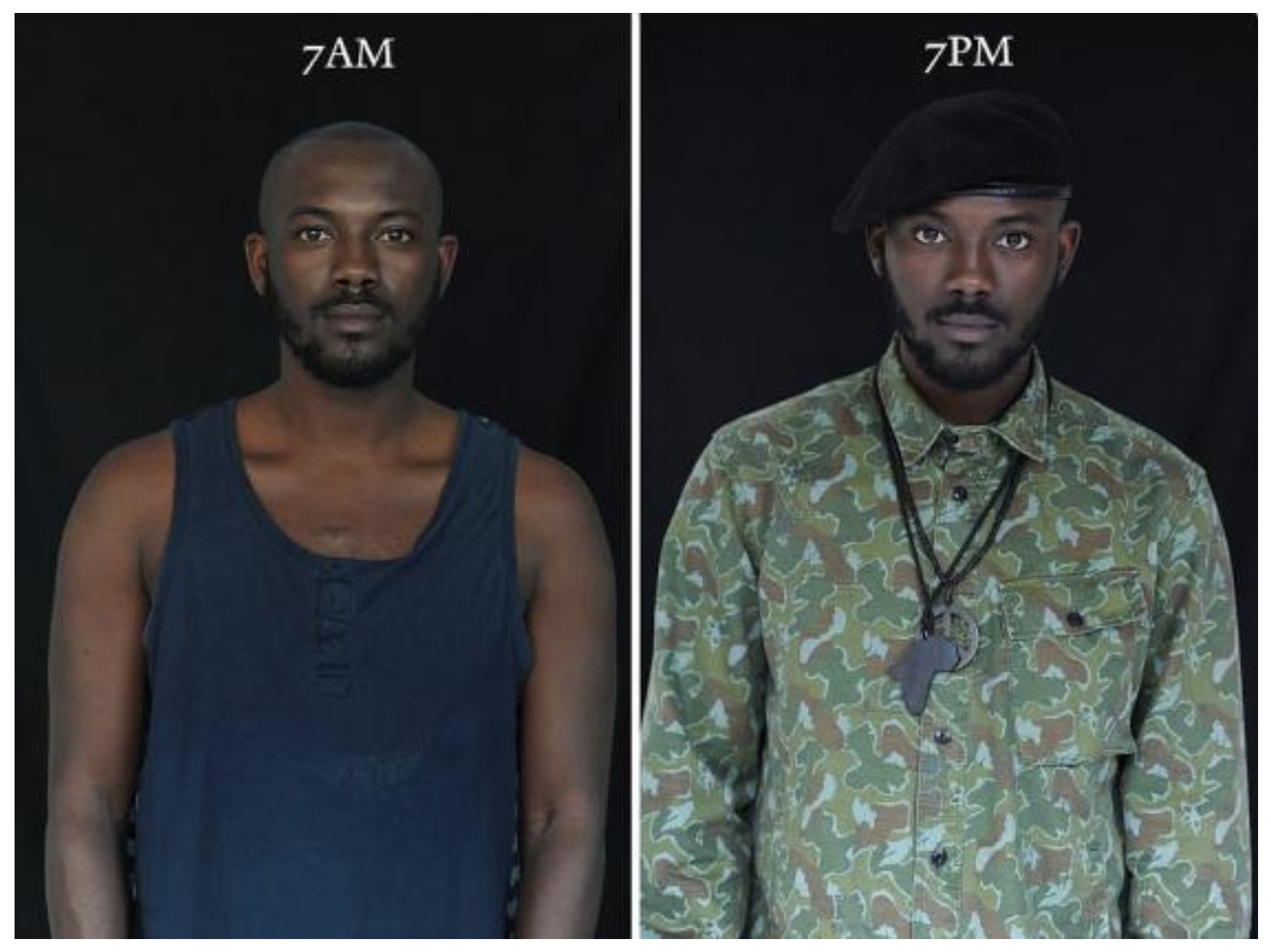
"A photographer took pictures of people at 7am and then again 7pm"


Text and images from Indy100.com (2016). Photos by Barbara Iweins.

Five years ago, Amsterdam-based street fashion photographer Barbara Iweins decided that she wanted to get to know the fascinating strangers she captured on camera.

So she did.

'Au Coin de ma Rue', or 'At the Corner of my Street', is a multi-year project exploring how Iweins' relationship with her subjects has changed as she got to know them better. Iweins told indy100:

"At first it was a selfish sociological experiment. I thought that meeting them a few times in my life would not change my perspective towards them. But very quickly, a feeling of trust and complicity started to grow. I realised that’s what happens when people are no longer anonymous people any more. We start caring for them."

The yearly portraits - with possessions, friends, and hugging Iweins herself - are intimate and lively.

Perhaps the most striking is year four, where Iweins photographed her subjects at 7am, when they'd just woken up, and 7pm.

Either they spent the night at Iweins', or she went around to wake them up:

"Entering their place as a burglar to wake them up was... quite an experience."

"The funny small thing I realised is that I thought I would have 20 minutes to shoot the expression of a person waking up but actually no, the uninhibited glaze in the eyes of a person disappears in five minutes... Behind my camera I could really see in a matter of seconds that the person was taking his face, his body back in control. The vulnerable human being was gone."


Check out all of the photos:

Source: https://www.indy100.com/article/a-photographer-took-pictures-of-people-at-7am-and-then-again-7pm--W1xzKbOgKwW

These photos remind me of the Wine Project: What happens after a busy and stressful day at work after drinking one, two and three glasses of wine? Here's a sampling from the Wine Project by Marcos Alberti.

https://visualanthropologyofjapan.blogspot.com/2016/12/the-wine-project.html