Showing posts with label homeless. Show all posts

Tuesday, March 28, 2017

"Writing with Light Photo Essays - A Collaboration between Cultural Anthropology and Visual Anthropology Review"

Today in my Documenting Japan class the students are starting their Two-Frame Photo Story Presentations. The assignment was inspired by my participation in a visual literacy workshop run by John Condon and Miguel Gandert at the Summer Institute for Intercultural Communication Workshop in 2009 and the film Life Through a Lens about photographer Annie Liebovitz. The experimentation of experience with photography combining image and text remains important and relevant. See announcement below:

Writing with Light is an initiative to bolster the place of the photo-essay—and, by extension, formal experimentation—within international anthropological scholarship. As a collaboration between two journals published by the American Anthropological Association (AAA), Cultural Anthropology and Visual Anthropology Review, Writing with Light is led by a curatorial collective that aims to address urgent and important concerns about the sustained prominence of multimodal scholarship. Anthropological projects based in video, installation, performance, etc. take as a given that multimodality changes what anthropologists can and should see as productive knowledge. Such projects compel anthropologists to begin rethinking our intellectual endeavors through an engagement with various media, addressing the particular affordances and insights that each new form of scholarship offers. How, for example, does photography produce different types of knowledge than text and/or film? What criteria might we need to interrogate and evaluate each of these forms of multimodal scholarship? As part of a broader set of questions about the relationship between forms of scholarly work and knowledge production, we explore the ongoing relevance of the photo-essay.

The Writing with Light collective focuses on the photo-essay in the belief that multimodal (or visual) forms are not a singular paradigm and that a consideration of a singular research form might help us to rethink a broader array of anthropological questions. How does the photo-essay configure our engagement through its unique form of mediation and composition? We believe that the photo-essay provides a critical opportunity for reevaluating the word–image relationship. Conventionally known for its narrative qualities, the photo-essay is especially useful in reconsidering the relationship between words and images in photographic storytelling, as well as efforts to generate innovative anthropological knowledge with the capacity to go beyond storytelling. For example, we are especially interested in the photo-essay’s potential to generate insights focused on issues of mediation and representation, as well as methodological questions with the potential to shift how anthropologists conceive of the discipline itself.

This initiative is unique in that it draws on Cultural Anthropology’s wider view of emerging trends in anthropology, while foregrounding the particular concerns of Visual Anthropology Review as far as theorizing and critiquing practice-based modes of ethnographic scholarship. By relaunching the existing Cultural Anthropology Photo Essays section as a collaboration with Visual Anthropology Review, the initiative aims to open new spaces for interaction between sections of the AAA and corners of the discipline. By merging the literary and epistemological critiques of an earlier generation with the formal and aesthetic critiques driving visual anthropology today, we draw on the etymology of the word photograph for inspiration: thus, writing with light.


For more information: https://culanth.org/photo_essays

I am cheating on my own two-frame story today by borrowing two photos from Japan Today both published today to examine and ponder current housing conditions in Japan.


Source: https://www.japantoday.com/category/picture-of-the-day/view/welcome-back


Source: https://www.japantoday.com/category/picture-of-the-day/view/its-home-for-some

I am not suggesting that these housing types are representative of Japan by any means. But it is mighty sad and one wonders about the priorities of the Japanese government as it increases its military budget and pledges aid for developing countries (aid = business opportunities). What about the people in Japan that need assistance? These are urgent and important concerns that need exploring...

Friday, August 28, 2015

"Photo exhibition focuses on faces, lives of Tokyo’s homeless"


Photo and text from The Japan Times, 8/27/15.

An ongoing photo exhibition in Tokyo illustrates a burning desire of people living on the streets: to simply build normal relationships with the rest of society.

The Tokyo Metropolitan Human Rights Promotion Center currently displays 42 photos of the homeless, taken by freelance photographer Hideaki Takamatsu, who began the project out of curiosity about how the homeless live.

Takamatsu started shooting photos of the homeless in 1994, when he attended a photography school after graduating from college with aspirations of becoming a photojournalist.

He said he was shocked to see a line of cardboard boxes where homeless people lived at the busy Shinjuku Station in Tokyo. “To my surprise, people with business suits walked on by without paying attention to the homeless.

“I tried to take their photos as part of a school assignment, but I realized they would never allow me to do so unless we reached a mutual understanding,” he said.

They wanted to know who he was and also wished him to know who they were before getting in front of his camera.

Since then, Takamatsu has met many people who live on the streets, eaten with them and photographed them. One such homeless person came close to committing suicide and another ran away several times from a hospital where he had been put under protection.

Of the photos on display, half are black-and-white images taken up to 2000. They depict the harsh living conditions of the homeless, with one photo showing a man rummaging through leftovers outside a restaurant.

Takamatsu said he accompanied the man to the restaurant several times before he took photos of him.

“While these photos reflect the general and conventional public image of the homeless, I tried later to use a different method to bring out their individuality,” Takamatsu said.

He had them strike various poses to make them aware that their photos would be seen by other people and to shoot color photos to attract more attention.

Hence, the other half of the photos on display are in color. He calls it a “collaborative work” between himself and the homeless.

Takamatsu said that some of the homeless people he photographs are paid to be vendors for Big Issue, a magazine established in 2003 in Japan to provide homeless people with work.

“As they stand on the same corner of a street regularly, they get acquainted with passers-by who also regularly walk the street,” Takamatsu said.

“One (homeless man) married one of his frequent customers, while others have become involved in counseling young people,” he added.

For the human rights promotion center, meanwhile, the homeless problem is a regional challenge. Takamatsu’s photos, it said, give the public a glimpse into the lives of people they otherwise seldom would have contact with.

The facility is located near the Sanya district, known as a source of manpower for civil engineering and construction projects where there was a lot of cheap accommodation during Japan’s postwar high economic growth period. Many day laborers there saw their jobs dry up following the burst of the “bubble economy” in the early 1990s, and they ended up homeless.

There have been recent reports of local young people harassing those living in parks or riverside areas.

“We expect the photo exhibition to make the public more aware of the homeless and promote social inclusion,” a center official said, referring also to a new type of homeless who spend their nights at Internet cafes or fast-food shops.

The Tokyo Metropolitan Government indicates the number of homeless in Tokyo’s 23 wards gradually declined to around 780 as of January since peaking at 5,800 in August 1999. But the entire picture remains unclear.

The admission-free exhibition is open from 9 a.m. to 5 p.m. and runs through Nov. 29. For further information, call the human rights promotion center at 03-3876-5372.


Source: http://www.japantimes.co.jp/news/2015/08/27/national/social-issues/photo-exhibition-focuses-faces-lives-tokyos-homeless/#.Vd7DLc5ZG2w

Related: "Yokohama Street Life: The Precarious Life of a Japanese Day Laborer" by (anthropologist) Tom Gill. @ The Asia-Pacific Journal, Vol. 13, Issue. 34, No. 2, August 24, 2015

URL: http://japanfocus.org/-Tom-Gill/4366/article.html

Wednesday, March 27, 2013

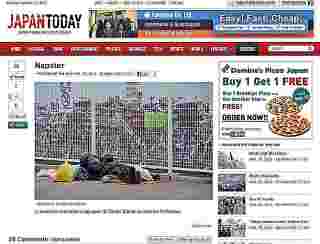
Picture of the Day: Homeless "Napster"

Image borrowed from Japan Today, 3/25/13. Image quality altered on purpose.

The caption for Japan Today's Picture of the Day (3/25/13) reads "A homeless man takes a nap near JR Omiya Station in Saitama Prefecture." But the purpose of the photo remains a mystery, especially in the context of it being displayed in a news resource. This is a photo I would advise my students not to take and certainly not to post on the internet with such a cutesy title... Unless the photographer actually interacted with the subject, confirmed he was indeed homeless and was indeed taking a nap and received informed permission for the photo to be used (with the subject being aware of his portrait rights and privacy). There is no indication of any such interaction. The problematic representation of the photo plays out in the discussion made up of Japan Today reader comments. I first saw the photo and comments the morning of the 25th. At that time there were 39 comments and some mentioning of others being deleted by the moderator. When I checked later in the evening the Picture of the Day had been changed and the comments had been reduced to 28. There was discussion and bickering about the nature of homelessness and what is appropriate action to help the homeless (and I suspect these type of comments were the ones deleted). Here is a sample of the comments I was most interested in dealing with the methods and ethics of shooting photos in public in Japan. (I reproduce these comments in case they might be deleted in the near or distant future.)

I don't understand why this picture, its title or this sight is trying to making a humorous comment about a homeless man sleeping on the street. Did the person snapping the picture think to ask him why he was there or how they could help?

I saw this many many times when working in Omiya. Never thought of taking his photo and uploading it to Japan Today.

I wouldn't take this photo. But if there is any good that comes of it then so be it.

How could any good possibly come of this? It's callous and tasteless and nothing else.

This seems very unprofessional and callous of a news organization to attach a humorous headline to a picture depicting the obvious plight of a fellow human being. I would expect this sort of content from 2 channel, not from JT.

A homeless person 'takes a nap' is rather making light of the real situation - and more accurately should read 'A homeless person is LIVING...'. Using the photo as part of a piece on homelessness would've been better. Simply using it as 'Picture of the Day' with a pun of a title and a quirky throw away comment is tasteless and quite unnecessary.

He looks pretty happy. not all homeless people are miserable, you know. also the photo is a clever juxtaposition of the relative poverty of this poor guy with the relative wealth of the society in which he lives (as shown by the bicycles behind him and the high qulity security fence). also, Omiya in Saitama is a brilliant place where I am suere this guy gets lots of sympathy and handouts and so on. So stop ripping on JT - plenty else to read into this picture.

Source: http://www.japantoday.com/category/picture-of-the-day/view/napster

It is not only Japan Today that runs these kinds of questionable photos - I have seen similar pictures in various photo blogs about Japan: those taken without consent and based upon assumptions and stereotypes rather than interaction and research. The common sense rule of thumb would be for the photographer to put herself in the place of the subject - would she want to be represented in such a way?

Read more about these issues in Japan: http://visualanthropologyofjapan.blogspot.jp/2009/02/ethics-of-visual-anthropology-in-japan_12.html

Thursday, August 21, 2008

"Tokyo through the Eyes of Shibuya Shantytown Residents"

(Please excuse the advertisements attached to the film...)


Filmmaker Bob Jaroc recently made this short film dealing with homeless people in Japan. Part of his rationale for the film:

My intentions for the piece were to stay clear of making a patronizing "cry/be angry for the homeless people" thing or a romanticized view of that life. I wanted to distill the experiences of the people who took the time to talk to me and question myself why I ended up going there in search of something to film.

Read more at Boing Boing.net.

Link to "Tokyo through the eyes of Shibuya shantytown residents" on Boing Boing TV
http://tv.boingboing.net/2008/07/30/tokyo-through-the-ey.html


How do you feel about the film? Does it really tell us anything about homeless people in Japan? Is this film visual anthropology? Is it art? If it is art, is it appropriate to use the homeless people in this way? Are food, cigarettes and alcohol adequate compensation? How would you go about making a film on this subject?