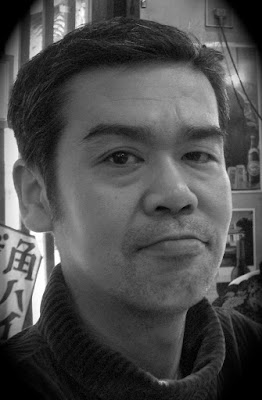
 1. F-san
I am starting a new project based upon taking portraits of a particular population I have been researching for some time now. With that in mind I recently had an opportunity to practice taking portraits as sort of a pre-project exercise. Here I give you the results, some explanation of the setting and finally ask for advice for my project.
 2. S-san
 I have been frequenting a certain
izakaya for the last several years and have become well-known by the owner, staff and regular customers. Many of these people have become good friends. Often times I take photos and I have actually posted
photos of this setting on VAOJ before. I am not sure how many of these people understand that I am a visual anthropologist, but they do understand I am a university professor and I have been accepted as a regular customer. This year the
izakaya scheduled a special
shinnenkai, or new year's party, offering participants food and all you drink for four hours for a mere 2000 yen.
 3. A-san
 When I made my reservation to attend I asked the owner if I could take photos and I was given permission to do so. Before and during the event I made it known to all that I was the official photographer. Everyone seemed happy to have their photographs taken. By the end of the event the owner was making sure I was getting photos of certain individuals. Only one person had an objection to being photographed and I honored her/his request. I also made sure that s/he did not appear in any public or posted photographs by accident. I am giving copies of photographs to the owner and making many of them available on my Flickr account to other customers and friends.
 4. B-san
I include getting permission in such detail because of my interest in the
ethics of photographing in the Japanese public and because of some recent blogs discussing photographing in public without prior permission and almost bragging about still shooting when asked not to. (I commented about this on one particular blog and warned about the strict/paranoid laws in Japan, but the author responded by deleting my comments.) I discuss ethics and legalities not to discourage students/people from taking photos in public but rather to encourage interaction. By simply asking permission one can start a dialogue and get more information about the context of the photo. Respecting the people one photographs is important as well.
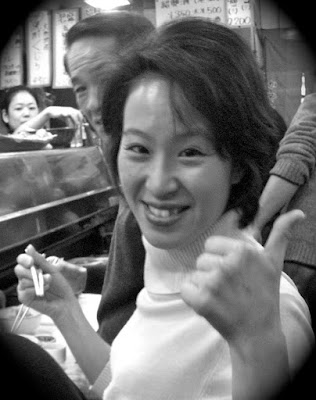 5. K-san
Anyway, I found myself in a very advantageous setting where people were allowing me to get in their face and take photos of them. Here are my results. I beg feedback and advice from VAOJ readers about theses portraits.
 6. O-san
 In particular I am interested in the following two questions:
1) What information would you like to have included with an individual's portrait? (For example, age, occupation, education, hobbies, etc.)
2) What information would you like to have included that would put these portraits in a Japanese context? I see this project as ethnographic in nature, so how can I make sure my audience(s) understand I am describing Japanese culture(s)?
 7. U-san
Advice on photographic technique is also solicited. Most of these portraits were close-up shots with very little cropping done after the photo was taken. I tweeked exposure and contrast a bit when needed (usually to compensate for poor lighting).
 8. M-san
Stylistically I choose to present the portraits in black and white. But some portraits seemed just as good or even better in color. What do you think? This is a major consideration for my upcoming project: black and white or color? Or both? How do I decide?
 8.1. M-san (color)
As I said before, very little cropping was done after taking the photograph. No cropping was done in the following shot. The blurring effect comes from the person making the infamous peace sign during the shot.
 9. G-san
Black and white or color?
 9.1. G-san (color)
The last shot I cropped a lot out in an attempt at artistic endeavor. Of course I want to focus on her face, but I also want to have my audience(s) wonder about what is being cropped out as well.
 10. T-san
Black and white or color?
 10.1 T-san (color)
For my project I want to focus on the face (I think) of the individual within Japanese cultural contexts. So once again I ask for your advice and feedback.
The
shinnenkai was a lot of fun as well as a chance for an academic exercise. This year has been important for the
izakaya because the master has begun to turn over the shop to his daughter and her husband. So stay tuned, there might be more posting on this
izakaya. In the meantime, if you are interested you can click
here to see more shots of the
shinnenkai.

 Partial image borrowed from Japan Press (you can see the whole image at http://www.japanpress.info/archives/994)


