Tuesday, April 22, 2014

"Digital eyes show your emotions for you"


Photo and text from Japan Today, 4/22/14.

Can’t be bothered to show anyone what you’re thinking? Then a Japanese scientist has the answer—a pair of digital eyes that can express delight and anger, or even feign boredom.

Building on a long line of slightly wacky and not-very-practical inventions for which Japan is famous, Hirotaka Osawa has unveiled the “AgencyGlass”.

“I wanted to build a system that is capable of carrying out social behaviors for humans,” he told AFP.

Just as robots can reduce the need for physical labor, the AgencyGlass—which looks like two small TV screens set in spectacle frames—aims to cut down its user’s emotional demands by carrying out their eye movements for them.

The two organic light-emitting diode (OLED) screens, which are connected to motion sensors and an external camera, show a pair of eyeballs that can appear to be making eye contact while the wearer is looking somewhere else entirely.

The wearer has to choose their emotion in advance—if they want to appear “attentive”, for example, they must switch it to this mode before putting the glasses on.

Osawa, of the prestigious Tsukuba University, said possible applications include for flight attendants dealing with irritating passengers, or teachers who want to project an image of kindness towards shy students.

“As the service sector grows and becomes more sophisticated, it becomes increasingly important that we behave by showing understanding to others,” he said. “That requires us to behave differently from our true feelings.”

Such “emotional labor” has caused some people to become deeply conflicted and develop emotional illnesses, Osawa said, adding that his technology could eventually help them.

The glasses weigh around 100 grams with the battery lasting roughly an hour, Osawa said, adding that the prototype cost just over 30,000 yen to make. They are currently not in production.


Source: http://www.japantoday.com/category/technology/view/digital-eyes-show-your-emotions-for-you-2

Friday, April 11, 2014

Friday Fun! "This [American] Sign Language Rap Battle Is Unlike Anything You've Ever Seen"

This is way too cool. Thanks to my colleague MH for sharing this with me. Check it out!


Again, very cool. But one might ask why was a stoned rapper asked to judge the interpreters? Where were the deaf people?

Source: http://www.huffingtonpost.com/2014/04/08/sign-language-rap-battle_n_5112402.html?utm_hp_ref=mostpopular

Monday, April 7, 2014

"Stores sharing biometric face data"


Image and text from The Japan News, 4/6/14.

Automatically recorded images by security cameras of shoppers’ faces have been shared among 115 supermarkets and convenience stores in the Tokyo metropolitan and another area as an antishoplifting measure, without customers’ knowledge, The Yomiuri Shimbun has learned.

Although the images are used mainly to prevent shoplifting, experts and industry bodies say it is necessary to make clear rules because providing people’s facial data to a third party could constitute an invasion of privacy.

The facial data in question was shared by 115 stores of 50 separate operators that have installed a shoplifting prevention system that a Nagoya-based software development company began marketing in October last year. The stores include major convenience stores operated by individuals under franchise contracts.

At these shops, security cameras film all customers’ faces. If a person shoplifts or makes an unreasonable complaint at one of the stores, security camera footage of the person is processed into facial data with the recognition system and classified into categories such as “shoplifter” and “complainer.”

They are then sent to the software firm’s server to be recorded. The facial images themselves cannot be browsed from other stores.

Once registered on the digital blacklist, however, a warning is issued to the staff of other stores—in a way only the staff can notice—when the face recognition system installed at these stores detects the blacklisted person visiting their stores.

At these stores, stickers are placed within the stores to inform customers that “face recognition security cameras are installed.” But customers are not informed that the stores are sharing the facial data.

Facial recognition—done through computer analysis of a person’s face—is a type of biometric recognition system used to confirm identity, age or sex, along with other specifics of individuals. Unlike fingerprints or iris recognition systems, it can collect information on individuals’ facial data when the subjects pass by security cameras. Facial recognition systems are known to identify a specific person with an accuracy rate of at least 99.9% and are used to identify terrorists at such places as airports.

Under the Personal Information Protection Law, facial images filmed by security cameras are considered personal information. The law allows such images to be filmed when they are used for crime prevention, but sharing the facial data could be a violation of the law that bans providing personal information to third party without the person’s consent.

Face data sharing could be a privacy invasion if the data is used for personal identification by relating it to his or her criminal records or buying history, for example.

Commenting on the facial data sharing, lawyer Yoichiro Itakura, an expert of personal information protection, said the data could be used in a way disadvantageous to customers as “stores can arbitrarily register specific shoppers as suspicious people, and they may then suffer unjust treatment at stores they have never visited before.”

Itakura also pointed out, “Even when someone is erroneously registered [as a suspicious person], he or she won’t be given an opportunity to complain about the mistake.”

An official of the Nagoya software development firm said: “The system has no problems. We just responded to the needs of the stores, which is their need to prevent shoplifting.”


Source: http://the-japan-news.com/news/article/0001187654

Sunday, April 6, 2014

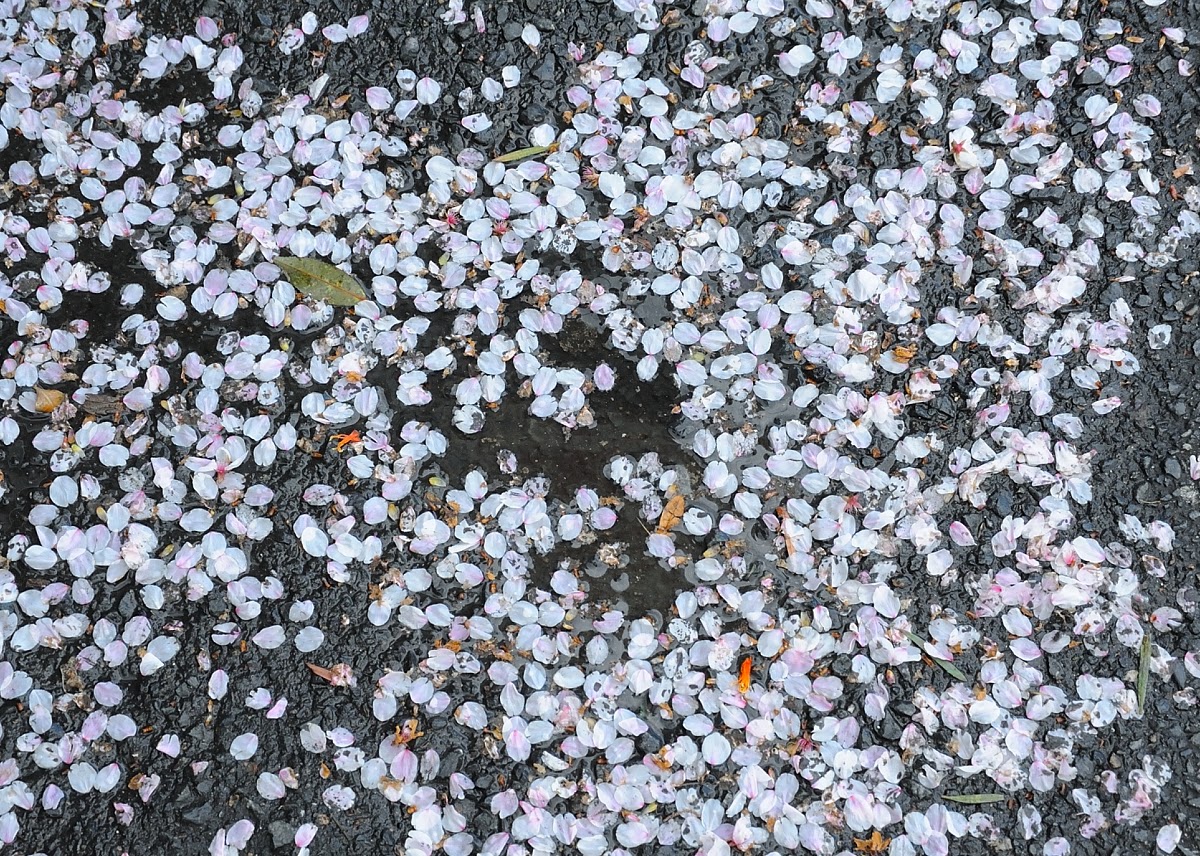
Sakura II: The Fallen Petals


It all ends too soon; delicate cherry blossoms are swept away by wind, rain, flowing currents and neighborhood women with their brooms...


Saturday, April 5, 2014

Sakura I: Between Work and the Wind & Rain, This Year's Shots...


The timing of the cherry blossoms (full bloom during the weekdays) along with the chilly/windy/rainy weather made it difficult to go out and enjoy ohanami. Luckily I am blessed with many cherry trees behind my house so I can simply open the window and enjoy. I left early for work one day so as to get some sakura shots as is custom here at VAOJ. Happy Spring!


See previous sakura-related posts on VAOJ:
Spring 2010
Spring 2011
Spring 2012 pt.1
Spring 2012 pt.2
Spring 2012 pt.3
Spring 2013 pt. 1
Spring 2013 pt. 2
Spring 2013 pt. 3

Tuesday, March 25, 2014

Update: Visual Documentary Project 2013: Plural Co-existence in Southeast Asia


Announcement from H-ASIA:

On 11 March 2014, the Center for Southeast Asian Studies (CSEAS),hosted the second visual documentary project forum. This project aims to offer a platform to young Southeast Asian documentary film makers who are producing films/documentaries in the region. This year's theme was plural co-existence in Southeast Asia and we received very strong submissions. Five were chosen to be shown in Kyoto, Japan and all directors traveled from Thailand, Cambodia, Vietnam, and the Philippines to participate in the event. The documentaries are freely available to watch online and can be accessed below.

Link: http://sea-sh.cseas.kyoto-u.ac.jp/en/visual-documentary-project2013/

Sunday, March 16, 2014

Just say no... in Japan.


Image borrowed from Japan Today, 3/15/14. Caption reads: What do you think of this ad by the Osaka Pharmaceutical Associations warning people to be aware of the danger of marijuana. It features Monster Engine, a comedy duo from Osaka, and says Dame Zettai or Absolutely No.

The bottom text includes the kanji characters for cannabis (大麻 or taima) and marijuana written in katakana (マリファナ or marifana). The text on the right side of the image can be translated as "the wrath of the gods." Monster Engine seems to have skits where they portray the play of the gods. Here is a YouTube clip to get an idea of who these guys are: http://www.youtube.com/watch?v=qJODLiCIvS8

I'm not sure whoever made this poster was thinking. Japan and the Osaka Pharmaceutical Associations need to reassess their ideas about marijuana, especially when countries, states and communities have lax laws or even support medical and/or recreational uses of it. An acquaintance of mine recently went to consult his English speaking Japanese doctor about stress related illnesses both mental and physical. The doctor prescribed handfuls of pills without explaining possible side effects. My acquaintance did some simple research on the internet and found many negative side effects of the stress relieving prescriptions, including addiction, depression and sexual dysfunction that would not go away for two years after the use of the drugs. At their next meeting my acquaintance asked the doctor about medical marijuana in Japan. The doctor just laughed... "Oh! Not in Japan!"

I recently had a cold and went to the doctor and requested a prescription for a strong cough syrup. He seemed confused. Both my Japanese interpreter and I extensively explained what I wanted and he seemed to understand. When I took the prescription to the drug store I was handed four different sets of pills and no cough syrup. The doctor didn't seem to understand in the end, or perhaps he thought he knew best and simply prescribed drugs made by company members of the Osaka Pharmaceutical Associations.

It would be nice if individuals had the opportunity, choice and respect to collaborate in their own health... And not be subject to such blatantly biased (and misinformed) propaganda. (Sorry for the rant. Being sick sucks no matter where you are...)

Source: http://www.japantoday.com/category/picture-of-the-day/view/crock-pot

Saturday, March 15, 2014

"Teens sharing photos of themselves 'praying' for victims of Tohoku disaster cause stir"


Image and text borrowed from Japan Today, 3/14/14.

Last Tuesday marked the third anniversary of the 2011 Tohoku disaster, a day on which tens of thousands of people lost their lives and many more were displaced, never able to return to their homes. At 2:46 p.m., the exact moment the quake struck three years ago, people across the country stopped to take part in nationwide moment of silence.

Teens across the land also took a moment to pay their respects that day, although the actions of a few were perhaps a little misguided. Soon after the moment of silence, photos emerged online showing kids “praying” inside “purikura” sticker photo booths, which were quickly shared and “favorited”.

Internet commenters reacted angrily to the images, calling them disrespectful and deploring how the smartphone generation feels the need to broadcast almost everything they do.

Although some people, busy as they were, went about their day oblivious to the fact that the moment of silence was being held, the vast majority stopped what they were doing and took a few seconds to reflect. Even on the streets of Tokyo, hundreds of people came to a sudden halt as memorial services were broadcast on big screens.

Not long afterwards, a number of photos appeared online showing teens supposedly praying and showing their respects for the dead. Many included messages such as “in memory of those who lost their lives on March 11, 2011,” and seemed quite genuine. Others less so.

Naturally, the online community was both surprised and angered to see such photos, which were mostly taken in “purikura” photo booths, which require manual operation and for the participants to strike a suitable pose while the machine takes their photo. They’re also almost always located within noisy video arcades, begging the question of whether these kids were really taking their reflection seriously.

Despite being daubed with the kanji characters for silent prayer (黙祷), few netizens believed that these shared displays of respect for the dead were genuine, and found the very idea of taking photos of oneself during a time like this, not least then sharing them online, in very poor taste.

“What on earth are these people doing sharing photos on Twitter of themselves praying? What on earth is wrong with Japan?” wrote one of the many angry Twitter users in response to the photos, adding that surely the money spent on taking the photo would have been better given to a relief fund to help those affected by the disaster.

The majority of the comments made online, however, were far blunter:

“Man, this pisses me off.”
“Idiots.”
“These kids have zero morals.”
“Are they even praying properly?”
“Purikura is anything but silent prayer.”
“Silent prayer isn’t some event you know!”

In fairness, we’re sure that at least some of the kids who took photos like these genuinely meant well and that their hearts were in the right place. They’re young and, what with growing up in the age of smartphones and selfies, by sharing their photos in this way they may have felt that they were showing their respects appropriately. Rather, it is down to their teachers, parents and even older siblings to tell them that while social media can be a wonderful tool for spreading a message, there are times when we should put down our phones and appreciate the gravity of the situation, and certainly not just for show.

Stepping into a purikura booth to document your prayers for the dead is most definitely not a good idea. But then again, sharing photos of yourself supposedly passionately kissing your boy/girlfriend, or taking time out from “having an amazing time with the best friends ever” to Tweet or update your Facebook status with is perhaps just as idiotic, so maybe we’re not really setting the best example?


Source: http://www.japantoday.com/category/national/view/teens-sharing-photos-of-themselves-praying-for-victims-of-tohoku-disaster-cause-stir