The Japan Anthropology Workshop (JAWS) and the Anthropology of Japan in Japan (AJJ) joint conference will be held in Kobe from April 4th (Friday) to April 6th (Sunday), 2025. The conference will take place in person, focusing on the theme: Ritual Practices and Daily Rituals in Japanese Society.
Venue: University of Hyogo, Kobe Campus for Commerce, Kobe, Japan
Ritual Practices and Daily Rituals in Japanese Society
The 21st century began as one of the most prosperous periods in human history, only to be profoundly affected by a pandemic and multiple wars, which have had a deep impact on society as a whole. As anthropologists, our role is to document, interpret, and possibly offer solutions for a better future. A significant part of understanding human behavior is the analysis of ritual and ritual practices.
In this edition of the JAWS/AJJ Conference, we aim to explore the role of ritual practices in Japanese society from various perspectives. Rituals can be sacred or social, serving as a form of cultural communication that transmits the cognitive categories and dispositions that shape people’s perceptions of reality (Bell 2009). By analyzing the underlying mechanisms of rituals, we can gain a deeper understanding of human society, as well as the universal and culturally specific aspects that define our communities.
As Joy Hendry suggests, “In many anthropological studies, ritual and religion are closely related, although in complex societies, there is often no particular connection between them, and the term ‘ritual’ may also refer to behavior, like etiquette, that is determined by society and where individuals have little choice in its execution.”
Rituals have always been a key focus for anthropologists, both globally and in Japan. While rituals are not difficult to identify, they are open to numerous interpretations and approaches, drawing interest from social psychologists, folklorists, scholars of religion, communication, the performing arts, and more. We do not seek to impose a specific definition of ritual, as this could be contentious. Instead, we encourage participants to focus on the concept of change. How would you define ‘ritual’ in your research? How has it evolved? This is the central debate we wish to foster, with the goal of deepening our understanding of modern Japan and inspiring broader discussions within world anthropology.
Schedule:
Of special note to visual anthropologist is Session 14 on Saturday, April 5, 15:40-17:10.
Panel: Reflecting and Revisiting「Teaching Japan」
Chair and Organizer: Steven C. Fedorowicz, Professor, Kansai Gaidai University
Discussants: Ioannis Gaitanidis (Associate Professor, Chiba University) and Greg Poole (Professor, Doshisha University)
Panel Abstract:
Teaching Japan: A Handbook (Gaitanidis and Poole 2024) was launched and introduced at the Anthropology of Japan in Japan 2023 Annual Meeting. In their opening chapter, co-editors Gaitanidis and Poole discussed the logic behind the book, “…despite the rich history of critical discussion around ‘researching Japan,’ there is not yet a comprehensive guide for taking these scholarly debates into the undergraduate, and (often) non-Japanese Studies, classroom. This then was the impetus for this forthcoming interdisciplinary collection of pedagogical case studies…” The book launch was a year and a half ago, and the book chapters were written long before that. This panel strives to continue the discussion that Teaching Japan began through a revisit of our chapters, to rethink, reflect, self-criticize and/or build upon our original ideas. In his presentation, McMorran asks critical questions about ethnographies in/about Japan to further explore the validity and value of collaborative ethnographic research beyond the borders of Japan. Fassbender rethinks teaching methods and approaches to counteract the influence of social media that limits students in their understanding of complicated and multifaceted issues surrounding gender and reproductive politics. McGuire reassesses teaching methods and approaches to explore the complexities of social inequality through intersectionality and reflects on the inclusion of literature that looks beyond Japanese society. Fedorowicz revisits the potential for a more active student learning environment and further course development amidst the current multimodal turn in and outside the classroom to make a new version of his course. Discussion and feedback are especially encouraged.
Paper 1: Japan All Around: Teaching about Japanese Society in Singapore
Chris McMorran, Associate Professor, National University of Singapore
In my chapter in Teaching Japan: A Handbook, I discussed disciplinary shifts in anthropology toward studies that are multi-sited and unbounded by national borders. Despite admitting the importance of such geographically promiscuous research, however, I shared my rather conservative approach to teaching about Japan through ethnography, specifically ethnographies based in Japan. I concluded my chapter by asking about the risks and potential rewards of using ethnography to move beyond a Japan-centered understanding of Japanese society. In this presentation, I introduce an ongoing pedagogical effort to answer this question. I outline a course I teach in Singapore that includes students in qualitative research among Japanese citizens residing in the small city-state. Despite its dry title, “Japanese Political Economy” approaches the subject from a distinctly human angle, by focusing on the ways Japan’s political economy has impacted the work lives and family lives of Japanese citizens residing in Singapore. In my presentation, I share the course aims, the research assignment, and the insights gained from several years of teaching the course. What have students learned about Japan and Japanese society by examining the work lives and family lives of those who reside outside its borders? Finally, despite their physical distance from Japan, how can students be inspired by anthropology to see, and investigate, Japan all around them?
Paper 2: How to Unlearn Reproductive Politics in the Classroom
Isabel Fassbender, Assistant Professor, Kansai Gaidai University
Building on my chapter, Teaching Gender and the Politics of Reproduction in Japan: Self-Government as a Theoretical Reference Point, recent experiences and observations in a course offered to mostly one-semester foreign exchange students inform this presentation about challenges and opportunities in teaching reproductive politics in university. It discusses classroom strategies to create a space to learn about reproductive politics in Japan and at the same time consider biomedical ethical questions detached from social ideologies or political partisanship for students that come from a background where these issues are often highly politicized. Contents of the course focus on historical circumstances and contemporary debates surrounding population control and reproduction in Japan (including pregnancy, birth, reproductive technologies, and contraception). However, as a matter of course, ideological and political frameworks that shape current debates in Western contexts often circumscribe the scope within which students access legal and ethical questions surrounding these issues. Not rarely in today’s media landscape, opinions are significantly conditioned through social media channels, which can be simplified and/or biased. It is thus crucial to provide students with opportunities to unlearn or question their preconceptions along with factual knowledge. Teaching methods that emphasize particular historical, socio-political, and cultural circumstances in Japan, as well as presenting diverse viewpoints and theories beyond neoliberal and capitalist approaches that automatically equate developments in science and technology with moral and ethical progress, have proven to be effective in broadening the scope of possible class debates in the context of reproductive politics.
Paper 3: How (un)equal is Japanese Society: Thinking with Intersectionality in the Classroom
Jennifer M. McGuire, Associate Professor, Doshisha University
Understanding inequality in Japan requires moving beyond single-axis frameworks. To fully grasp the causes and consequences of social inequalities, we need tools that delve into the complexity of oppression and power. In this presentation, I discuss how I use intersectionality as a provisional concept and analytical tool in an advanced level course in an English-taught program at a Japanese university. I argue that despite significant obstacles to its use in a university course, including a relative lack of English-language sources about Japan, it is crucial to view and interpret Japanese society through an intersectional lens to challenge assumptions and develop a more nuanced understanding of social inequalities. I analyze data collected in the classroom, particularly class discussions and students’ written responses, focusing on how gender intersects with class and disability to produce inequalities and discrimination. Additionally, I examine the need for heightened sensitivity and awareness when teaching in a multidisciplinary, multilingual setting where students’ positionalities and subjectivities can result in particularly complex relationships to Japan. While I argue that intersectionality helps us move beyond stereotypical and superficial understandings of marginalized social groups, I also reflect on the significant challenges of applying a framework that originated in Black feminism in the United States to a society with a vastly different sociopolitical and historical context.
Paper 4: The Visual Anthropology of Japan: In and Outside the Classroom, Revisited
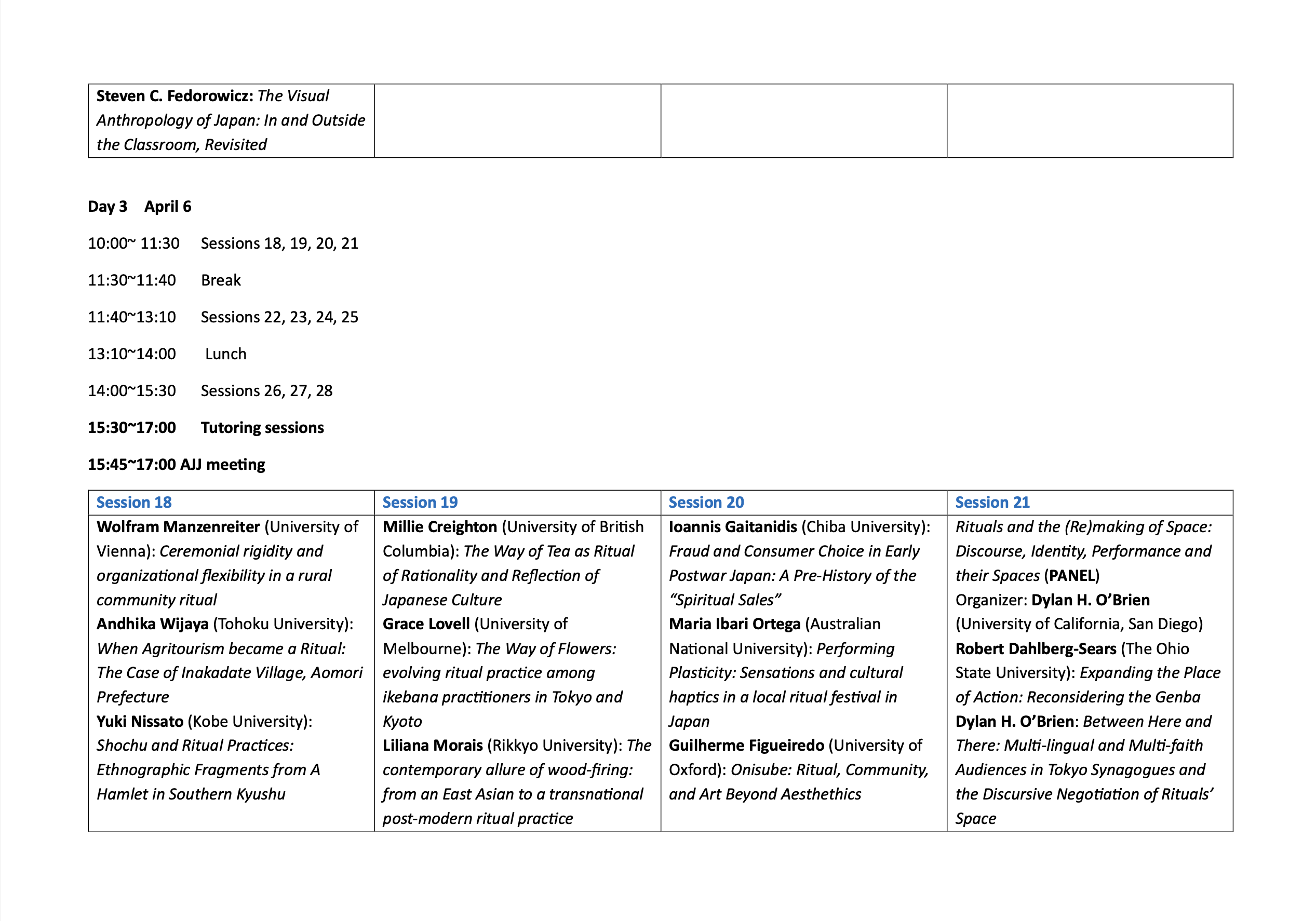
Steven C. Fedorowicz, Professor, Kansai Gaidai University
My chapter describes teaching a class comprised of international exchange students from many different countries alongside local students preparing for their study-abroad programs called “Visual Anthropology of Japan” at a Japanese university from 2006 to 2014. Topically, the course was about the presentation and representation of culture through film, photography, and other visual communication arts within the shifting anthropological ecologies of media, methods, and theory. Teaching “Japan” in this context required several balances of instruction and guidance for students of different academic levels, backgrounds, language skills and expectations studying together in the same class. Because of my training and background in cultural anthropology and visual anthropology, I do not consider my text as a theoretical treatise on pedagogy per se. Rather it is closer to an ethnographic—sometimes autoethnographic—account based on the fieldwork of teaching this course under certain conditions at a global educational setting. In my presentation, I will revisit this setting through the reflexive lens of ba (Kajimaru, Coker and Kazuma 2021), specifically, the convergence of players, place and performance during the period of the multimodal turn in visual anthropology that coincided with the class. This reminiscent revisit reaffirms the potential and possibility for a more active student learning environment and further course development to make a new and improved version of the course.
Explorations and experiments in visual representations - multimodality, sensory ethnography, reflexivity, autoethnographic vignettes, ethnographic photography and ba...
Showing posts with label AJJ. Show all posts
Thursday, February 27, 2025
Saturday, November 27, 2021
「Food and Drink at a Japanese Standing Bar: An Appetizing Production – Extended Media Mix」@ AJJ (Anthropology of Japan in Japan) 2021 Annual Meeting, Dec. 4
Abstract:
AJJ takes place December 3-5. Participation is free, but you must register to get the Zoom link. Lots of good people and scholarship at the AJJ! Check it out!
For the link and full meeting program, go to https://www.ajj-online.net/2021/11/10/2021-annual-meeting-program/
In Japan, food is prominent in documentaries, cooking shows, travel shows, variety shows, dramas, manga, anime, books, magazines, blogs, Facebook and Instagram. This food, not eaten but consumed, provides gratification and knowledge. Many of these media descriptions are set in izakaya (Japanese-style pubs) and tachinomiya (Japanese standing bars) that serve B-kyu gurume (B-rank food)—comfort food and/or local food. These are fascinating shops and sites to explore the production (cooking) and consumption (eating) of food. Media portrayals are another form of production, that of information and recreation, that is “good to think” (Levi-Strauss 1962), “communicated” (Barthes 1966; Dusselier 2009) and “shared among people” (Cheung 2002).
This presentation is a multimodal visual ethnography of a 40-year-old tachinomiya in Osaka called Tenbun. Tenbun features many kinds of food and drink, a lively and relaxed atmosphere and plenty of colorful characters including the owner, employees and regular customers. Based upon long-term patronage, focused participant-observation and photography, a photo exhibition and other post-fieldwork encounters, my analysis positions the research within the intersection of food anthropology and the popular Japanese “foodie” media. Matthew Longcore discusses how Anthony Bourdain, Gordon Ramsey and other Western food experts feature “ethnographic culinary adventures [that] bring food and film together for the enjoyment, entertainment, and enlightenment of foodies and anthropologists alike” (2019). Nancy Stalker provides an excellent and detailed history of popular Japanese media that influences and reflects the so-called modern “gurume boom” beginning in the 1980s and 90s (2016). I build upon this history through explorations of current documentaries, TV dramas and social media, gaining different perspectives to re-position my tachinomiya research in wider social and academic contexts.
Virtual talk on Zoom.
Saturday, December 4, 2021
Special presentation: 1:00 - 2:00 PM Japan time
AJJ takes place December 3-5. Participation is free, but you must register to get the Zoom link. Lots of good people and scholarship at the AJJ! Check it out!
For the link and full meeting program, go to https://www.ajj-online.net/2021/11/10/2021-annual-meeting-program/
Wednesday, December 9, 2020
Behind the Scenes:「Tenbun Closing」Presentation @ Anthropology of Japan in Japan Annual Meeting 2020
A Multimodal Special Bonus
Here's some more information about this post-fieldwork event: behind the scenes secrets, out-takes, bonus photos and dissemination of data.
I. The Performance
I have received some good feedback after the presentation. One colleague wrote, "I enjoyed also the performative moment when you drank "sake"—not sure whether everyone noticed."
Oh that was real sake I tell you. Gonzo Anthropology. I bought a small bottle just for the session. Tasty. I also hung the piece of the noren I received after Tenbun closed behind me but it didn't look so great in the background onscreen. So I used a virtual picture instead. But soon the room smelled like grease and tobacco as the noren hadn't been washed in well over a year. So with those smells, the grease remaining on my fingers and the taste of the sake, it was real sensory ethnography during this post-fieldwork event...
There were also comments about the emotion of the presentation. I am really glad that people felt it. I have presented "The End" segment a few times at conferences and classes and I always get choked up.
II. Cut For Time - Methodology
I usually went to Tenbun without much stuff, just my trusty Nikon D700 and its 24-120 VR lens kit. When I wasn't shooting I left it on the bar. I wanted people to get used to me and the camera. The first night of the final week I brought only my camera but the battery died very quickly. So I had to use my back-up: the camera on my iPhone 7 plus. The next night I decided I needed to be better prepared, so I brought a big bag full of equipment (pictured above). Luckily there was room in my bag for the big bottle of sake and glasses Tencho gave me.
The morning of the last night I tried to replace the SD card in my Nikon. But some of the small pins in the narrow slot were bent and I couldn't fix it. So for the final night I used my new(er) Panosonic Lumix G9 Pro. I am still not so used to using it but it is very light due to being mirrorless and got the job done. Still, I am sad at the passing of my D700...
III. Cut For Time - COVID-19 and Social Distance Concerns
Tenbun's last week was after my university suspended face-to-face classes and went remote but before the Japanese government called for the country-wide state of emergency. You can see from the photos and video that there were few masks at Tenbun and no social distancing. People were shaking hands, putting their arms around one another, hugging... On the last night I was at the crowded bar standing next to a regular customer of over 20 years who is a medical doctor. I commented to him that we were probbaly being very stupid and careless. He agreed, but then said that no matter what, he had to be there. "If I get sick and die, so be it. I have to be here now." He explained when he graduated from medical school he had trouble finding a job and was very depressed. The only support he got was from going to Tenbun and Tencho. He said he would always be grateful to Tencho and referred to him as his onjin (roughly translated, benefactor). I haven't heard this term for a long time. I wonder if people still use the term.
IV. Project Links - General
Click on the links below for more on the Tachinomiya Project.
Photo Exhibition and Visual Ethnography - "Tachinomiya: There Are Two Sides to Every Noren"
"Tachinomiya" Photo Exhibition and Visual Ethnography: The First Week
"Tachinomiya" - A Successful and Memorable Photo Exhibition/Event/Research Method
Happy Tachinomiya Halloween - and - (Pre-)Announcement: AJJ Presentation in December: "Tachinomiya: Photo Exhibition as Research Method"
AJJ Presentation - Tachinomiya: Photo Exhibition as Research Method
ANNOUNCEMENT:「Tachinomiya: Photo Exhibition as Post-Fieldwork Encounter」- Society for East Asian Anthropology Regional Conference 2019 in Tokyo
Tenbun Closing 「天文のれんを下ろす」Paper/Presentation at 2020 AJJ Annual Meeting
V. Project Links -「Tenbun Closing」
Click on the links below for more on 「Tenbun Closing」.
Sad News for VAOJ and Many Others: Tenbun Closing - Leading to a Week of Intensive Photography and Salvage Ethnography
「Tenbun Closing」- Leading to a Week of Intensive Photography and Salvage Ethnography pt.2 - posing for pictures, sharing drinks with the staff, farewell handshakes and hugs, reminiscing with old photos and having your favorite sake for the last time...
「Tenbun Closing」- Leading to a Week of Intensive Photography and Salvage Ethnography pt.3 - "...and how do you feel about Tenbun closing, Tani-san?"
「Tenbun Closing」- Leading to a Week of Intensive Photography and Salvage Ethnography pt.4 - What's in my bag?
「Tenbun Closing」- Leading to a Week of Intensive Photography and Salvage Ethnography pt.5 - Raw Data of the Last Night
「Tenbun Closing」- Leading to a Week of Intensive Photography and Salvage Ethnography pt.6 - The Shutters Are Drawn And The Noren Is Taken Down
VI. Future Tenbun Projects
Well, I can't give it all away. Stay tuned to VAOJ for more!
Tenbun Lives! Post-Producing Forever!
Wednesday, December 2, 2020
「Anthropology of Japan in Japan」 2020 Annual Meeting (December 5-6)
Sponsored by Temple University. Held on Zoom. Lots of great papers! Free! Registration is required.
Of special interest might be a presentation at 10:00 AM on Sunday, December 6.
For registration, schedule and other information:
https://tinyurl.com/AJJ2020
Of special interest might be a presentation at 10:00 AM on Sunday, December 6.
For registration, schedule and other information:
https://tinyurl.com/AJJ2020
Wednesday, November 26, 2014
Visual Anthropology at the 2014 AJJ Fall Meeting
The 2014 Anthropology of Japan in Japan Fall Meeting will take place at Nanzan University in Nagoya, Japan on Saturday, November 29 and Sunday, November 30.
Click here for instructions to access Nanzan University.
Below is information on VAOJ events that might be of interest to visual anthropologists:
An Introduction to Visual Anthropology (Guest Lecture)
This lecture/workshop will examine visual anthropology, especially in the Japanese context, through a deconstruction of the term and an exploration of “the visual,” “visualization” and “anthropology.” We will then perform a reconstruction and consider the origins and functions of visual anthropology. Visual anthropology is more than using cameras and the passive viewing of images. Theoretical concerns such as the relationship(s) between the visual anthropologist, subjects and audience will be discussed. Finally, the challenges of doing visual anthropology will be presented through a proposed set of guidelines for “shooting culture” (both photography and film) in Japan.
R Building - Room R33
Saturday, November 29, 1:30-2:45 PM
Inspiration Porn and Representations of Deaf People in Japan (Paper Presentation)
This paper will deal with so-called "inspiration porn" and its relationship to disability identities with a focus on deaf people in Japan. Inspiration porn can be described as the idealization of disabled people “overcoming” -- doing common everyday life tasks (e.g. riding a train, having a job) or for achievements that have nothing to do with their particular disability (e.g. deaf athletes). Cross-cultural examples, observations and perspectives will be discussed to set up an exploration of how disabled and deaf people are portrayed in various media. Japanese deaf people are often critical of the representations of deaf protagonists and characters in popular television dramas and movies. Such representations create strong but inaccurate images of deafness and sign language that ultimately serve to perpetuate deficit models of disability. On the other hand, representations of disabled/deaf people themselves as seen on NHK programs such as Baribara (Barrier Free Variety Show) and the “Deaf People” corner of Minna no Shuwa (Everyone’s Sign Language) challenge and add to a social welfare discourse with abled (bodied) Japanese and their (re)evaluations of who or what makes up contemporary mainstream society.
R Building - Room R51
Saturday, November 29, 3:00-4:15 PM
There are many more interesting presentations, lectures and film screenings on both days.
For more information about the AJJ Fall 2014 Meeting: http://ajj2014meeting.blogspot.jp/
Subscribe to:
Posts (Atom)