Check it out!
July 17, 2024, 18:00-19:30
Room 402, 4F, Building 2
Sophia University, Tokyo
Abstract:「The Tachinomi Project」is a visual ethnography based upon the con- vergence of social science research and contemporary art. The project began with long-term participant-observation and a photographic exhibition featuring a 40-year-old tachinomiya (standing drink bar) in Osaka called Tenbun. The study sought to explore photography in public spaces, privacy and image ethics while showcasing a “grimy” (Farrer 2019) and stimulating atmosphere with colorful characters including the shop owner, employees and regular customers. The interactions with Tenbun collaborators and gallery audience at the exhibition became the first of several post-fieldwork encounters, leading to the re-positioning of the research into wider social and academic contexts during and after the COVID 19 pandemic. This present account utilizes reflexivity, autoethnographic vignettes (Stevens 2013) and photography to explore the intersections of the sensory (Pink 2013 [2009], multimodal (Collins et al. 2017), and ba (Kajimaru et al. 2021) of Tenbun and other eating and drinking establishments.
Click here for some background on the project.
Yoroshiku onegai shimasu.
Explorations and experiments in visual representations - multimodality, sensory ethnography, reflexivity, autoethnographic vignettes, ethnographic photography and ba...
Showing posts with label 天文. Show all posts
Wednesday, July 10, 2024
A call out to my friends and colleagues, visual and multimodal anthropologists, cultural anthropologists, photographers & sake and tachinomiya lovers in Tokyo and the surrounding area; VAoJ is making a rare appearance in Tokyo for a special lecture:「The Intersections of the Sensory, Multimodal and Ba: The Tachinomi Project」Please share and spread the word...
Sunday, July 7, 2024
Standing Drink Bar「Tenbun」Old Boys Reunion 立ち呑みの居酒屋「天文」O.B. 会
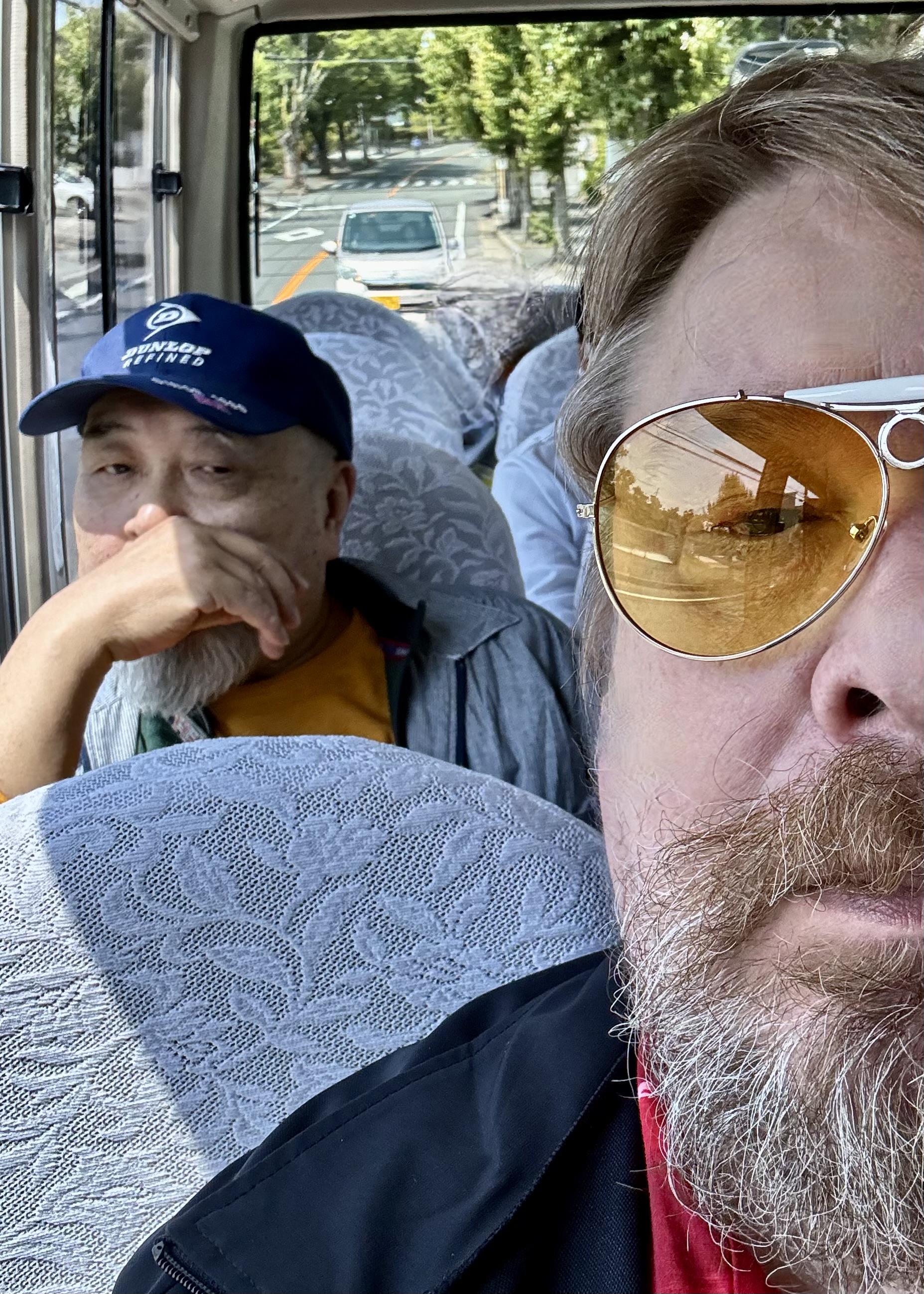
We were on the bus, traveling through the borderlands between Osaka and Kyoto Prefectures when the imojōchū began to kick in.
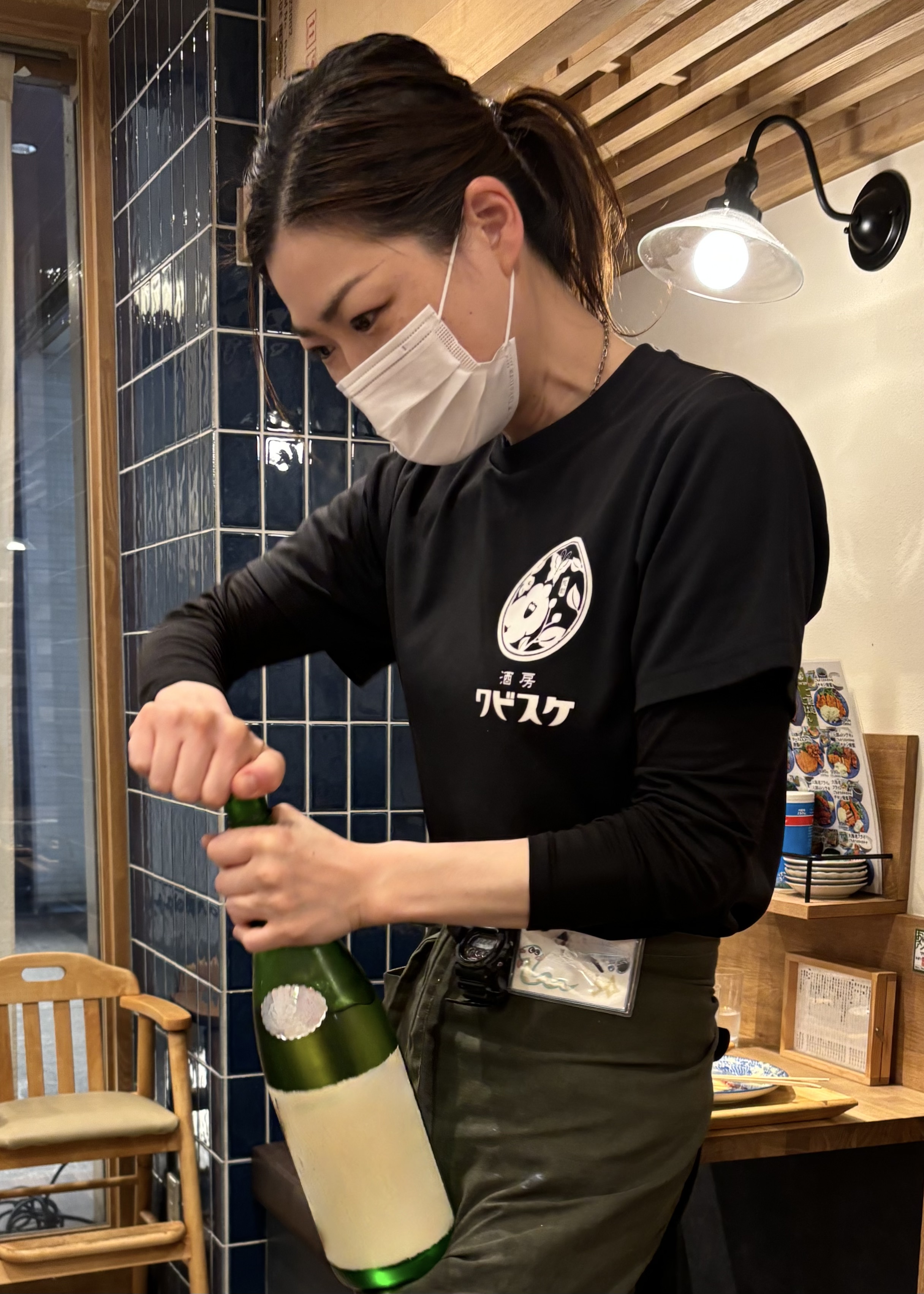
We had just finished an hour-and-a-half of “all you can eat/all you can drink” at a traditional izakaya banquet. This kind of gluttonous binging and imbibing pushes participants, especially those on a pensioner’s budget with little left over after pachinko and horse race betting activities, to extremes, to make sure they get their money’s worth. Since the food turned out to be only standard fare, we concentrated on the drinking: beer, sake (nihonshu) and sweet potato distilled liquor (imojōchū; usually 25-35% alcohol). A half hour in we were getting livelier and louder, and receiving dirty looks and disapproving frowns from the shop staff and other customers. Our severs were stingy, only allowing us to order a new drink after giving up the empty vessel from the previous beverage. Some of us countered this policy by pouring alcohol into PET bottles and plastic bags for secret take-out. We drank steadily until the last order. Somehow, we all were able to stand, pay our portions of the bill, use the toilet and stumble to the return bus without too much trouble. What started out as a gathering of long-lost friends taking a short trip on a privately rented bus with quiet small talk of recent illnesses, hospitalizations and deceased drinking companions, was now a drunken cacophony of laughing, shouting, quiz games and attempts at singing enka. We exited the bus at the Keihan Kuzuha train station, took a memorial photo and made our way to the shopping arcade, formerly the aged, everyman Norengai (“Noren Street”), home to several traditional eating and drinking establishments. Recently this arcade was gentrified and renamed “El Kuzuha.” The older shops, many of which closed due to COVID-19, were conveniently replaced with fashionable chain restaurants. We wandered through the corridors until deciding on an acceptable pub for our continued revelry. This post-fieldwork encounter chronicles a reunion of the owner and regular customers (the O.B.s or Old Boys) of a 40-year-old tachinomiya (“standing drink bar”) in Osaka called Tenbun, that closed in 2020.
Imojōchū has a strong taste and pungent smell, even when mixed with ice and water. For me, drinking it results in a contemplative body buzz; but when combined with beer and sake, the odoriferous contemplation turns into a gregarious stupidity. Nonetheless, this can be fun with the right people at the right time.
The Tenbun O.B. reunion was such a righteous group and occasion. After all, we were trying to resurrect something. Not a specific time, place, feeling, memory or dream. Something more, perhaps a sort of fluid liminal communitas (and I do not use these terms lightly) that, in the past, we could enter at will, or at least between Tenbun’s usual business hours Monday through Saturday. The hour of day (or night), people, circumstances, jokes, arguments, daily specials and drinks always varied and at the same time enmeshed to create this familiar something. Looking back, I can see how we took it for granted, the longest-term customers for as long as 40 years. But now we missed it. And we wanted it back, even if only for this one day.
Of course, none of the O.B.s explained the reunion in these terms, except for the over-analyzing anthropologist with a camera, soaking in another post-fieldwork experience. Ba…
To be continued…
Thursday, June 27, 2024
Announcement: VAoJ @Sophia University Institute of Comparative Culture 上智大学比較文化研究所「The Tachinomi Project」July 17, 2024
Dowload flyer here: https://www.icc-sophia.com/_files/ugd/2edff9_6a975eb58ccc4236ad4014881870fc43.pdf
SOPHIA UNIVERSITY INSTITUTE OF COMPARATIVE CULTURE: https://www.icc-sophia.com/
Wednesday, April 19, 2023
56: So on this Day I will wake up early to do a zoom guest lecture at 8:00 AM (Japan time)...
"Introduction to Visual Anthropology: Focus on Photo-ethnography."
The first half of the lecture will be about Visual Anthropology in general; the second half will be about my Tachinomiya Visual Ethnography Project. I will discuss the setting of a standing drink bar in Japan, my photographic fieldwork, photo exhibition and post-fieldwork encounters.
頑張ります!
The first half of the lecture will be about Visual Anthropology in general; the second half will be about my Tachinomiya Visual Ethnography Project. I will discuss the setting of a standing drink bar in Japan, my photographic fieldwork, photo exhibition and post-fieldwork encounters.
頑張ります!
Thursday, February 16, 2023
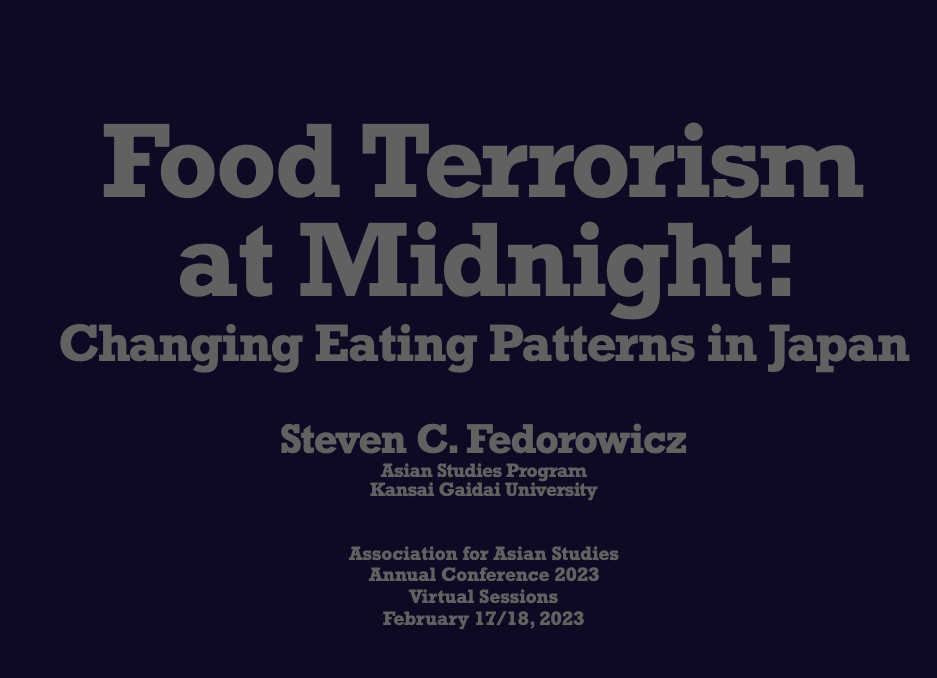
「Food Terrorism at Midnight: Changing Eating Patterns in Japan」@ Association for Asian Studies Annual Conference 2023 Virtual Sessions February 17/18, 2023
I am dedicating this presentation to Dr. Mark Hollstein, who passed away unexpectedly, suddenly and tragically on January 31, 2023. Mark was my friend and colleague for twenty years. We had many things in common - Japan, research, family life, politics, music and Star Trek. We talked almost every day. I was able to show Mark an early draft of this presentation and he gave me lots of good feedback. I miss him so much. Deepest condolences to his wife, son, family, friends and students. Rest in Peace.
See Mark's obituary here: https://www.legacy.com/us/obituaries/saltlaketribune/name/mark-hollstein-obituary?id=40271263
Abstract: In Japan, food and drink are prominent in cooking shows, travel shows, variety shows, dramas, manga, anime, books, magazines, blogs, Facebook and Instagram. The term “food porn” has been used to describe some media due to its sensual presentation intended to provide unattached pleasure or gratification for viewers. Since the 2010s, the Japanese term meshi tero (“food terrorism”) has been used with a meaning similar to “food porn.” However, food terrorism implies a deliberate attack or form of harassment that creates jealousy or resentment, causing victims to run to the kitchen or convenience store for snacks. Late-night food terror is especially insidious. Midnight has become a prime time for the television networks to air new food terrorism dramas. My research builds upon Stalker’s detailed history of the Japanese gourmet boom (2016) and Longcore’s discussion of “ethnographic culinary adventures... for the enjoyment, entertainment, and enlightenment of foodies and anthropologists alike” (2019). Food terrorism became more pronounced in 2020, when the Japanese government imposed restrictions on dining out during the COVID-19 pandemic. People now watch food terrorism with feelings of nostalgia, envy and/or hopefulness about being able to dine out again without concern. This paper examines food terrorism and changing eating patterns in Japan through multimodality (Collins et al. 2017) and sensory ethnographic methodologies (Pink 2009).
Keywords: visual anthropology, ethnographic photography, food porn, food terrorism, Japan
Session: V1-408
Contemporary Japanese and Korean Society
Friday, February 17, 2023, 8:00-9:30 PM (EST)
Saturday, February 18, 2023, 10:00-11:30 AM (Japan time)
For registration and information about the conference: https://www.asianstudies.org/conference/register2023/#
See Mark's obituary here: https://www.legacy.com/us/obituaries/saltlaketribune/name/mark-hollstein-obituary?id=40271263
Food Terrorism at Midnight:
Changing Eating Patterns in Japan
Steven C. Fedorowicz
Asian Studies Program
Kansai Gaidai University
Abstract: In Japan, food and drink are prominent in cooking shows, travel shows, variety shows, dramas, manga, anime, books, magazines, blogs, Facebook and Instagram. The term “food porn” has been used to describe some media due to its sensual presentation intended to provide unattached pleasure or gratification for viewers. Since the 2010s, the Japanese term meshi tero (“food terrorism”) has been used with a meaning similar to “food porn.” However, food terrorism implies a deliberate attack or form of harassment that creates jealousy or resentment, causing victims to run to the kitchen or convenience store for snacks. Late-night food terror is especially insidious. Midnight has become a prime time for the television networks to air new food terrorism dramas. My research builds upon Stalker’s detailed history of the Japanese gourmet boom (2016) and Longcore’s discussion of “ethnographic culinary adventures... for the enjoyment, entertainment, and enlightenment of foodies and anthropologists alike” (2019). Food terrorism became more pronounced in 2020, when the Japanese government imposed restrictions on dining out during the COVID-19 pandemic. People now watch food terrorism with feelings of nostalgia, envy and/or hopefulness about being able to dine out again without concern. This paper examines food terrorism and changing eating patterns in Japan through multimodality (Collins et al. 2017) and sensory ethnographic methodologies (Pink 2009).
Keywords: visual anthropology, ethnographic photography, food porn, food terrorism, Japan
Session: V1-408
Contemporary Japanese and Korean Society
Friday, February 17, 2023, 8:00-9:30 PM (EST)
Saturday, February 18, 2023, 10:00-11:30 AM (Japan time)
For registration and information about the conference: https://www.asianstudies.org/conference/register2023/#
Saturday, January 28, 2023
This is what replaced Tenbun:「"Takoyaki/side dishes standing bar Peke x Peke"」
Tenbun closed on March 28, 2020. The space it occupied was empty for a year and a half. Then on October 10, 2021, a new shop opened, Peke x Peke. I walked by the new shop a few times but never felt right about going in. But a couple weeks ago I went there to take photos and I did go in for a drink. Of course, it just wasn't the same. It seemed (bias warning) too new, artificial, cheap, trying too hard to be hip and stripped of any tradition and personality. I couldn't believe they tore out the beautiful old counter and replaced it with what they did. There weren't many customers (but it was a Monday evening) and none of the old Tenbun regulars were there. Replacing old shops with new chain stores is a part of the gentrification process going on at Keihan line train stations. Peke x Peke is not a chain. The manager told me that this is the only location with this particular configuration. But the owner has multiple shops.
You can get a good idea of the new configuration in my photos and then with photos from a web site I include below. Scroll to the end of this post for a link to see our beloved Tenbun.
Photos that accompnaied the announcement of the new shop on "Ko-shin," the Hirakata-shi Featured Event (i.e. advertisements) website.
https://www.hira2.jp/open-close/batubatu-20211018.html
Congratulatory flowers in front of the shop when it opened.
The new layout, counter, big screen TV...
Seating...
Take-out window.
Here's where to go to see Tenbun:
https://visualanthropologyofjapan.blogspot.com/2020/12/behind-scenestenbun-closingpresentation.html
Saturday, October 2, 2021
Midnight Presentation (2)
Original images from: https://www.netflix.com/jp-en/title/80113037
https://www.snapgalleries.com/product/barry-feinstein-george-harrison-all-things-must-pass-poster-image-friar-park-england-1970/
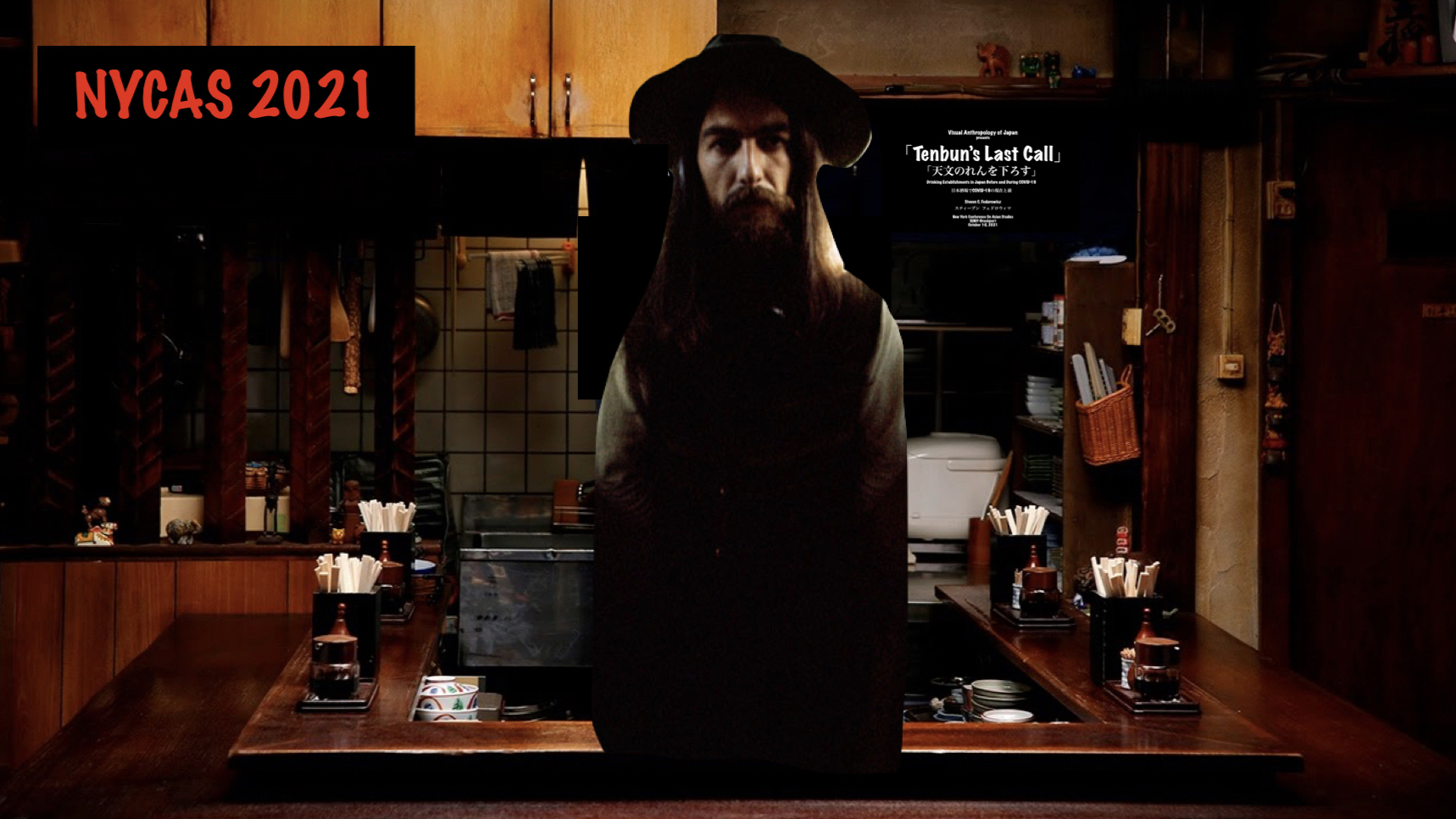
「Tenbun’s Last Call: Drinking Establishments in Japan Before and During COVID-19」@ New York Conference on Asian Studies 2021, Oct. 1-2
Midnight Presentation
Original image from: https://www.netflix.com/jp-en/title/80113037
「Tenbun’s Last Call: Drinking Establishments in Japan Before and During COVID-19」@ New York Conference on Asian Studies 2021, Oct. 1-2
Wednesday, September 29, 2021
「There Are Two Sides to Every Noren: Photo Exhibition as Art and Anthropology」@ A/R/P (Art/Research/Practice) 2021, October 3
There Are Two Sides to Every Noren:
Photo Exhibition as Art and Anthropology
のれんの表裏には異なる意味があります:
アートと人類学としての写真展
Abstract: Visual anthropology is an intersection of art and science – it entails commitment, ethical concerns, close relationships and ever-changing negotiations with participants (subjects and audience). This on-going research project is a visual ethnography of a tachinomiya (Japanese standing bar) in Osaka called Tenbun. It is based on my years of patronage, including two years of dedicated participant-observation and photography. Tenbun features many kinds of food and drink, a lively and relaxed atmosphere and plenty of colorful characters including the owner, employees and regular customers. One outstanding feature of this tachinomiya is its long, dark blue noren, a kind of fabric curtain as its entrance that signals that the shop is open for business and provides partial seclusion for the shop and customers. The noren can be seen as a fluid wall; when calm it blocks much of the view from the outside, but when the wind blows its separated partitions offer more glimpses of the inside. The glimpses can be narrow or revealing. One cannot control the wind; this fluid wall illustrates the complexities of personal privacy in public spaces in Japan, especially in the context of taking photographs in public and image rights. An important component of this project was a photo exhibition with prints and portraits illustrating the atmosphere of Tenbun. Initially I thought the photo exhibition to be the final product of the fieldwork and research. But I found the exhibition and interactions with the gallery audience to reveal important aspects of heuristic processes, meaning-creation, evocation and multivocality. Viewers were doing more than merely looking at my photographs, they were analyzing, scrutinizing, reacting and providing various interpretations and valuable feedback. In this multi-media presentation, I will discuss the "post-fieldwork encounters" of the photo exhibition as a collaborative media event through multimodal analyses and autoethnographic vignettes.
A/R/P (Art/Research/Practice) 2021
Tokyo University of the Arts
Oct. 3 - Session 7 - 13:30 - 15:00
via Zoom (conference registration required - free!)
https://arp.geidai.ac.jp/?fbclid=IwAR2sMtNm5ANkyfKO6iaSuRcLOl7GXktKmxlhcBrGJWq7oxZH42-FLmLTM4c
I'm really looking forward to this conference!
おすすめ!Check out Can Tamura's presentation, "Pandemic-Friendly Posthuman Ethnographic Filmmaking: The 24 Solar Terms of Echigo-Tsumari," Session 8, Oct. 3, 15:15-16:45.
Tuesday, September 28, 2021
「Tenbun’s Last Call: Drinking Establishments in Japan Before and During COVID-19」@ New York Conference on Asian Studies 2021, Oct. 1-2
Abstract: This presentation is a multimodal visual ethnography of drinking establishments such as izakaya (“Japanese pubs”) and tachinomiya (“standing bars”) in Japan before and during the COVID-19 pandemic. The focus will be on a 40-year-old standing bar in Osaka called Tenbun. Tenbun serves many kinds of alcohol and food items and has a lively atmosphere with plenty of colorful characters, including the owner, employees and regular customers. Not only is it a popular place to eat and drink, it is an important setting for socialization. This study is based upon over two years of dedicated participant-observation and photography, a photo exhibition and other post-fieldwork encounters. COVID-19 has brought changes for eating and drinking establishments in terms of safety precautions and consumption behavior; many shops have been forced to close. Tenbun closed shop in March, 2020. This research project examines the intersection of food anthropology, multimodal research methods, recent research on drinking establishments and the plethora of “foodie” media productions. It has also become a form of salvage ethnography. My data and photographs not only preserve Tenbun but also document the eating, drinking and socializing habits of Japan before the COVID-19 pandemic.
https://www.brockport.edu/academics/conferences/new_york_asian_studies/
SUNY Brockport, Brockport, New York
October 1, 2021 - Session A1
11:00 AM - 12:30 PM EDT (12:00 - 1:30 AM, Oct. 2 Japan time)
via Zoom (conference registration required)
For information on the conference and program:
https://www.brockport.edu/academics/conferences/new_york_asian_studies/
Monday, March 29, 2021
「Tenbun Closing」One Year Anniversary, pt. 2: Tenbun People See the Photo Essay (the subjects become the audience once again)
The gang got together for the first time in months. Some have gone through hardships and losses. But it was good to get together at this Italian restaurant. Everyone was happy and thrilled with the photo essay!
For more information on Tenbun and the project: 「Behind the Scenes:「Tenbun Closing」Presentation @ Anthropology of Japan in Japan Annual Meeting 2020」
http://visualanthropologyofjapan.blogspot.com/2020/12/behind-scenestenbun-closingpresentation.html
「Eat, Drink, and Stand in Japan」at Anthropology News (oneline version)
https://www.anthropology-news.org/index.php/2021/01/08/eat-drink-and-stand-in-japan/
http://visualanthropologyofjapan.blogspot.com/2020/12/behind-scenestenbun-closingpresentation.html
「Eat, Drink, and Stand in Japan」at Anthropology News (oneline version)
https://www.anthropology-news.org/index.php/2021/01/08/eat-drink-and-stand-in-japan/
Sunday, March 28, 2021
「Tenbun Closing」One Year Anniversary, pt. 1: Empty Space
March 28, 2020 was Tenbun's last day of business. One year later the location of Tenbun is empty space. The red circles on the floor guide for エルくずは (Elle Kuzuha) show where Tenbun was (lot 5) and that no new shop has opened there.
The Norengai is no more (only two shops seem to have a small noren now). This shot was taken at 5:30 PM last Thursday. The renamed エルくずは is no longer a busy and popular corridor like it once was. The demise was likely caused by the refurbishment/gentrification of the area by Keihan Densha, higher rents, more chain restauraunts, the close of the pachinko parlour and finally the close of Tenbun. COVID-19 was the last nail in the coffin. In all, three shops have gone out of business and remain vacant. At least one shop seems to be at least temporarily closed. Shuttered and closed. But not forgotten...
For more information on Tenbun and the project: 「Behind the Scenes:「Tenbun Closing」Presentation @ Anthropology of Japan in Japan Annual Meeting 2020」
http://visualanthropologyofjapan.blogspot.com/2020/12/behind-scenestenbun-closingpresentation.html
「Eat, Drink, and Stand in Japan」at Anthropology News (oneline version)
https://www.anthropology-news.org/index.php/2021/01/08/eat-drink-and-stand-in-japan/
Monday, March 22, 2021
I received some extra copies of my photo essay (Thanks Nat@AN) to give to the folks at the tachinomya along with a Japanese translation of the text. But don't tell, it's supposed to be a surprise...
For more information about Tenbun and the tachinomiya project (special multimodal bonus edition):
http://visualanthropologyofjapan.blogspot.com/2020/12/behind-scenestenbun-closingpresentation.html
To view the story online (with a different layout):
https://www.anthropology-news.org/index.php/2021/01/08/eat-drink-and-stand-in-japan/
http://visualanthropologyofjapan.blogspot.com/2020/12/behind-scenestenbun-closingpresentation.html
To view the story online (with a different layout):
https://www.anthropology-news.org/index.php/2021/01/08/eat-drink-and-stand-in-japan/
Friday, January 29, 2021
Wednesday, January 20, 2021
Checked my postal mail: the print copy finally made it to Japan!
Anthropology News,
November/December 2020,
Volume 61, Issue 6, p. 12-15
ISSN 1541-6151
Available online (but without the cool cover): https://www.anthropology-news.org/articles/eat-drink-and-stand-in-japan/
The Tenbun/tachinomiya project: http://visualanthropologyofjapan.blogspot.com/2020/12/behind-scenestenbun-closingpresentation.html
Tuesday, January 19, 2021
Subscribe to:
Posts (Atom)