Showing posts with label visual anthropology. Show all posts

Wednesday, April 1, 2026

Visual Anthropology in Japan:「The Tachinomi Project」 日本に映像人類学: 「立ち呑みプロジェクト」 @ Salon KGU

Visual Anthropology in Japan:
「The Tachinomi Project」

A chance to share my research with colleagues at work...

Abstract:

「The Tachinomi Project」is a visual ethnography based upon the intersections of social science research and contemporary art. The project began with long-term participant-observation and a photographic exhibition featuring a 40-year-old tachinomiya (standing drink bar) in Osaka called Tenbun. The study sought to explore photography in public spaces, privacy and image ethics while showcasing a “grimy” (Farrer 2019) and stimulating atmosphere with colorful characters including the shop owner, employees and regular customers. The interactions with Tenbun collaborators and gallery audience at the exhibition became the first of several post-fieldwork encounters, leading to the re-positioning of the research into wider social and academic contexts during and after the COVID 19 pandemic. This present account utilizes reflexivity, autoethnographic vignettes (Stevens 2013) and photography to explore the intersections of the sensory (Pink 2013 [2009]), multimodal (Collins et al. 2017), and ba (Kajimaru et al. 2021) of Tenbun and other eating and drinking establishments.

Thursday, April 16, 2026
18:30 ~ 20:00
CIE 3rd Floor Seminar Room


日本に映像人類学:
「立ち呑みプロジェクト」

職場の同僚と自分の研究成果を共有する機会…

要旨:

「立ち呑みプロジェクト」は、社会科学的調査と現代美術の交差領域に立脚したビジュアル・エスノグラフィーである。本プロジェクトは、大阪の創業40年の立ち呑み屋「天文」における長期的参与観察、ならびに同店を主題とした写真展を起点に始まった。本研究は、公共空間における写真撮影、プライバシー、および映像倫理を検討することを目的とし、店主や従業員、常連客といった多様な人々が織りなす、「猥雑(grimy)」(Farrer 2019)かつ刺激的な空間の様相を詳らかにするものである。 フィールドワーク後、写真展における「天文」協力者と観覧者とのインターアクションを皮切りに、コロナ禍中またそれ以降のより広範な社会的・学術的文脈で捉え直すこととなった。 本研究では、再帰性、オートエスノグラフィー的ヴィニエット(Stevens 2013)、写真を通し、「天文」をはじめとする飲食施設における感覚(Pink 2013 [2009])、マルチモーダル(Collins et al. 2017)、場(Kajimaru et al. 2021)の交差について論じる。

2026年4月16日(木)
18:30~20:00
CIE 3階 セミナー室


春から初夏にかけてのサロンKGUの全スケジュールはこちらです。
Here is the complete Salon KGU schedule for the spring and early summer:

BONUS!
かたの桜 純米吟醸酒 雪の香(ゆきのか) 17度
Katano Sakura Junmai Ginjo Sake Yukinoka (Scent of Snow) 17%

片野桜大吟醸袋吊りしずく(令和7酒造年度) 17度
Katano Sakura Daiginjo Undiluted Brew Genshu (2025) 17%


山野酒造 大阪府交野市
Yamano Sake Brewery Katano City, Osaka Prefecture


URL: https://www.katanosakura.com/

Friday, January 2, 2026

Early New Year's Day 2026 at Ubusuna Shrine「2026年元旦、産土神社にて」

And the shrine looked very different today...

As I wrote in a previous post, due to the resignation of the local neighborhood shrine elders, it was unknown who would prepare and officiate at the shrine for the New Year celebration. It seems the tasks were left up to the priest and his staff from the nearby Shimagashira Tenmangu Shrine「島頭天満宮」, the current parent shrine to our Ubusuna Shrine「産土神社」in the regional and national Shinto Church social organization. In the past when the shrine did not have its own priest and the the neighborhood elders ran things, Ubusuna Shrine was fairly independent, especially in terms of grounds maintenance and festivals. There was also a stronger feeling of community. The priest from Shimagashira only came on special occasions and he had his wife conduct the monthly service.

***

TANGENT: Ubusuna Shrine is located in Shirogaki-cho, Kadoma-shi, Osaka prefecture. It has over 800 years of history going back to when the area was a village known as Kamimbushi. This area was part of the greater Kawachi province that was established in the 7th century. At that time, Ubusuna Shrine was one of the major and largest shrines in the area. You can check out the shrine homepage that was made by one of the shrine elders:

  
Information on Shimagashira Tenmangu Shrine:
https://osakadai3shibu.kilo.jp/jinja/kadoma/jinja/simagasira.html

***

I visited the shrine just past midnight, and it seemed sabishii 「寂しい」or lonely, and very minimalist. I did not see or meet anybody I knew from the neighborhood. The people that were there were bed-town strangers. And more people seemed to bring their little dogs with them this year.

I liked the glowing lighting of the lanterns (which made for some nice photos), but much was missing from the set-up in previous years.

There were no bonfires and there were fewer spotlights. It was darker, colder and less dramatic.

The large white tent where parishioners could receive omiki, the sacred sake, was missing (it was replaced with a small vessel of sake and small paper cups as self service at the counter where amulets were sold; there was a small note saying there was only a limited amount of the sake and when it was gone, it was gone. Last year, I was responsible for pouring and offering sake to the parishioners. We had several large bottles of sake on hand and some small snacks as well.)

There were only two young shrine maidens (probably working as a part-time job) selling amulets and fortunes. They seemed to be the only support staff there (as opposed to the usual 10-15 elders and volunteers in the past).

The Hinomaru「日の丸」or Japanese flag, and illustrations of the flag were abundantly present, and the Japanese National Anthem, Kimigayo「君が代」, was playing in a repeating loop inside the shrine office building. (The flag and the anthem are two very powerful and problematic symbols associated with Japanese right-wing nationalism.)

There was a "Staff Only" sign in English (and in Japanese in a much smaller font size) on the shrine office door. I have never seen any usage of English at the shrine before.

The were two signs announcing the cancellation of the Tondo Matsuri on January 15 (there will be a future post on this cancellation...).   

Here are some of the photos I took.
To get a better idea of the shrine layout in the daytime:

Ubusuna Shrine prepped and (almost) ready to go (?)...: http://visualanthropologyofjapan.blogspot.com/2025/12/ubusuna-shrine-prepped-and-almost-ready.html

Compare with last year with this important post which has turned into a piece of salvage ethnography:

New Year's Eve 2024 / Early New Year's Day 2025「2024年大晦日から2025年元旦」: http://visualanthropologyofjapan.blogspot.com/2025/01/new-years-eve-2024-early-new-years-day.html

Wednesday, December 31, 2025

Ubusuna Shrine prepped and (almost) ready to go (?)...

There have been big changes at our local shrine in the last year. The local elders, who have been in charge of preparations for most of the shrine activities for years, decades really, resigned en masse in April. Really, there are no others who are prepared to replace them and their knowledge. The biggest question was, who would prepare and officiate the shrine for the New Years activities? Unlike last year, I was not asked to help or participate. These photos were taken before in the late afternoon of December 31, 2025, before the expected big rush at midnight. I have no idea who did the set-up. But it is very different and minimal compared to previous years.

Wednesday, December 17, 2025

2025年度第24回手話言語研究セミナー The 24rd Sign Language Research Seminar「Memories of the Deaf Evoked by Home Movies」

Seems to be a perfect match for VAoJ! Sign language and home movies...

The Japan Institute for Sign Language Studies (JISLS) held its first "Sign Language Research Seminar" in 2000 with the aim of deepening the understanding of sign language research by exchanging opinions among participants from various fields such as sign language, sign language interpreting, welfare, and education. From FY2021, the seminar is being held as part of the "Sign Language Research and Dissemination Project" commissioned by the Ministry of Health, Labour and Welfare.

In 2025, the theme will be "Memories of the Deaf Evoked by Home Movies," and we will discuss the importance of preserving old footage related to sign language, share the status of domestic and international research (Part 1) , and present research findings in 2025 (Part 2).


For more information and registration: https://jisls.com-sagano.com/seminar/

Tuesday, October 21, 2025

Announcement: A screening of a documentary film "Kitaushima" (North Cormorant Island)

Produced, Directed and Written by John Williams
Co-Producer and Co-Director: Yu Iwasaki
2024/86 min./Japan/Bilingual version (Japanese with English subtitles, English with Japanese subtitles)

November 12, 2025
18:30 to 20:30 (Doors Open at 18:00,Screening from 18:30)
Room L-821, 8F, Library building, Sophia University
No registration necessary / Free of charge

North Cormorant Island was filmed over ten years (between 2014 and 2024) in the remote fishing village of Kitaushima (which means North Cormorant Island), on Sado Island, Japan. Until the 1960’s the village was only accessible by boat, but a couple of hundred people lived there, rice-farming, fishing and raising cattle. After a road was built, young people began to drift to the cities and now there are less than thirty residents, most of them over seventy years old. The film blends observational documentary, following the everyday life of the village, the rituals, customs and work of the people who live there with a personal, poetic reflection on the director’s childhood in his father’s village in Wales. It is a film about time, place, mortality and human relationships with the land and the sea.

The film was awarded the Audience Award at Tokyo Documentary Film Festival, 2024.


Trailer: https://youtu.be/vm7UQ7CNgo8

This event is part one of the Sophia Symposium 2025 “Exploring a Japanese Fishing Village through Art” organized by John Williams and the ICC Collaborative Research Unit with the JSPS Scientific Research (C) 24K03565 Art, Environment and Sustainable Futures.

Symposium Part two: November 15th / 18:30 to 19:30 (Doors Open at 18:00) Performance of a Play “The Blue Tanuki Dreams of a Two-Moon Night.” (In Japanese with English text explanation.)

Symposium Part three: November 16th / 10:00 to 18:40 Symposium with guest speakers reflecting on similar projects in villages in Brazil, Norway and the UK.


***

北鵜島

監督:ジョン・ウィリアムズ、岩崎裕
2024年/86分/日本/バイリンガル版(日本語に英語字幕、英語に日本語字幕が付きます)

11月12日
18:30-20:30(開場18:00、上映開始18:30)
上智大学図書館 8階 L-821会議室
事前登録不要/入場無料

佐渡島にある海辺の小さな集落、北鵜島。その素朴さと美しさに魅了された、英国ウェールズ出身の監督が10年にわたり東京からかの地へ通い、人々と風土を記録する。中世から続く神事「車田植」などの風習や、山海の恵みと厳しさと共に生きる人々の知恵や精神に触れるなかで、監督は故郷ウェールズでの思い出や、海洋学者だった父の最期に思いを馳せる。さまざまな歴史や記憶が重なり、やがて鮮やかな人間賛歌へと結実していく。(2024年東京ドキュメンタリー映画祭観客賞受賞作品)

Source: https://www.icc-sophia.com/post/a-screening-of-a-documentary-film-kitaushima-north-cormorant-island/

Tuesday, August 19, 2025

"Taking Pictures of Snakes at Midnight: An Anthropological Perspective" - An Anthropological Talk by Ryan Xin XIE

"Taking Pictures of Snakes at Midnight: An Anthropological Perspective" on the relation between snakes and humans, and nature and humans, in Hong Kong, by Ryan Xin Xie.
Venue: Hong Kong Museum of History on Friday, August 22, 2025 at 7:00 p.m.

For more information: https://www.arts.cuhk.edu.hk/~ant/hkas/current_event.htm

Monday, August 18, 2025

"Light Leak as Method: Theorizing a Photographic Accident" - Essay on American Anthropologist by Myriam Amri

ABSTRACT: This project began as a 35 mm film photography collection to document the presence of waste in the Northwest border of Tunisia, as the materiality of waste, its existence “everywhere,” has become a medium through which people in the region understand their positions at the margins of the nation-state. Yet after months, I realized that a light leak had marked all of my photographs. Taking the accident as a chance encounter, I produced a collection of images that articulate the gap between their intended effects, of visualizing waste, and their final rendering, images marked by a light leak. In this essay, I trace the project's process from my initial intentions of photographing waste to the light leak accident, to the final rendering into a visual booklet. In doing so, I foreground the light leak as an accident that became a generative method to examine the spills, leaks, and overflows of wasteful landscapes in North Africa.

Access article: https://anthrosource.onlinelibrary.wiley.com/doi/10.1111/aman.28101

This article is part of the special section of American Anthropologist titled “On Vanishing Fieldsites.” The multimodal accompaniment to this article is available at https://simplebooklet.com/lightleak

Sunday, June 8, 2025

New Publication: "An archive of archives lost" by Dada Docot

Abstract: ‘An Archive of Archives Lost’ is an affective autoethnographic visual essay that examines the devastating impact of climate change through the lens of personal loss. The Philippines is among the countries most vulnerable to the ongoing climate crisis, with tropical storms getting stronger and more frequent. As a result of the intensified damage, many homes have lost their personal photographic archive, which used to bring together families and community through shared memories. The repeated experience of typhoons, flooding, and loss has made the community attuned to a routine cycle of letting go. The destruction of photographs symbolizes a deeper loss of cultural and social ties whose affective impact I explore.

Open Source full text article: https://www.tandfonline.com/doi/full/10.1080/17540763.2025.2487588

Docot, D. (2025). An archive of archives lost. Photographies, 18(2), 223–244. https://doi.org/10.1080/17540763.2025.2487588

Friday, May 16, 2025

New Book Announcement: "Art x Research x Archives: Investigating Art and Creative Humanities" edited by the Center for Future Creation and Inheritance, Tokyo University of the Arts / 東京藝術大学未来創造継承センター編『アート×リサーチ×アーカイヴ――調査するアートと創造的人文学』

Art x Research x Archives - Investigative Art and Creative Humanities
Supervisor: Yoshitaka Mori
Edited by Tokyo University of the Arts Future Creation and Inheritance Center
Getsuyosha 2,400 yen 46-size (188mm long x 130mm wide x 19mm wide, 310g weight) 272 pages (8 pages in color) ISBN: 978–4–86503–207–9 C0070

Contemporary art has expanded its scope by adopting research methods from sociology and cultural anthropology, while traditional humanities have also begun to incorporate new endeavors related to vision and hearing into their research. Archives do not simply support culture, but are beginning to play a role in actively creating it. The forefront of art is introduced through the multiple different practices of artists and researchers active in a cross-disciplinary field! [This book is a transcript of a portion of the public lectures given at the "Yurakucho Geidai Campus" in collaboration with the Tokyo Metropolitan Government, Mitsubishi Estate, and Tokyo University of the Arts.]

Authors: Watanabe Hidenori (Professor at the University of Tokyo Graduate School), Kawase Itsushi (Visual Anthropologist), Shitamichi Motoyuki (Artist), Okahara Masayuki (Professor Emeritus at Keio University), Takayama Akira (Director and Artist), Hasegawa Ai (Artist, Keio University), Habaya Kazuma (Center for Future Creation and Inheritance, Tokyo University of the Arts)

アート×リサーチ×アーカイヴ――調査するアートと創造的人文学
毛利嘉孝=監修
東京藝術大学未来創造継承センター=編
月曜社 本体2400円 46判(縦188mm×横130mm×束幅19mm, 重量310g)272頁(内カラー8頁)ISBN:978–4–86503–207–9 C0070

現代芸術は社会学や文化人類学などのリサーチ手法を採用することでその領域を拡大し、伝統的な人文学も視覚や聴覚などにかかわる新たな試みをその研究に取り込み始めた。アーカイヴは文化を単に支えるだけでなく、それらを積極的に生み出す役割を担いつつある。横断的な領域で活動するアーティストや研究者による、複数の異なる実践から紹介するアートの最前線!【本書は、東京都と三菱地所と東京藝術大学の三者連携による「有楽町藝大キャンパス」公開講座の一部を収録した講義録です。】

著者:渡邉英徳(東京大学大学院教授)、川瀬慈(映像人類学者)、下道基行(アーティスト)、岡原正幸(慶應義塾大学名誉教授)、高山明(演出家・アーティスト)、長谷川愛(アーティスト、慶應義塾大学)、幅谷和眞(東京藝術大学未来創造継承センター)

For more information: https://urag.exblog.jp/243923067/

Thursday, April 3, 2025

The Visual Anthropology of Japan: In and Outside the Classroom, Revisited

JAWS / AJJ Joint Conference 2025
Session 14 - Reflecting and Revisiting「Teaching Japan」
University of Hyogo - Kobe Campus for Commerce
Building 5
April 5, 2025, 15:40 - 17:10

Campus access: https://www.u-hyogo.ac.jp/english/access/#id01

Campus map: https://www.u-hyogo.ac.jp/about/access/kobeshoka/

Paper 4: The Visual Anthropology of Japan: In and Outside the Classroom, Revisited
Steven C. Fedorowicz, Professor, Kansai Gaidai University

Abstract: My chapter describes teaching a class comprised of international exchange students from many different countries alongside local students preparing for their study-abroad programs called “Visual Anthropology of Japan” at a Japanese university from 2006 to 2014. Topically, the course was about the presentation and representation of culture through film, photography, and other visual communication arts within the shifting anthropological ecologies of media, methods, and theory. Teaching “Japan” in this context required several balances of instruction and guidance for students of different academic levels, backgrounds, language skills and expectations studying together in the same class. Because of my training and background in cultural anthropology and visual anthropology, I do not consider my text as a theoretical treatise on pedagogy per se. Rather it is closer to an ethnographic—sometimes autoethnographic—account based on the fieldwork of teaching this course under certain conditions at a global educational setting. In my presentation, I will revisit this setting through the reflexive lens of ba (Kajimaru, Coker and Kazuma 2021), specifically, the convergence of players, place and performance during the period of the multimodal turn in visual anthropology that coincided with the class. This reminiscent revisit reaffirms the potential and possibility for a more active student learning environment and further course development to make a new and improved version of the course.

For more details about the conference and panel: https://visualanthropologyofjapan.blogspot.com/2025/02/announcement-jawsajj-joint-conference.html

Friday, January 17, 2025

「とんど祭り @ 産土神社 2025」Tondo Matsuri @ Ubusuna Shrine 2025

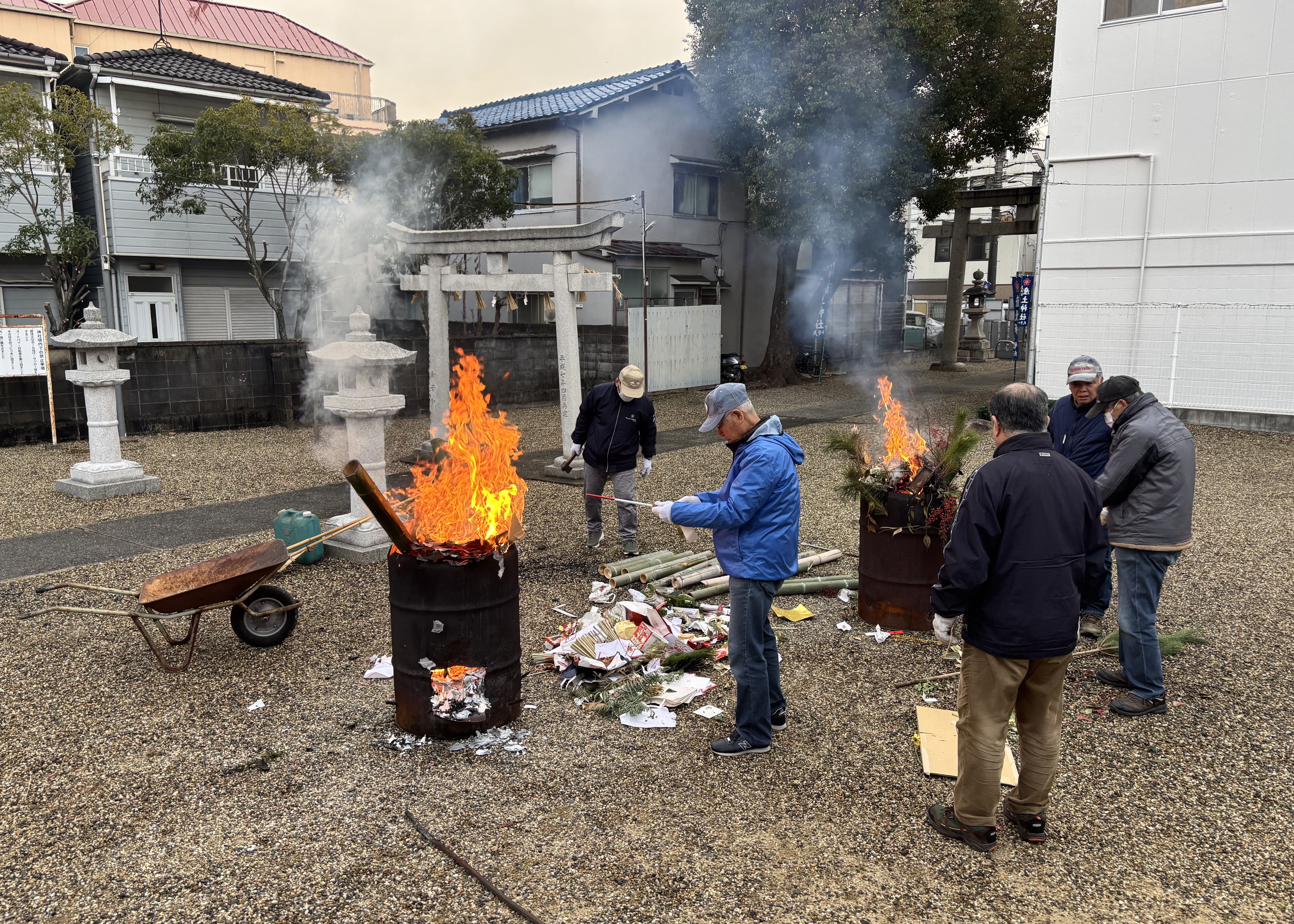
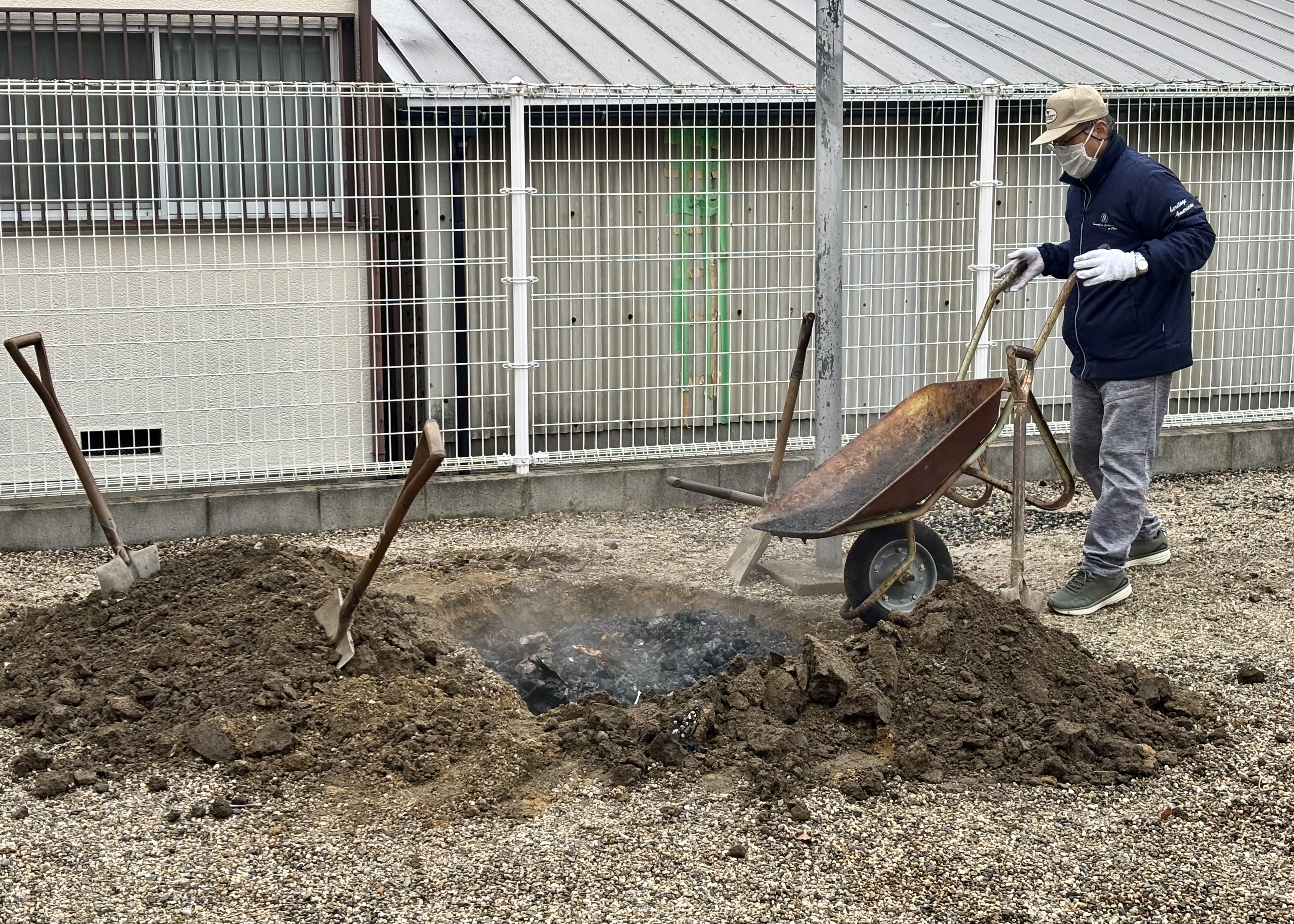
On January 15, 2025, from 8:00 - 10:00 AM, we (the shrine elders and the recruited volutnteer/visual anthropologist) held the Tondo Matsuri at our local shrine, Ubusuna Jinja, in Shirogaki-cho, Kadoma-shi, Osaka-fu. This low key community based event is a chance for neighbors to bring their religious amulets from the previous year and new year's decorations to the shrine to be burned. Like Shinto itself, one might argue that this festival is more tradtional/cultural than religious in nature. I documented this same event at the shrine in 2013. Aside from a few changes, (fewer participants, older participants, no tobacco smokers or beer), this year's event was the same as it was in 2013 (as a good ritual should be...). Check out the 2013 post for more specifics about the Tondo Matsuri.

Tondo Festival - とんど祭り (1/15/13): https://visualanthropologyofjapan.blogspot.com/2013/01/tondo-festival.html

See also:
Remains of the 2018 Kayashima Shrine Tondo Festival (1/15/18): https://visualanthropologyofjapan.blogspot.com/2018/01/remains-of-2018-kayashima-shrine-tondo.html

Let's get back to Ubusuna Jinja in 2025...