Explorations and experiments in visual representations - multimodality, sensory ethnography, reflexivity, autoethnographic vignettes, ethnographic photography and ba...
Showing posts with label 産土神社. Show all posts
Saturday, February 14, 2026
Thursday, January 15, 2026
Tondo Matsuri at Ubusuna Shrine scheduled for January 15, 2026 has been canceled. 2026年1月15日に予定されていた産土神社のとんど祭りは中止となりました。
Ubusuna Shrine, Shirogaki-cho, Kadoma-shi, Osaka-fu, Japan
One of two small hand-made signs at our neighborhood shrine.
The Tondo Festival (とんど祭り) is conducted annually on January 15 to coincide with ko-shogatsu (小正月), or "small new year." Ko-shogatsu is a holdover from the time when Japan used a lunar calendar and is acknowledges appreciation for housewives who were busy during the New Year; it also marks the "conclusion" of New Year's events. This festival has many names (Dondo yaki - どんど焼き - is a common name but there are many others) and local variations. It seems to be a large celebration in various locations across Japan. But my neighborhood version could barely be called a festival as it was practiced in a very low key manner. At the Tondo Matsuri, shimekazari (a traditional New Years decoration hanged at the entrance to a house), omamori (good luck charms), ofuda (talisman), ema (votive tablets) as well as other religious or new year's related ornaments are burned. This is in effect a sort of recycling - these various ornaments are returned after a year or so of use and new ones are purchased. This is also an important community service as many neighbors come during the morning to drop off their used New Year's or religious paraphernalia. It is actually a lot of hard work but also a chance to share New Year's greetings and scoialize with neighbors.
Tondo Matsuri at Ubusuna Shrine, January 15, 2025
But it was canceled this year, probably as fallout from the resignations of the shrine elders (as previously explained in a previous post) who conducted the Tondo Matsuri every year. I do not intend to blame the elders as many other traditional neighborhood activies have been shortened or canceled due to demographic changes and gentrification in Japanese neighborhoods like my own.
The signs at the shrine announce the cancelation and inform neighbors that a Tondo Matsuri will be conducted at the parent shrine,「島頭天満宮」Shimagashira Tenmangu Shrine, a 10-15 minute walk from「産土神社」Ubusuna Shrine, and invites people to drop off their items there (and to not bring their regular daily garbage for disposal). I usually have to work on January 15, but I was able to participate in the festival last year, not knowing that the shrine elders would resign and that it might be the last time the festival would be held. So the VAoJ post documenting the evetn becomes an important recording as salvage ethnography. View it here:
「とんど祭り @ 産土神社 2025」Tondo Matsuri @ Ubusuna Shrine 2025
https://visualanthropologyofjapan.blogspot.com/2025/01/2025tondo-matsuri-ubusuna-shrine-2025.html
I also participated in 2013:
Tondo Festival - とんど祭り (2013)
https://visualanthropologyofjapan.blogspot.com/2013/01/tondo-festival.html
It is my hope that my neighborhood can somehow reorganize to revive the shrine, its activities and other neighborhood traditions.
Bonus stuff (added 1/21/26):
January 8, 2026
Source: https://japantoday.com/category/national/elderly-woman-burned-as-clothes-catch-fire-at-new-year-bonfire-in-hokkaido
Dondo-yaki: Japan’s Fiery Farewell to the New Year (a simple explanantion found on GaijinPotBlog): https://blog.gaijinpot.com/dondo-yaki-japans-fiery-farewell-to-the-new-year/
Friday, January 2, 2026
Early New Year's Day 2026 at Ubusuna Shrine「2026年元旦、産土神社にて」
And the shrine looked very different today...
As I wrote in a previous post, due to the resignation of the local neighborhood shrine elders, it was unknown who would prepare and officiate at the shrine for the New Year celebration. It seems the tasks were left up to the priest and his staff from the nearby Shimagashira Tenmangu Shrine「島頭天満宮」, the current parent shrine to our Ubusuna Shrine「産土神社」in the regional and national Shinto Church social organization. In the past when the shrine did not have its own priest and the the neighborhood elders ran things, Ubusuna Shrine was fairly independent, especially in terms of grounds maintenance and festivals. There was also a stronger feeling of community. The priest from Shimagashira only came on special occasions and he had his wife conduct the monthly service.
Information on Shimagashira Tenmangu Shrine:
As I wrote in a previous post, due to the resignation of the local neighborhood shrine elders, it was unknown who would prepare and officiate at the shrine for the New Year celebration. It seems the tasks were left up to the priest and his staff from the nearby Shimagashira Tenmangu Shrine「島頭天満宮」, the current parent shrine to our Ubusuna Shrine「産土神社」in the regional and national Shinto Church social organization. In the past when the shrine did not have its own priest and the the neighborhood elders ran things, Ubusuna Shrine was fairly independent, especially in terms of grounds maintenance and festivals. There was also a stronger feeling of community. The priest from Shimagashira only came on special occasions and he had his wife conduct the monthly service.
***
TANGENT: Ubusuna Shrine is located in Shirogaki-cho, Kadoma-shi, Osaka prefecture. It has over 800 years of history going back to when the area was a village known as Kamimbushi. This area was part of the greater Kawachi province that was established in the 7th century. At that time, Ubusuna Shrine was one of the major and largest shrines in the area. You can check out the shrine homepage that was made by one of the shrine elders:
Information on Shimagashira Tenmangu Shrine:
https://osakadai3shibu.kilo.jp/jinja/kadoma/jinja/simagasira.html
I visited the shrine just past midnight, and it seemed sabishii 「寂しい」or lonely, and very minimalist. I did not see or meet anybody I knew from the neighborhood. The people that were there were bed-town strangers. And more people seemed to bring their little dogs with them this year.
I liked the glowing lighting of the lanterns (which made for some nice photos), but much was missing from the set-up in previous years.
There were no bonfires and there were fewer spotlights. It was darker, colder and less dramatic.
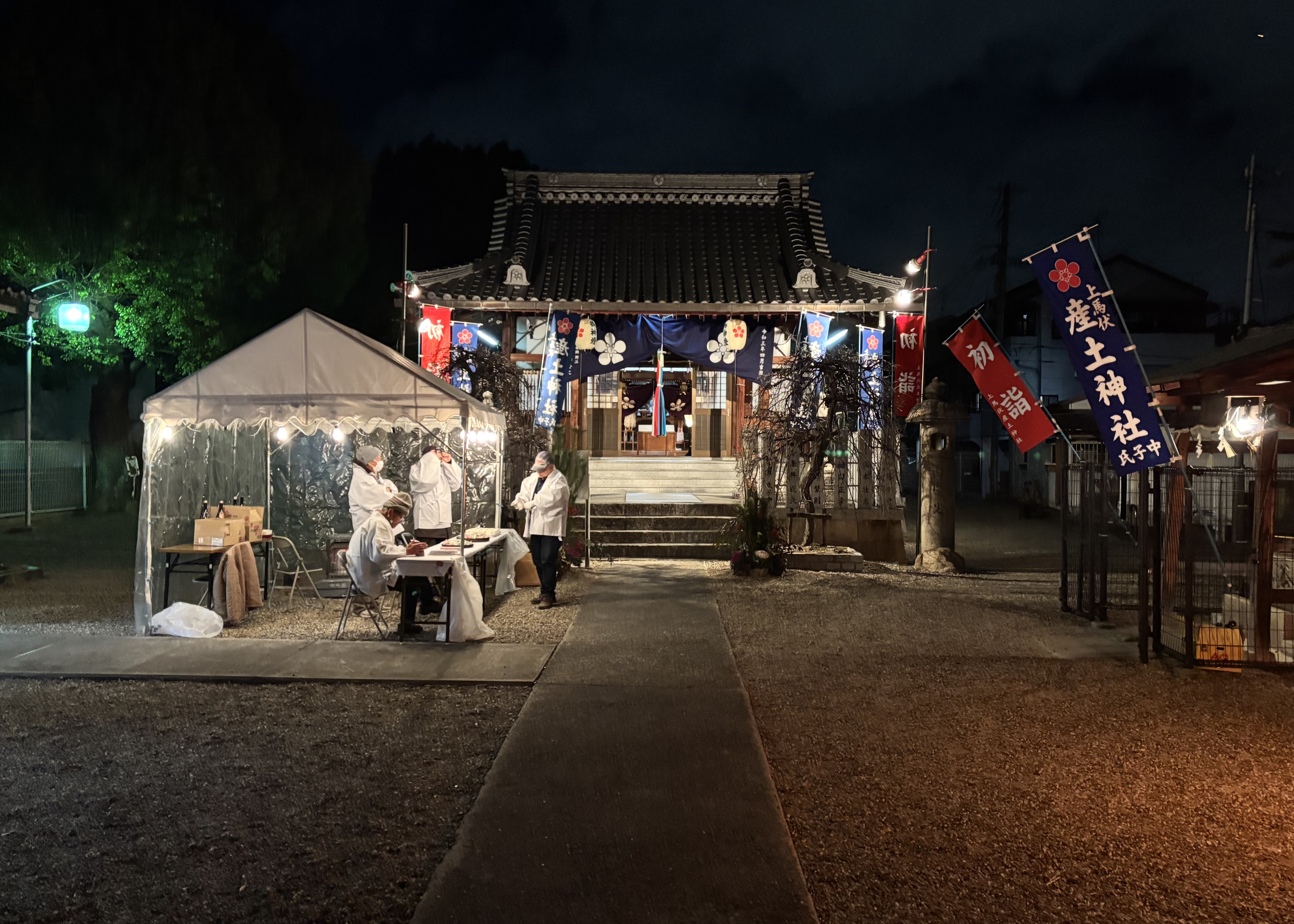
The large white tent where parishioners could receive omiki, the sacred sake, was missing (it was replaced with a small vessel of sake and small paper cups as self service at the counter where amulets were sold; there was a small note saying there was only a limited amount of the sake and when it was gone, it was gone. Last year, I was responsible for pouring and offering sake to the parishioners. We had several large bottles of sake on hand and some small snacks as well.)
There were only two young shrine maidens (probably working as a part-time job) selling amulets and fortunes. They seemed to be the only support staff there (as opposed to the usual 10-15 elders and volunteers in the past).
The Hinomaru「日の丸」or Japanese flag, and illustrations of the flag were abundantly present, and the Japanese National Anthem, Kimigayo「君が代」, was playing in a repeating loop inside the shrine office building. (The flag and the anthem are two very powerful and problematic symbols associated with Japanese right-wing nationalism.)
There was a "Staff Only" sign in English (and in Japanese in a much smaller font size) on the shrine office door. I have never seen any usage of English at the shrine before.
***
I visited the shrine just past midnight, and it seemed sabishii 「寂しい」or lonely, and very minimalist. I did not see or meet anybody I knew from the neighborhood. The people that were there were bed-town strangers. And more people seemed to bring their little dogs with them this year.
I liked the glowing lighting of the lanterns (which made for some nice photos), but much was missing from the set-up in previous years.
There were no bonfires and there were fewer spotlights. It was darker, colder and less dramatic.
The large white tent where parishioners could receive omiki, the sacred sake, was missing (it was replaced with a small vessel of sake and small paper cups as self service at the counter where amulets were sold; there was a small note saying there was only a limited amount of the sake and when it was gone, it was gone. Last year, I was responsible for pouring and offering sake to the parishioners. We had several large bottles of sake on hand and some small snacks as well.)
There were only two young shrine maidens (probably working as a part-time job) selling amulets and fortunes. They seemed to be the only support staff there (as opposed to the usual 10-15 elders and volunteers in the past).
The Hinomaru「日の丸」or Japanese flag, and illustrations of the flag were abundantly present, and the Japanese National Anthem, Kimigayo「君が代」, was playing in a repeating loop inside the shrine office building. (The flag and the anthem are two very powerful and problematic symbols associated with Japanese right-wing nationalism.)
There was a "Staff Only" sign in English (and in Japanese in a much smaller font size) on the shrine office door. I have never seen any usage of English at the shrine before.
The were two signs announcing the cancellation of the Tondo Matsuri on January 15 (there will be a future post on this cancellation...).
Here are some of the photos I took. To get a better idea of the shrine layout in the daytime:
Ubusuna Shrine prepped and (almost) ready to go (?)...: http://visualanthropologyofjapan.blogspot.com/2025/12/ubusuna-shrine-prepped-and-almost-ready.html
Compare with last year with this important post which has turned into a piece of salvage ethnography:
New Year's Eve 2024 / Early New Year's Day 2025「2024年大晦日から2025年元旦」: http://visualanthropologyofjapan.blogspot.com/2025/01/new-years-eve-2024-early-new-years-day.html
Here are some of the photos I took. To get a better idea of the shrine layout in the daytime:
Ubusuna Shrine prepped and (almost) ready to go (?)...: http://visualanthropologyofjapan.blogspot.com/2025/12/ubusuna-shrine-prepped-and-almost-ready.html
Compare with last year with this important post which has turned into a piece of salvage ethnography:
New Year's Eve 2024 / Early New Year's Day 2025「2024年大晦日から2025年元旦」: http://visualanthropologyofjapan.blogspot.com/2025/01/new-years-eve-2024-early-new-years-day.html
Wednesday, December 31, 2025
Ubusuna Shrine prepped and (almost) ready to go (?)...
There have been big changes at our local shrine in the last year. The local elders, who have been in charge of preparations for most of the shrine activities for years, decades really, resigned en masse in April. Really, there are no others who are prepared to replace them and their knowledge. The biggest question was, who would prepare and officiate the shrine for the New Years activities? Unlike last year, I was not asked to help or participate. These photos were taken before in the late afternoon of December 31, 2025, before the expected big rush at midnight. I have no idea who did the set-up. But it is very different and minimal compared to previous years.
Tuesday, January 7, 2025
New Year's Eve 2024 / Early New Year's Day 2025「2024年大晦日から2025年元旦」
明けましておめでとうございます。今年もよろしくお願いします。
Happy New Year! VAoJ hopes for a wonderful, peaceful and meaningful 2025 for all!
Please forgive the lateness of our New Year's greetings. These photos span the time between New Year's Eve 2024 and the wee morning hours of New Year's Day 2025 at our local shrine, Ubusuna Jinjya (産土神社).
A few months ago, the shrine elders asked me to assist them with the preparations and activities during the new year holidays. They knew me because of my participation in the fall festival for the last several years, and because I was always taking photos at the shrine. They asked me, in part, because they are a small group of senior men who were looking for some young(er) blood to help out. I was extremely honored and promised to do whatever I could.
Preparations began on December 29. And we gathered again at the shrine at 10:30 PM on the 31st for the final provisions and to welcome worshipers and visitors who would be coming at midnight to offer their new year's prayers. Although I have gone to the shrine at midnight almost every year's eve for the last 20 years, I had no idea of the details and all the work involved to prepare the shrine. Despite their ages and various health problems, I found these older men to be strong, agile and most capable. I sort of felt like I was a kid again, assisting my father but not really knowing how to do anything.
At midnight, many people from the neighborhood started to arrive. Our shrine is a small one (now, anyway, in the past it was one of the largest and major shrines in the Kawachi region), but I estimate between 250 - 300 visitors came before we packed up and went home at 2:30 AM. My main duty was to assist in the preparation and serving of the omiki, or sacred sake.
While I was there to work for the shrine, I was able to take a few photos. I am grateful to the shrine elders for all of the work they have done for years for the benefit of our community. And I was grateful that I could assist, and do a little visual anthropology in between duties. In the following days I will post photos of the preparations for the event and the post-work we did on the morning on January 1.
Happy New Year! VAoJ hopes for a wonderful, peaceful and meaningful 2025 for all!
Please forgive the lateness of our New Year's greetings. These photos span the time between New Year's Eve 2024 and the wee morning hours of New Year's Day 2025 at our local shrine, Ubusuna Jinjya (産土神社).
A few months ago, the shrine elders asked me to assist them with the preparations and activities during the new year holidays. They knew me because of my participation in the fall festival for the last several years, and because I was always taking photos at the shrine. They asked me, in part, because they are a small group of senior men who were looking for some young(er) blood to help out. I was extremely honored and promised to do whatever I could.
Preparations began on December 29. And we gathered again at the shrine at 10:30 PM on the 31st for the final provisions and to welcome worshipers and visitors who would be coming at midnight to offer their new year's prayers. Although I have gone to the shrine at midnight almost every year's eve for the last 20 years, I had no idea of the details and all the work involved to prepare the shrine. Despite their ages and various health problems, I found these older men to be strong, agile and most capable. I sort of felt like I was a kid again, assisting my father but not really knowing how to do anything.
At midnight, many people from the neighborhood started to arrive. Our shrine is a small one (now, anyway, in the past it was one of the largest and major shrines in the Kawachi region), but I estimate between 250 - 300 visitors came before we packed up and went home at 2:30 AM. My main duty was to assist in the preparation and serving of the omiki, or sacred sake.
While I was there to work for the shrine, I was able to take a few photos. I am grateful to the shrine elders for all of the work they have done for years for the benefit of our community. And I was grateful that I could assist, and do a little visual anthropology in between duties. In the following days I will post photos of the preparations for the event and the post-work we did on the morning on January 1.
Subscribe to:
Posts (Atom)