Explorations and experiments in visual representations - multimodality, sensory ethnography, reflexivity, autoethnographic vignettes, ethnographic photography and ba...
Showing posts with label Southeast Asia. Show all posts
Tuesday, March 1, 2016
ANNOUNCEMENT - Visual Documentary Project 2015: Human Flows - "Movement in Southeast Asia"
About the project:
Southeast Asia is rich in its diversity of ethnic, religious and cultural composition. The region has maintained the coexistence of such diversity while at the same time achieving economic progress and becoming a hub for the flow of people, goods, money and information. Yet at present, the region is also confronted with serious issues such as the decrease of biodiversity and tropical forests, disasters, pandemics, aging population, ethnic and religious conflicts, economic differentiation and poverty.
In the face of this, how is coexistence and sustainability possible despite the diversity that exists? How can we make public resources out of the region’ s social foundations which are the basis of people’ s everyday lives? And, how can we connect these in a complementary way to existing systems of governance towards solving the problems and issues mentioned above?
In order to address these questions in the context of Southeast Asia, the Center for Southeast Asian Studies, Kyoto University has initiated this “Visual Documentary project” which explicitly examines the contours of their everyday lives through a visual approach since 2012. This project aims to use visual forms of expression to complement the growing literature that exists on Southeast Asian societies. From 2014, the Japan Foundation Asia Center joins this project as co-organizer to help widely promote the richness of Southeast Asian cultures to people in Japan. As of 2015, the project has linked up with numerous film schools in the region to help strengthen the documentary filmmaking network.
Human Flows - Movement in Southeast Asia -
Movement is a fundamental reality of human societies. In Southeast Asia how does it influence individuals, families, communities and nations? What journeys do people take as they move within, across and out of the region? What are their reasons to move and what stories do they have to tell? What experiences define movement in the region? And how will the region’s governments manage flows on the eve of the birth of ASEAN Economic Community?
Film Screening
KYOTO
Date & Time: March 23, 2016 13:30-18:00 (DOORS OPEN: 13:00)
Venue: Kyoto University International Science Innovation Building Symposium Hall
Language: Japanese / English Translation
Organizer: Center for Southeast Asia Studies
Co-organizer: Japan Foundation Asia Center
TOKYO
Date & Time: March 25th, 2016 13:30-18:00 (DOORS OPEN: 13:00) Admission Free , No Reservation Required
Venue: JFIC Hall SAKURA
Language: Japanese / English Translation
Organizer: The Japan Foundation Asia Center
Co-organizer: Center for Southeast Asia Studies
For more information: http://sea-sh.cseas.kyoto-u.ac.jp/en/vdp2015/
Friday, July 10, 2015
Visual Documentary Project 2015: Human Flows - Movement in Southeast Asia
Call for Documentaries
Deadline for submission: December 20, 2015
About the Project
Southeast Asia is rich in its diversity of ethnic, religious and cultural composition. The region has maintained the coexistence of such diversity while at the same time achieving economic progress and becoming a hub for the flow of people, goods, money and information. Yet at present, the region is also confronted with serious issues such as the decrease of biodiversity and tropical forests, disasters, pandemics, aging population, ethnic and religious conflicts, economic differentiation and poverty.
In the face of this, how is coexistence and sustainability possible despite the diversity that exists? How can we make public resources out of the region’ s social foundations which are the basis of people’ s everyday lives? And, how can we connect these in a complementary way to existing systems of governance towards solving the problems and issues mentioned above?
In order to address these questions in the context of Southeast Asia, the Center for Southeast Asian Studies, Kyoto University has initiated this “Visual Documentary project” which explicitly examines the contours of their everyday lives through a visual approach since 2012. This project aims to use visual forms of expression to complement the growing literature that exists on Southeast Asian societies. From This year, the Japan Foundation Asia Center joins this project as co-organizer to help widely promote the richness of Southeast Asian cultures to people in Japan. As of 2015, the project has linked up with numerous film schools in the region to help strengthen the documentary filmmaking network.
Human Flows - Movement in Southeast Asia -
Movement is a fundamental reality of human societies. In Southeast Asia how does it influence individuals, families, communities and nations? What journeys do people take as they move within, across and out of the region? What are their reasons to move and what stories do they have to tell? What experiences define movement in the region? And how will the region’s governments manage flows on the eve of the birth of ASEAN Economic Community?
The Center for Southeast Asian Studies (CSEAS) is accepting short documentaries from young filmmakers who are citizens of ASEAN nations and Japan to reflect on Human Flows in Southeast Asia. Submissions of up to 30 minutes can be on any topic that touches upon Southeast Asian’s experiences of human movement in the region. Themes can include economic migration, movement between countries in the region, pilgrimages, migration due to political crisis or environmental degradation, cultural influences and borderless journeys/wanderings.
For more information: http://sea-sh.cseas.kyoto-u.ac.jp/en/vdp2015/
Thursday, June 5, 2014
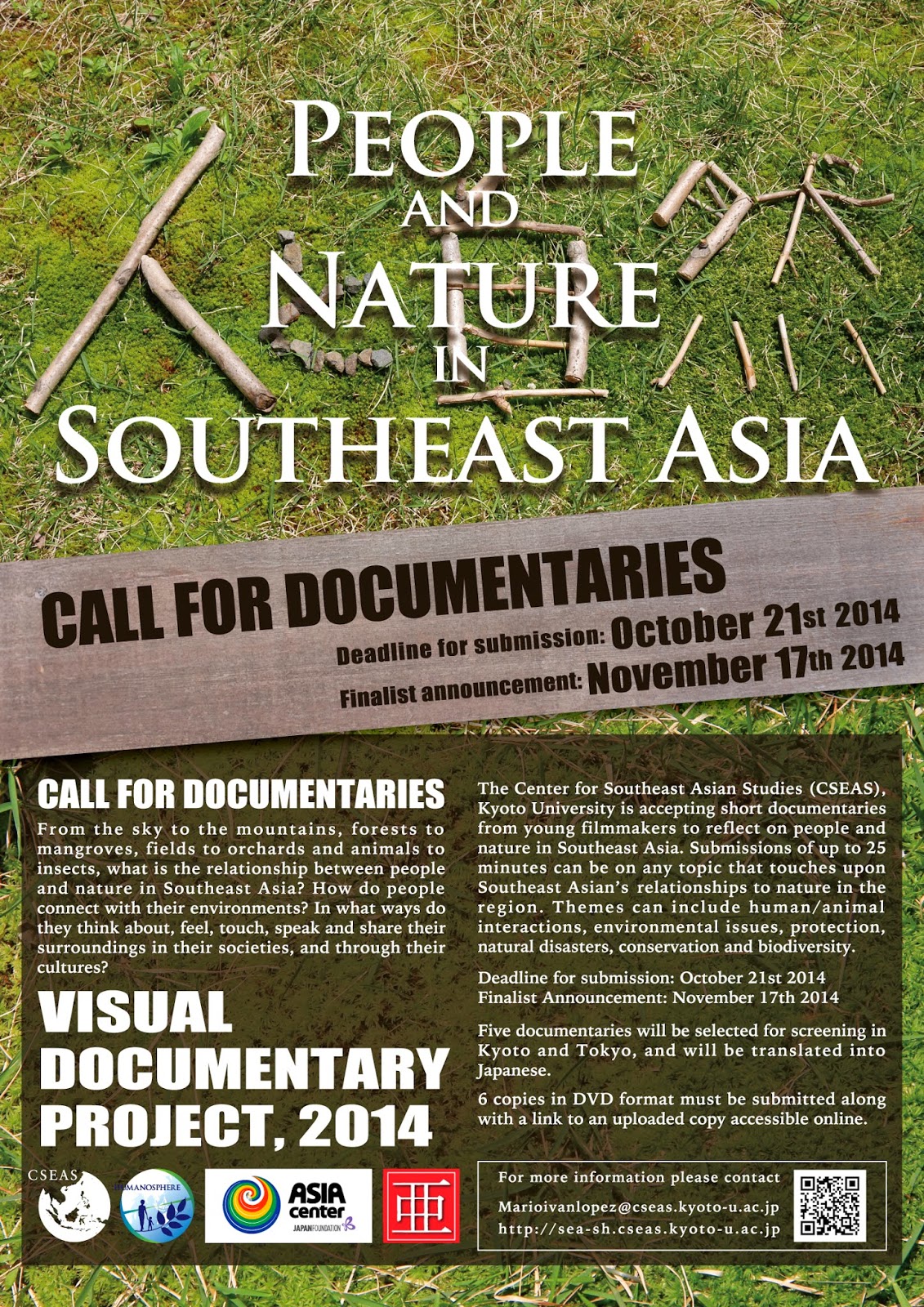
Call for Documentaries: 3rd Visual Documentary Project - People and Nature in Southeast Asia
The theme this year is People and Nature in Southeast Asia. From the sky to the mountains, forests to mangroves, fields to orchards and animals to insects, what is the relationship between people and nature in Southeast Asia? How do people connect with their environments? In what ways do they think about, feel, touch, speak and share their surroundings in their societies, and through their cultures? We are accepting short documentaries from young filmmakers to reflect on people and nature in Southeast Asia. Submissions of documentaries up to 25 minutes can be on any topic that touches upon Southeast Asian’s relationships to nature in the region. Themes can include human/animal interactions, environmental issues, protection, natural disasters, conservation and biodiversity.
For more information: http://sea-sh.cseas.kyoto-u.ac.jp/visual-documentary-project-2014/#2014top
Thursday, September 11, 2008
Southeast Asia Visions Collection
(Image borrowed from Southeast Asia Visions Collection)Another resource announcement from H-ASIA:
SOUTHEAST ASIA VISIONS
(Description from its web site:) ...a collection of European travel accounts of pre-modern Southeast Asia from Cornell University Library’s John M. Echols Collection. The site provides online access to more than 350 books and journal articles written in English and French. The works in the collection were selected for the quality of their first-hand observations and, together, provide a comprehensive representation of Southeast Asia. Along with their narratives, these accounts include some 10,000 images, drawings, photographs, prints and maps, many of them in color. The objectives of this project are both to meet the curricular needs of courses taught at Cornell University and to make these texts and images accessible via the Internet to students and scholars worldwide. It presents scholars an excellent opportunity to look anew at pre-modern Southeast Asia.
While the focus is on Southeast Asia, there are some Japan related materials available in this collection. This collection seems to be another valuable on-line resource which might be of interest to visual anthropologists.
I found the above photo in the "BROWSE BY IMAGE GEOGRAPHIC INFORMATION" section under Japan; the following information came up, which was hot-linked to the image:
Image geographic Information: Japan
An army officer on leave in Japan : including a sketch of Manila and environment, Philippine insurrection of 1896-7, Dewey's battle of Manila Bay and description of Formosa by Maus, Louis Mervin (1911), p.160B (Japanese Maid Preparing Dinner)
Link to Southeast Asia Visions:
http://dlxs.library.cornell.edu/s/sea/index.php
Subscribe to:
Posts (Atom)