Shop website: http://mikkouya.com/
Explorations and experiments in visual representations - multimodality, sensory ethnography, reflexivity, autoethnographic vignettes, ethnographic photography and ba...
Wednesday, January 24, 2024
Tuesday, January 23, 2024
This weekend I am going to Tokyo to meet with a sake expert; I want to give him a bottle of high quality sake from Osaka. So I went to Inada Sake Shop and not only found a great present but also the Foo Fighters sake that I have looking for since its debut in 2021!
Katano Sakura Junmai Ginjo Nama Genshu Super Dry and
Foo Fighters×TATENOKAWA JUNMAIDAIGINJO HANSHO Blue
Inada Sake Shop is over 90 years old and has a great selection of sake. They also have a small tachinomiya next door. On Saturday in the late afternoon, the place was packed (12 customers or so) and very lively. Lots of great sake, oden and other food, too.
Information about Inada Sake Shop: https://zaubee.com/biz/inada-liquor-store-oagrx5ub
About the sake I bought as a present for _________:
Katano Sakura Junmai Ginjo Nama Genshu Super Dry (720ml)
Characteristics:
Low-temperature fermented Ginjo brewed junmai unprocessed sake. A refreshing dry sharpness and a powerful flavor unique to raw unprocessed sake. It has a strong personality and flavor that is worth drinking. Although it is raw sake, you can enjoy its unique charm not only cold but also hot.
Kuramoto Yamano Sake Brewery:
In the Heian period, Katano no Sato was loved by aristocrats as a place to play in the fields such as picking cherry blossoms. This area, blessed with the clear waters of the Amano River and the fertile fields that spread across its basin, gave birth to many sake brewers during the Edo period. Inheriting that history and tradition, we are working hard to create a sake brewery with a ``bloomy'' atmosphere that resembles cherry blossoms.
Source: Osaka Prefecture Sake Brewers Association.
http://osaka-sake.com/index.html
Kuramoto Yamano Sake Brewery website: https://www.katanosakura.com/
Foo Fighters×TATENOKAWA JUNMAIDAIGINJO HANSHO Blue
Inada Sake Shop is over 90 years old and has a great selection of sake. They also have a small tachinomiya next door. On Saturday in the late afternoon, the place was packed (12 customers or so) and very lively. Lots of great sake, oden and other food, too.
Information about Inada Sake Shop: https://zaubee.com/biz/inada-liquor-store-oagrx5ub
About the sake I bought as a present for _________:
Katano Sakura Junmai Ginjo Nama Genshu Super Dry (720ml)
Characteristics:
Low-temperature fermented Ginjo brewed junmai unprocessed sake. A refreshing dry sharpness and a powerful flavor unique to raw unprocessed sake. It has a strong personality and flavor that is worth drinking. Although it is raw sake, you can enjoy its unique charm not only cold but also hot.
Kuramoto Yamano Sake Brewery:
In the Heian period, Katano no Sato was loved by aristocrats as a place to play in the fields such as picking cherry blossoms. This area, blessed with the clear waters of the Amano River and the fertile fields that spread across its basin, gave birth to many sake brewers during the Edo period. Inheriting that history and tradition, we are working hard to create a sake brewery with a ``bloomy'' atmosphere that resembles cherry blossoms.
Source: Osaka Prefecture Sake Brewers Association.
http://osaka-sake.com/index.html
Kuramoto Yamano Sake Brewery website: https://www.katanosakura.com/
Sunday, January 21, 2024
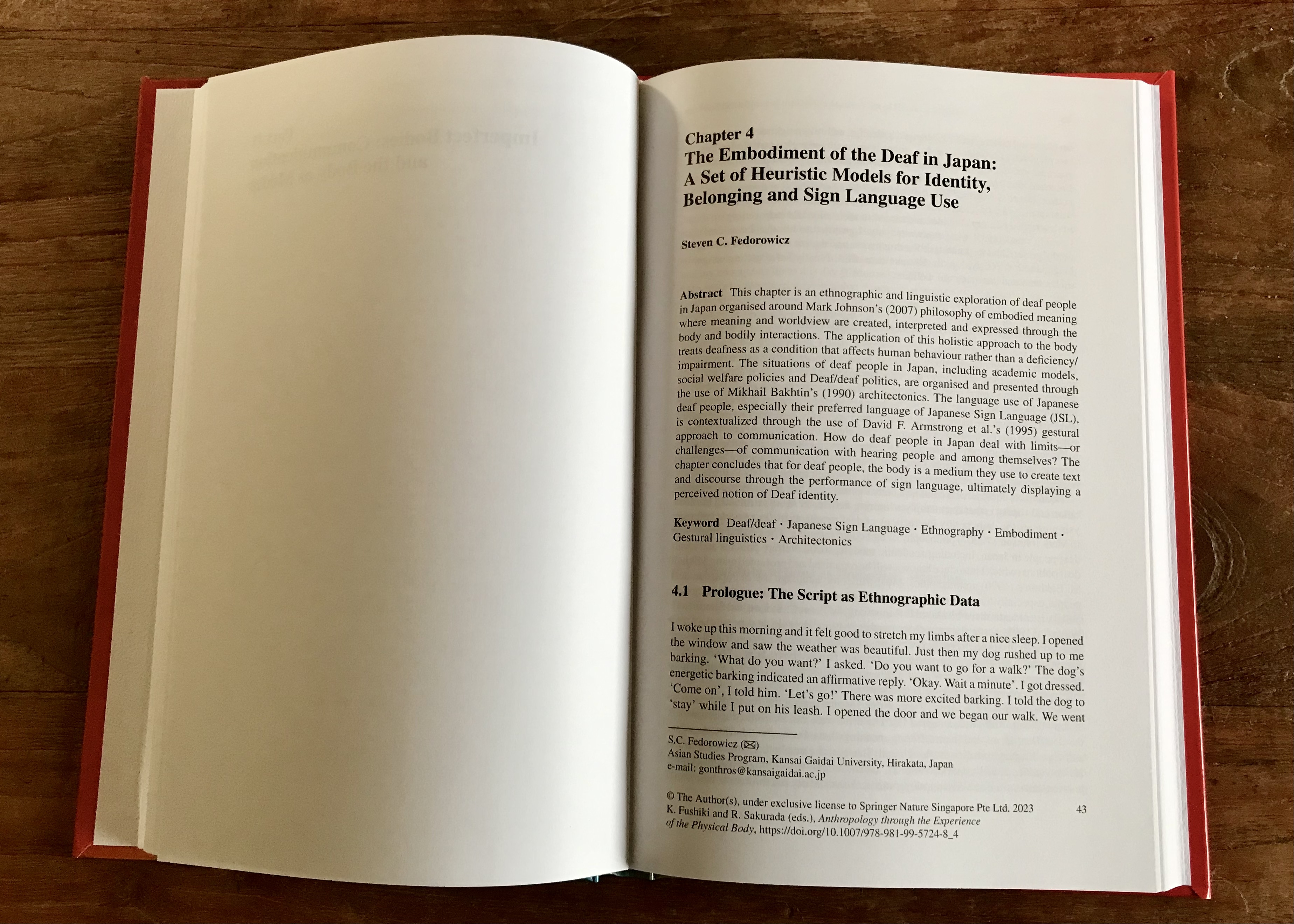
「Anthropology through the Experience of the Physical Body 」There's nothing like holding the real book for the first time...
Anthropology through the Experience of the Physical Body
Editors: Kaori Fushiki, Ryoko Sakurada (2023)
Book information: https://link.springer.com/book/10.1007/978-981-99-5724-8
See also: http://visualanthropologyofjapan.blogspot.com/2023/12/new-book-announcement-long-time-in.html
Chapter 4, p. 42-60
The Embodiment of the Deaf in Japan: A Set of Heuristic Models for Identity, Belonging and Sign Language Use
Steven C. Fedorowicz
Abstract: This chapter is an ethnographic and linguistic exploration of deaf people in Japan organised around Mark Johnson’s (2007) philosophy of embodied meaning where meaning and worldview are created, interpreted and expressed through the body and bodily interactions. The application of this holistic approach to the body treats deafness as a condition that affects human behaviour rather than a deficiency/impairment. The situations of deaf people in Japan, including academic models, social welfare policies and Deaf/deaf politics, are organised and presented through the use of Mikhail Bakhtin’s (1990) architectonics. The language use of Japanese deaf people, especially their preferred language of Japanese Sign Language (JSL), is contextualized through the use of David F. Armstrong et al.’s (1995) gestural approach to communication. How do deaf people in Japan deal with limits—or challenges—of communication with hearing people and among themselves? The chapter concludes that for deaf people, the body is a medium they use to create text and discourse through the performance of sign language, ultimately displaying a perceived notion of Deaf identity.
Keywords: Deaf/deaf, Japanese Sign Language, Ethnography, Embodiment, Gestural linguistics, Architectonics
Editors: Kaori Fushiki, Ryoko Sakurada (2023)
Book information: https://link.springer.com/book/10.1007/978-981-99-5724-8
See also: http://visualanthropologyofjapan.blogspot.com/2023/12/new-book-announcement-long-time-in.html
Chapter 4, p. 42-60
The Embodiment of the Deaf in Japan: A Set of Heuristic Models for Identity, Belonging and Sign Language Use
Steven C. Fedorowicz
Abstract: This chapter is an ethnographic and linguistic exploration of deaf people in Japan organised around Mark Johnson’s (2007) philosophy of embodied meaning where meaning and worldview are created, interpreted and expressed through the body and bodily interactions. The application of this holistic approach to the body treats deafness as a condition that affects human behaviour rather than a deficiency/impairment. The situations of deaf people in Japan, including academic models, social welfare policies and Deaf/deaf politics, are organised and presented through the use of Mikhail Bakhtin’s (1990) architectonics. The language use of Japanese deaf people, especially their preferred language of Japanese Sign Language (JSL), is contextualized through the use of David F. Armstrong et al.’s (1995) gestural approach to communication. How do deaf people in Japan deal with limits—or challenges—of communication with hearing people and among themselves? The chapter concludes that for deaf people, the body is a medium they use to create text and discourse through the performance of sign language, ultimately displaying a perceived notion of Deaf identity.
Keywords: Deaf/deaf, Japanese Sign Language, Ethnography, Embodiment, Gestural linguistics, Architectonics
Friday, January 19, 2024
Do these two visual images have anything in common? (subtitle: Coincidence?)
In「KOREA ENCOUNTERS: Experimental artists challenge 'suffocating' conformity in 1960s Seoul」(The Korea Times January 14, 2024), the caption for Image 1 reads, "Chung Chan-seung prepares an installation..." Author Matt VanVolkenburg writes,
"In December 1967, three experimental art groups... held an exhibition... in central Seoul.
This exhibition might have passed with little media notice had the artists not gone out into the streets to picket and decry public indifference and the fact that Korea had no galleries for modern art.
The highlight of the exhibition was Korea’s first-ever 'happening.' The term 'happening' had been coined by American artist Alan Kaprow in the late 1950s after he became interested in the performative aspects of making art. For him, the line between art and life was to be made as fluid and indistinct as possible." (my bolding)
Image 2 is a rendering of Myaku-Myaki, the mascot chosen for the Expo 2025 Osaka in 2022 designed by Kouhei Yamashita. The Japanese Ministry of Economy, Trade and Industry describes the mascot:
"The concept was to combine the logo with the water from Osaka, 'the city of water,' to give it the ability to transform...
This mascot has no fixed form. Everyone involved with the Expo imagines the mascot differently, changing it endlessly into various forms." (my bolding)
There seem to be similarities in the visual appearances and the conceptual visions. Both the "happening" and the mascot are flowing, variable, nebulous and multivocal. They both seem to be looking for a better future.
I don't recall how The Korea Times story popped onto my computer screen. Perhaps my recent online investigations of contemporary and visual art created some algorithms to make such an article appear. And I have always thought the mascot to be silly and odd (and not representative of Osaka). I wonder how these things occur.
Sources:
The Korea Times, January 14, 2024. https://www.koreatimes.co.kr/www/nation/2024/01/177_366860.html
designboom, October 31, 2023. https://www.designboom.com/design/myaku-myaku-expo-2025-osaka-mascot-10-31-2023/
Japanese Ministry of Economy, Trade and Industry, March 22, 2022. https://www.meti.go.jp/english/press/2022/0322_001.html
#koreanavantgardeartgroups
#koreanprotestart
#koreanhappening
#expos2025osakamascot
#myaku-myaki
#2025年日本万国博覧会マスコット
#ミャクミャク
#coincidence
"In December 1967, three experimental art groups... held an exhibition... in central Seoul.
This exhibition might have passed with little media notice had the artists not gone out into the streets to picket and decry public indifference and the fact that Korea had no galleries for modern art.
The highlight of the exhibition was Korea’s first-ever 'happening.' The term 'happening' had been coined by American artist Alan Kaprow in the late 1950s after he became interested in the performative aspects of making art. For him, the line between art and life was to be made as fluid and indistinct as possible." (my bolding)
Image 2 is a rendering of Myaku-Myaki, the mascot chosen for the Expo 2025 Osaka in 2022 designed by Kouhei Yamashita. The Japanese Ministry of Economy, Trade and Industry describes the mascot:
"The concept was to combine the logo with the water from Osaka, 'the city of water,' to give it the ability to transform...
This mascot has no fixed form. Everyone involved with the Expo imagines the mascot differently, changing it endlessly into various forms." (my bolding)
There seem to be similarities in the visual appearances and the conceptual visions. Both the "happening" and the mascot are flowing, variable, nebulous and multivocal. They both seem to be looking for a better future.
I don't recall how The Korea Times story popped onto my computer screen. Perhaps my recent online investigations of contemporary and visual art created some algorithms to make such an article appear. And I have always thought the mascot to be silly and odd (and not representative of Osaka). I wonder how these things occur.
Sources:
The Korea Times, January 14, 2024. https://www.koreatimes.co.kr/www/nation/2024/01/177_366860.html
designboom, October 31, 2023. https://www.designboom.com/design/myaku-myaku-expo-2025-osaka-mascot-10-31-2023/
Japanese Ministry of Economy, Trade and Industry, March 22, 2022. https://www.meti.go.jp/english/press/2022/0322_001.html
#koreanavantgardeartgroups
#koreanprotestart
#koreanhappening
#expos2025osakamascot
#myaku-myaki
#2025年日本万国博覧会マスコット
#ミャクミャク
#coincidence
Wednesday, January 17, 2024
祭り Matsuri
Photo Exhibition 写真展
Matsuri
「Through Multi-sighted Photographies」
祭り
「多視点からの写真を通して」
「多視点からの写真を通して」
2024 February 10 (Sat) ~ 13 (Tues)
2024年2月10日(土) ~ 13日(火)
JARFO Art Square
Kyoto, Japan
Gallery Info: https://jarfo.jp/jarfo
Link to accessibility/barrier-free information: https://visualanthropologyofjapan.blogspot.com/2024/02/matsuri-photo-exhibition-accessibility.html
This project is a collaboration that explores Japanese matsuri through the intersections of social science research and visual representation. Fedorowicz’s field sites are autumn danjiri festivals in his own neighborhood in Osaka. His research-based art is long-term, community-based, participatory, reflexive and informed by sensory ethnography and multimodality. Druet’s field sites are Kyoto’s Gion Matsuri and Jidai Matsuri. Her art-based research examines vernacular photography, spectacle, iconicity and the performative presence of the Kyoto geisha as dancers and models. Meshing their visions and what they captured together, the photographers want the images they took in these clearly separate loci to be features in a duo exhibition, juxtaposing 40 photos of the Kyoto and Osaka matsuri they engaged in with their cameras and embodied positions as researchers. The photographers hope that the visitors to this exhibition will participate in the research by supplying ideas and opinions through surveys, interview and informal discussions.
このプロジェクトは、社会科学研究とビジュアル表現の交わり (intersections) を通して日本の祭りを探求する共同プロジェクトである。 フェドロウィツの研究対象は、彼が住む大阪の秋のだんじり祭りで、彼のリサーチに基づくアートは、長期的、地域密着型、参加型、再帰的で、感覚エスノグラフィーとマルチモダリティの影響を受けている。一方、ドルーエの研究対象は、京都で最も祇園祭と時代祭である。彼女の芸術をベースとした研究では、ヴァナキュラー写真、壮観、アイコン性、そして、ダンサー・モデルとしての京都芸者のパフォーマティブな存在について考察している。自分たちのそれぞれのビジョンとカメラで撮影したものを融合させることで、明らかに別々の場所で撮影した写真を、今回の「デュオ展」の目玉として、京都・大阪で撮りためた写真40枚を展示する。来場者にはアンケートやインタビュー、非公式なディスカッションを通じて、アイデアや意見を共有してほしい。
Lucile Druet is Associate Professor of Japanese Arts and Culture at Kansai Gaidai University, Osaka. Her teaching covers literature, painting traditions, theatrical performances, film and Japanese fashion. Interested in the visual and aesthetical intersection of clothing and embodiment, she researches how kimono is practiced nowadays in Kyoto and how it appears in works of fiction and poetry. See more of her photographic work at: https://somosomo.co
Steven C. Fedorowicz is a cultural anthropologist, visual anthropologist and Associate Professor of Anthropology in the Asian Studies Program at Kansai Gaidai University in Osaka. He has lived in Japan for over 25 years. His research interests include deaf communities, sign language, religion, ritual, performance, B-kyu gourmet, drinking establishments and ethnographic photography. See more of his work at: https://visualanthropologyofjapan.blogspot.com/
ルシル ドルーエは、大阪にある関西外国語大学の日本芸術文化准教授。文学、絵画の伝統、演劇、映画、日本のファッション等、多岐にわたって教鞭をとっている。衣服と体現の視覚的、美的交差に興味を持ち、現在京都でどのように着物が着られているのか、小説や詩の中で着物がどのように表現されるのか、研究を重ねている。ドルーエの写真作品は下記のサイトで閲覧可能である: https://somosomo.co
スティーブン C. フェドロウィツは、文化人類学者、ビジュアル人類学者であり、彼もまた大阪にある関西外国語大学留学生別科の准教授でもある。日本に住んで25年、研究テーマは多岐にわたり、ろう者コミュニティ、手話、宗教、儀式、パフォーマンス、B級グルメ、飲み屋、民族写真などが含まれる。フェドロウィツの作品は下記のサイト閲覧可能である: https://visualanthropologyofjapan.blogspot.com/
Labels:
announcement,
danjiri,
Geisha,
Kyoto,
Osaka,
photo exhibition,
photography,
だんじり,
京都,
写真展,
大阪,
祭り,
芸者
Tuesday, January 16, 2024
Monday, January 8, 2024
Monday, January 1, 2024
Here's to a better 2024...
I arrived at Ubusuna Jinja shortly after midnight. On my way I could smell the smoke from the two blazing barrel fires at the shrine. The rain had stopped, but the wind was still strong. Because of the weather, not many people ventured to the shrine at midnight like in previous years. Except for the shrine elders, none of my neighborhood friends were there. I dropped off last year's ofuda from the house and my office. I was eager to rid myself of anything from 2023.
The line to offer New Year's prayers was short. When it was my turn, I climbed the steps, threw some money in the offering box, rang the bell, bowed, clapped twice and prayed. I prayed for world peace and health and prosperity for my friends and family. And I prayed and pleaded for my own health, and for a better 2024.
Please. A better 2024. 2023 was awful. Yes, Hanshin won the Japan Series. But that was the only good thing to happen. A better 2024. Please.
After my prayer I accepted the omiki (sacred sake) and chatted with two of the shrine elders. Then I wandered around and took a few photos. I decided to wait for a while, with hopes that some of my friends might come.
The fires were warm and comforting, the flames crackling as they consumed the very dry wood that was fed to them. It started to rain again, and the wind got stronger. Bursts of wind caused the flames to jump and emit sparks as far as four meters away.
An older woman approached me and asked in Japanese, "Is this your first time here?"
"No. I have lived in this neighborhood for over 20 years. I come here every year."
Her family approached and asked the woman if she was speaking to the foreigner in English. She told them, no, he can speak Japanese, Kansai-ben. They laughed and went to take selfies in front of the shrine. My friends weren't coming. I decided it was time to leave. I went home and finished the Yoshida Rui New Year's Special.
A better 2024. Or how about a great 2024?
Happy New Year from「VAoJ」. 今年もよろしくお願いします.
"No. I have lived in this neighborhood for over 20 years. I come here every year."
Her family approached and asked the woman if she was speaking to the foreigner in English. She told them, no, he can speak Japanese, Kansai-ben. They laughed and went to take selfies in front of the shrine. My friends weren't coming. I decided it was time to leave. I went home and finished the Yoshida Rui New Year's Special.
A better 2024. Or how about a great 2024?
Happy New Year from「VAoJ」. 今年もよろしくお願いします.
Wednesday, December 13, 2023
New Book Announcement: A LONG time in the making! "Anthropology through the Experience of the Physical Body"
Finally! The new book edited by Kaori Fushiki and Ryoko Sakurada has been published! The origins of this book go back to May, 2014 and the panel "Anthropology through the Experience of the Physical Body" at the International Union of Anthropological and Ethnological Studies conference in Chiba, Japan. It has been a long and difficult road.
Book description (from Amazon.jp): This book seeks to break new ground, both empirically and conceptually, in examining changing understandings of the physical human body from a variety of anthropological perspectives. In doing so, it interrogates how the body has been and continues to be conceptualised, experienced and interacted with. After an introductory appraisal of recent approaches to understanding the body, the book provides empirically rich accounts from East and Southeast Asia of how cultural, environmental and social norms shape human physicality. The contributions are organised in four broad themes. Part I, ‘Body and Space’, offers two contrasting case studies from Malaysia, both of which examine gender norms associated with marriage and pregnancy, including the taboos associated with these rites of passage. Part II, ‘Imperfect Bodies: Communication and the Body as Media’, analyses two case studies―Deaf people in Japan and masked theatre performance in Bali, Indonesia, to reflect on changing attitudes towards disability, which reflect broader social norms and cultural beliefs about the nature of disability and its place in society. Part III, ‘The Body and Image’, provides a pair of case studies from Singapore, on male fans of the popular manga boys’ love genre and on ways that the Chinese zodiac system is determined from birth and continues to be spiritually embedded in the body of a Chinese individual through ritual practices. Part IV, ‘The Body as Container: Taming the Bodies?’, presents a single case study from Thailand of spirit possession among schoolchildren. Though wide-ranging, all the case studies posit that the body is a site of constant negotiation. The way the body is presented and the way it is seen are shaped by a complex array of social, cultural, political and ideational factors. Anthropology through the Experience of the Physical Body is a valuable interdisciplinary work for advanced students and researchers interested in representations of the body in East and Southeast Asia and for those with wider interests in the field of critical anthropology.
Of interest to VAoJ readers might be chapter 4, The Embodiment of the Deaf in Japan: A Set of Heuristic Models for Identity, Belonging and Sign Language Use. I will post more specifics when I actually receive my own print copy, hopefully soon. It is currently available on Amazon in Kindle format; the print format will be available is March, 2024.
Many thanks to the editors, contributors and production staff.
Book description (from Amazon.jp): This book seeks to break new ground, both empirically and conceptually, in examining changing understandings of the physical human body from a variety of anthropological perspectives. In doing so, it interrogates how the body has been and continues to be conceptualised, experienced and interacted with. After an introductory appraisal of recent approaches to understanding the body, the book provides empirically rich accounts from East and Southeast Asia of how cultural, environmental and social norms shape human physicality. The contributions are organised in four broad themes. Part I, ‘Body and Space’, offers two contrasting case studies from Malaysia, both of which examine gender norms associated with marriage and pregnancy, including the taboos associated with these rites of passage. Part II, ‘Imperfect Bodies: Communication and the Body as Media’, analyses two case studies―Deaf people in Japan and masked theatre performance in Bali, Indonesia, to reflect on changing attitudes towards disability, which reflect broader social norms and cultural beliefs about the nature of disability and its place in society. Part III, ‘The Body and Image’, provides a pair of case studies from Singapore, on male fans of the popular manga boys’ love genre and on ways that the Chinese zodiac system is determined from birth and continues to be spiritually embedded in the body of a Chinese individual through ritual practices. Part IV, ‘The Body as Container: Taming the Bodies?’, presents a single case study from Thailand of spirit possession among schoolchildren. Though wide-ranging, all the case studies posit that the body is a site of constant negotiation. The way the body is presented and the way it is seen are shaped by a complex array of social, cultural, political and ideational factors. Anthropology through the Experience of the Physical Body is a valuable interdisciplinary work for advanced students and researchers interested in representations of the body in East and Southeast Asia and for those with wider interests in the field of critical anthropology.
Of interest to VAoJ readers might be chapter 4, The Embodiment of the Deaf in Japan: A Set of Heuristic Models for Identity, Belonging and Sign Language Use. I will post more specifics when I actually receive my own print copy, hopefully soon. It is currently available on Amazon in Kindle format; the print format will be available is March, 2024.
Many thanks to the editors, contributors and production staff.
Tuesday, December 12, 2023
"Character for tax (税) picked as kanji of 2023" - and I my salary is less than it was two years ago...
Photo and story from Japan Today, 12/12/23.
I would have actually voted for "(Hanshin) Tigers" as the kanji of the years. But...
The money that I now actually make has decreased in the last two years. My winter bonus this year is more than $100 less than it was two years ago. Why? My university tells me that since my salary increases (by a very small amount) every year, I am now in a higer tax bracket, thus the government takes more money from my paycheck. At the same time, the cost of everything (groceries, etc.) has increased. Is this fair? I think not. The government certainly needs to reduce taxes and work to decrease the price of necessities for its residents. But at the same time, it seems that employers need to better support their employees (or has the idea of managers/employers as onjin「恩人」become obsolete?). At the same time, I might add, my university has not increased research funds for its faculty for well over 20 years, and no longer furnishes computers, printers, etc. to professors (instead we are supposed to use our own research funds which are supposed to be used for actual reseach activities) for these vital tools we need to do our very job, i.e. teaching). And, again, at the same time, teachers need to pay for more online services and software to do our job. Recently, my university has announced that since "COVID-19 is under control," they will be canceling the Zoom accounts of faculty and staff. WTF?
Let's hope for a Happy New Year on may levels...
I would have actually voted for "(Hanshin) Tigers" as the kanji of the years. But...
The money that I now actually make has decreased in the last two years. My winter bonus this year is more than $100 less than it was two years ago. Why? My university tells me that since my salary increases (by a very small amount) every year, I am now in a higer tax bracket, thus the government takes more money from my paycheck. At the same time, the cost of everything (groceries, etc.) has increased. Is this fair? I think not. The government certainly needs to reduce taxes and work to decrease the price of necessities for its residents. But at the same time, it seems that employers need to better support their employees (or has the idea of managers/employers as onjin「恩人」become obsolete?). At the same time, I might add, my university has not increased research funds for its faculty for well over 20 years, and no longer furnishes computers, printers, etc. to professors (instead we are supposed to use our own research funds which are supposed to be used for actual reseach activities) for these vital tools we need to do our very job, i.e. teaching). And, again, at the same time, teachers need to pay for more online services and software to do our job. Recently, my university has announced that since "COVID-19 is under control," they will be canceling the Zoom accounts of faculty and staff. WTF?
Let's hope for a Happy New Year on may levels...
Subscribe to:
Posts (Atom)