Explorations and experiments in visual representations - multimodality, sensory ethnography, reflexivity, autoethnographic vignettes, ethnographic photography and ba...
Thursday, December 5, 2013
Visual Anthropology of Japan Fall Photo Exhibition
The VAOJ Fall Photo Exhibition at Kansai Gaidai University features both print and digital formats in two locations. Check out the prints in the CIE first floor lounge and the the digital show in CIE Room 3208 (along with the Asian Studies Program Student Ceramics and Manga Exhibitions). There are a wide range of subjects and lots of interesting photographs.
Project titles and artists:
Purikura by Emma Fukuyama
Bringing Art to Life by Cody Alexander Golden
Makeup by Rina Hamada
Why Do We Pierce? by Sayaka Higshine
A Flood of Katakana by Haruka Ichihashi
Nekohoudai by Zoë Madonna
“Yūjo” by Chelsea Pinneke
Hello Kitty Everything and Anything? by Jake Reynolds
日本のカスタムカー by Jesse Sherriff
灯籠 Lanterns of Japan by Kyle Sine
What is Kawaii for Japanese Girls? by Saori Tsuge
Free and open to all!
Wednesday, December 4, 2013
"Japan in Depth / HIV check system needs improvement"
From The Japan News, 12/2/13:
It has become imperative to improve checks for human immunodeficiency virus, including those on blood donations, following the discovery of the virus in donated blood that was used in transfusions.
About 1,500 people a year develop AIDS or are newly infected with HIV in Japan. As it is possible to prevent the development of HIV into AIDS if the virus is detected early, HIV checks are crucial.
In the latest case, one of two people who received transfusions of the blood in question contracted HIV.
The Red Cross Society told a Health, Labor and Welfare Ministry panel on activities involving blood products that it does not conduct blood donations to check for HIV and does not notify donors of infection, in principle, if found.
The Red Cross Society emphasized this at a meeting of the panel of the ministry’s Pharmaceutical Affairs and Food Sanitation Council held on Tuesday. “There are people who donate blood in the belief that they will be notified if the result is positive,” an official of the society said.
Among about 5 million blood donations per year, 60 to 100 are found to be HIV positive, and are consequently disposed of.
The government recommends people take the tests at public health centers and local governments anonymously and at no charge. However, many checks can only be taken during the day on weekdays.
Ichiro Itoda, director of Shirakaba Clinic in Shinjuku Ward, Tokyo, which provides such tests, as well as treatment for people infected with HIV, said, “Unless people can receive the checks in the evening and on weekends and holidays, and do so at local clinics, the number of blood donations checked for HIV will not decrease.”
The number of HIV checks conducted by public health centers and other conventional sites since 2010 has fallen by about 50,000 to 130,000 a year.
However, the number of people who take HIV tests offered by private institutions by mail has been rapidly increasing.
According to research by a team of Keio University researchers led by Shingo Kato, a junior associate professor of the university, there were 65,000 private-sector HIV checks last year.
For the test, which costs several thousand yen, users take blood samples at home and send them to companies that then conduct the checks. The results can be accessed, for instance, through a password-protected Web portal.
Gunma Medical Examination (GME), a medical institution in Takasaki, Gunma Prefecture, tests more than 10,000 samples a year. An official of the organization said applications for the tests have tripled since Tuesday, when it was revealed that HIV-tainted blood had passed through the checks.
According to GME, three or four samples a year are found to be HIV positive through its tests. Officials said they recommended people found to be HIV positive take a test to confirm the result at a medical institution. GME does not conduct follow-up research analyses.
Prof. Aikichi Iwamoto of the Institute of Medical Science of the University of Tokyo, also chairman of the health ministry’s AIDS Trend Committee, said, “While it’s desirable to increase the options for receiving the checks, infected people need to be linked with medical institutions more smoothly.”
HIV infection through blood transfusions would undermine the very foundation of the blood donation system in this country.
To prevent this, the Japanese Red Cross Society is planning to raise the precision of their HIV tests on donated blood from next summer. However, it is difficult to detect the HIV virus in the blood for about 40 days after infection, as the amount is still small. Strictly speaking, there is no foolproof way to prevent infected blood from slipping in through the test.
Blood donors’ identification is verified through their driver’s license or other such documents. They are also interviewed by a doctor using a questionnaire with 23 questions, such as whether they have been abroad, whether they have donated blood before, and whether they have had sexual relations with multiple partners or other men.
Regarding the case in question, the Japanese Red Cross said the infected donor had lied on the questionnaire. In Australia, donors who make false statements on such questionnaires are penalized. However, the ministry is reluctant to introduce such penalties.
Twenty-five years ago, there were about 8 million blood donations per year in Japan. However, today the number has dwindled to about two-thirds of this figure.
An official of the Japanese Red Cross lamented the situation. “We can’t simply doubt people who come into donate their blood out of good will,” the official said.
Source: http://the-japan-news.com/news/article/0000838089
Normal life with 1 pill a day (The Japan News, 12/2/13)
AIDS was first recognized in 1981 in the United States and the virus causing the disease was identified in 1983. After that, research on a treatment to prevent the virus from developing into the disease began around the world.
The past decade has seen major advances in therapies, and today’s patients can live longer without developing AIDS if the virus is strictly controlled with multiple medications. A groundbreaking pill combining various effects appeared this year, making it possible for some patients to lead normal lives by just taking one pill a day.
In a follow-up survey of 3,683 Japanese infected with the virus and AIDS patients who began receiving treatment in 2001 or later, the survival rate after eight years of treatment is higher than 95 percent.
A follow-up survey in Europe said there is almost no difference in life expectancy between HIV-infected patients who properly take their drugs and those who are not infected.
While fears of AIDS as a terminal illness may have faded, there are now fewer opportunities to educate the public in AIDS prevention compared to the 1980s and ’90s when scandals over HIV-tainted blood were a major social issue.
Aya Yamamoto, assistant chief of the Health, Labor and Welfare Ministry’s Specific Disease Control Division, said, “Education at schools may overemphasize that AIDS is no longer a fearful disease, which could result in carelessness among students.”
The ministry’s AIDS-related countermeasures, including educational activities and development of treatment systems, cost ¥5.4 billion this fiscal year.
As the figure is dropping by a few hundred million yen each year, the ministry aims to develop new ways to promote AIDS prevention, such as training courses for local government officials and strengthening cooperation with nongovernmental organizations.
Source: http://the-japan-news.com/news/article/0000838457
The above article is problematic in that people might think they can simply take a pill if they develop HIV and continue to live a healthy life. This is dangerous thinking in that people might get careless and not worry so much about safe sex. Do you really want to have to take a pill for the rest of your life? Do you really want to pay for such a pill for the rest of your life?
Here's a good source of information about the realities of the global situation of HIV/AIDS - "World AIDS Day: AIDS Isn't Over"
Link: http://www.aidsfreeworld.org/Publications-Multimedia/Articles/World-AIDS-Day.aspx?utm_source=Newsletter+Peer+List&utm_campaign=77fe32d2ef-TEMPLATE_PEER_LIST12_01_2013&utm_medium=email&utm_term=0_349f52eb1e-77fe32d2ef-65518773
Tuesday, December 3, 2013
"NHK ordered to pay damages to indigenous Taiwanese woman for defaming her"
From Japan Today, 11/30/13:
A Japanese court has ordered public broadcaster NHK to pay damages to an indigenous Taiwanese woman for defaming her by using the term “human zoo” in a program, officials said Friday.
Overturning a lower court ruling, the Tokyo High Court ordered NHK to pay 1 million yen to the woman, with presiding judge Noriaki Sudo reportedly saying the broadcaster used a term that had a “serious discriminatory meaning”.
The program looked at the “Japan-Britain Exhibition” held in London in 1910 to which Japan took several members of Taiwan’s aboriginal population, including the father of the woman, as exotic exhibits, Jiji Press and Kyodo News reported.
Taiwan was a Japanese colony at the time, and the practice of exhibiting the little-known peoples of far-flung territories was a common one among Western imperial powers.
Historians say Japan, which had emerged from self-imposed isolation just half a century earlier, joined in partly as an attempt to establish itself as an imperial power and mitigate the perceived risk of being colonised itself.
In the ruling, Sudo said NHK “repeatedly used the term without giving consideration to its discriminatory meaning,” which implied the people of the Paiwan—Taiwan’s indigenous population—were uncivilized, the Tokyo Shimbun reported.
Some of those who took part did so earnestly, and not as mere curiosities, the judge said, according to the paper.
In a statement sent to AFP on Friday, NHK said: “We are sorry that our argument was not taken up. We will decide how to deal with the issue after studying closely the court’s verdict.”
Source: http://www.japantoday.com/category/national/view/nhk-ordered-to-pay-damages-to-indigenous-taiwanese-woman-for-defaming-her
Monday, December 2, 2013
"AIDS fatigue: a dangerous diagnosis"
To truly address the HIV/AIDS pandemic, the global community must refocus its efforts on finding a cure and a vaccine.
December 01, 2013
By Warner C. Greene
Warner C. Greene is a physician and the director of virology and immunology research at the Gladstone Institutes in San Francisco.
From Los Angeles Times
I saw my first AIDS case in 1981, the year the disease was identified. And for most of the time since then, I've conducted laboratory research to better understand the precise mechanisms by which the virus HIV causes AIDS.
Lately, however, I've been equally worried about a related condition that is prevalent, persistent and threatens to bankrupt us. People in my world call it AIDS fatigue.
AIDS fatigue has several telltale symptoms. One is thinking that the AIDS crisis is under control. Another is believing that AIDS is someone else's problem, while still another is assuming that antiretroviral medications cure HIV/AIDS. All three notions, unfortunately, are false.
World AIDS Day on Sunday is a great opportunity to begin treating these malignant misconceptions, which we must do to address one of the most lethal pandemics ever to strike mankind. As a global community, we are not supplying — and may not even be able to afford to supply — enough of the lifesaving drugs required to prevent an HIV infection from progressing to AIDS for all the people who need them.
Our best option is to cure this disease — thereby eliminating the need to fund a lifetime of expensive medications for tens of millions of people — while also developing a vaccine to prevent new infections. And to do this, we must first treat AIDS fatigue with the only medicine known to address it: facts.
Since the beginning of the epidemic, AIDS-related illnesses have killed 36 million people, a number equal to the entire population of Canada. UNAIDS estimated recently that the rate of new infections is finally slowing. This is an excellent trend, but it's important to remember that the epidemic will continue to expand in the absence of a cure. HIV infected an additional 2.3 million people in 2012 alone.
Around the world, no one is spared. Today, nearly 1% of the adult population carries the HIV virus. It infects slightly more women than men, and more than 9% of those with the virus are children. But because more than 70% of new infections occur in sub-Saharan Africa, many Americans think of it as a distant problem. They don't seem to realize that the epidemic continues to strike close to home too.
In 2011, Los Angeles County reported 1,880 new HIV diagnoses, accounting for 38% of California's 4,950 HIV diagnoses reported in that year. And a full 43% of the 80,000 Angelenos who have contracted the virus since its discovery are now dead. Nationwide, meanwhile, the number of people living with HIV could increase as much as 38% between 2010 and 2020, costing an additional $128 billion to $237 billion in healthcare costs, according to the Centers for Disease Control and Prevention.
Indeed, those unmoved by the human suffering this disease causes might be interested to learn of the effect HIV/AIDS has on their pocketbooks. In 2010, the average U.S. lifetime HIV-treatment bill was calculated at $380,000 per person. That cost is borne by all of us through higher insurance rates and tax dollars.
Medications have saved millions of lives, but these drugs do not cure HIV/AIDS. And many who need them are not getting them. More than 20% of what the federal government spends on AIDS supports critical international programs such as the President's Emergency Plan for AIDS Relief. The program has been highly effective in battling the epidemic in Africa. But we still live in a world in which not all those who need treatment can get it, particularly in sub-Saharan Africa, where the pandemic is most widespread and money for treatment is scarce. For example, only 18% of HIV-positive pregnant women are being treated with crucially important antiretroviral drugs in Nigeria, home to the world's second-largest population of people with HIV.
All this points to the need for a cure. In addition to being a global cause for celebration, a cure for HIV/AIDS would eliminate the need to spend billions of dollars on lifelong, lifesaving treatments for the 35 million who are already infected.
Research to produce a vaccine or a cure isn't cheap, however. And with sequestration, government shutdowns and renewed fiscal constraints, research funds are increasingly difficult to come by. We have to remember that spending now — whether through increased government grants, insightful philanthropy or bold investments from pharmaceutical firms — will more than pay for itself down the road.
The scientific community has made tremendous strides against this disease. And a recent flurry of news reports — including stories about the so-called Berlin Patient, the Mississippi Baby, France's Visconti cohort and two Boston men whose viral load became undetectable after stem cell transplants — has given us renewed hope for a cure. But it will take a renewed commitment of research funds if we are deliver on that hope. We are unlikely to put an end to the disease if we allow AIDS fatigue to take hold.
Source: http://articles.latimes.com/2013/dec/01/opinion/la-oe-greene-aids-research-20131201
Friday, November 29, 2013
Visual Anthropology of Japan Fall Student Film Festival
Join us under the stars in an intimate setting for the VAOJ Fall Student Film Festival. The event is located at Kansai Gaidai University in front of the CIE building. Bring a (warm) drink, blanket and someone to keep you warm. There is a wide variety of subjects featured in seven short films.
Film titles and filmmakers:
Japanese Game Centers by Ashley Glazebrook
31st by Thomas Klecka
Agrim: From Nepal to Japan by Lee Lester
Wishes and Good Fortunes: Ema and Omikuji by Gabriella Munoz
Love Languages by Caitlin Skvorc
The Stroke of a Word: Japanese Calligraphy by Allison Stalberg
I am a Hafu: In Two Worlds (Japan/Korea) by Julie Xiong
Free and open to all!
Thursday, November 28, 2013
"Red Cross to step up checks on donated blood"
An update from yesterday's HIV/AIDS news. From The Japan News, 11/28/13:
The Japanese Red Cross Society has said it will improve the precision of HIV tests on donated blood following the revelation that blood infected with the HIV virus was transfused to two people and infected one of them with the virus after slipping through checks by the society this year.
The infection is the first since the society strengthened its checking system in 2004 after another case of HIV infection through blood transfusion in 2003.
The society currently tests samples of donated blood from groups of 20 people, but the society said it will improve the accuracy of the checks by next summer and test the sample of each donor’s blood individually.
According to the society, transfusion of the infected blood occurred in February and October, to one person each time. A man in his 60s who received the blood in October during surgery for a chronic disease of the digestive system became infected with HIV. Whether the other person has been infected with the virus will be examined later, the society said.
The donor, a Japanese man in his 40s, donated blood five times until his HIV infection became apparent in November. His donation in November was not used for transfusion because the society’s test detected antibodies to the HIV virus in his blood. However, his February donation slipped through the test and was transfused to two people because the amount of the virus in that donation was very small.
In the early stages of an HIV infection, there is a period when it is difficult to detect the virus in the blood because the amount is very small. This is likely what happened in this case.
In 1999, the society introduced the nucleic acid amplification test (NAT) that detects the genes of the HIV virus with a high level of accuracy by amplifying the genes. In 2003, however, infected blood slipped through these tests and caused an HIV infection. To increase the level of precision, the society in 2004 started checking samples of donated blood from groups of 20 people, compared with groups of 50 as it had done previously. Now the society has decided to check the sample of each donor’s blood individually.
After the revelation of the infection, the donor told the society that he had sexual contact with another man about two weeks before donating the blood. But he did not disclose this on the checklist he had to complete before the donation.
The society believes he likely made the blood donation because he wanted to have an HIV check.
Perfect defense difficult
Although the Japanese Red Cross Society says it will review the checking system of donated blood in the wake of an HIV infection caused by blood donated by an infected person, it is technically difficult to perfectly prevent tainted blood from slipping through tests.
This is because of the period during the early stages of an HIV infection when the virus is undetectable. This is called the window period.
When someone is infected with HIV through sexual contact, the virus multiplies and emerges in the blood within a month. The NAT can detect the virus if there is a certain amount of it in the blood. But the current NAT can only detect the virus 13 days after the virus has started emerging in the blood.
Therefore, even after the current testing system started in 2004, it has been pointed out that infected blood donated during the 40 days or so of the window period after potentially risky sexual contact could slip through the test undetected.
From next summer, the society will conduct the NAT on each donor’s blood individually. This will make the test 20 times more precise, but even with this step the window period will become only two days shorter so it cannot be called a sweeping solution.
Last year, 68 cases of HIV infection were detected from about 5.27 million samples of donated blood. The rate is about twice as high as the rate of new patients with HIV infection found in the country. The society makes it a rule in principle not to tell the result of the HIV test to donors who tested positive, but it seems there is no end to people donating blood to test for HIV infection.
Source: http://the-japan-news.com/news/article/0000829064
Happy Thanksgiving!
UPDATE:
55 blood donations discarded as HIV-tainted
(The Japan News, 11/29/13)
Fifty-five of the about 3.9 million blood donations made from January through September this year were found to be HIV positive, the Health, Labor and Welfare Ministry’s AIDS Surveillance Committee announced Wednesday.
All 55 donations of HIV-tainted blood were discarded and not used in transfusions. However, the Japanese Red Cross Society confirmed by Monday that one donation of infected blood slipped through the HIV screening in February and was transfused to two people, consequently infecting one of them with the disease.
“Some people still seem to make blood donations to check if they are HIV positive,” a ministry official said.
The ministry urges people to take free and anonymous HIV tests at public heath centers instead.
According to the committee, there were 3.91 million blood donations by September this year. There has been a rate of 1.41 cases of HIV per every 100,000 donations, which is about twice as high as the rate of people with HIV infection newly found nationwide. There were 68 cases of HIV detected last year, representing an HIV-infection rate of 1.29 per 100,000 donations.
Source: http://the-japan-news.com/news/article/0000831988
UPDATE 2:
Tainted blood recipient HIV-free
(The Japan News, 12/1/13)
A woman in her 80s who received blood from an HIV-infected male donor has tested negative for the virus, the health ministry has said.
The blood from the donor in his 40s was transfused to two people. The other recipient, a man in his 60s, was found earlier this week to have been infected with the virus, which causes AIDS.
According to the ministry, the woman received a transfusion of a red blood cell product made from the donor’s blood in February after a bone fracture.
The woman escaped infection because 90 percent of blood plasma, where the HIV virus exists, was removed from the red blood cell product, according to officials of the Japanese Red Cross Society.
Source: http://the-japan-news.com/news/article/0000835301
Wednesday, November 27, 2013
HIV/AIDS in Japan: More Tainted Blood Given to Patients
The two related stories below as reported by The Japan News happen to coincide with both my Deaf World Japan and Japan and Globalization classes' recent study and discussions of the HIV/AIDS situation for both hearing and deaf people in Japan. In addition, World AIDS Day is coming up soon (December 1) and so the media will probably have more coverage about the positive steps taken in the fight against AIDS. But apparently not in Japan...
HIV-tainted blood given to 2 patients
Blood from a donor infected with HIV, the virus that causes AIDS, was transfused into two patients as the donated blood slipped through checks by the Japanese Red Cross Society, it was learned Tuesday.
The Japanese Red Cross Society and the Health, Labor and Welfare Ministry have identified the recipients of the blood transfusions and are checking whether they were infected with the virus.
The ministry’s Pharmaceutical Affairs and Food Sanitation Council will discuss steps to be taken at a panel on blood product operations.
It is the first time that blood from a donor infected with HIV was found to have been transfused to patients since the Japanese Red Cross Society reinforced its checking systems in 2004, after a case of HIV infection through blood transfusion was found the previous year.
According to the ministry and the Japanese Red Cross Society, HIV antibodies were detected in blood that was donated earlier this month. Though that blood was not used for transfusion, it was found that the same donor had also given blood in February this year.
The society checked a stored sample from the earlier donation, and HIV genes were detected. The society also confirmed that the blood, given by an unnamed man, was transfused to two patients at two different medical institutions.
The Japanese Red Cross Society said the man wrote untrue answers on a 23-point checklist at the time of his recent donation, including a question about whether he was making the donation to receive an HIV test because he was worried about AIDS.
The ministry's position is that the man possibly donated blood aiming to check whether he was infected with AIDS.
The checks are conducted in two stages. First, each blood sample undergoes tests to detect antibodies of viruses. Since 1999, this has been followed by higher-accuracy tests conducted on groups of 20 samples.
If any group is found to contain a sample that is HIV-positive, all the samples are checked in more detail to pinpoint the donor in question. The blood that was transfused to the two patients this year was not found to be HIV-positive when it was checked in February.
However, this may be due to the fact that HIV infection has an initial stage called a window period, during which the viruses cannot be detected because there is such a small amount of them in the blood.
The test the Japanese Red Cross Society introduced in 1999 is called the nucleic acid amplification test (NAT), which multiplies the number of virus genes in a sample to more accurately detect their existence.
But in 2003, a quantity of donated blood passed through the NAT check and was transfused to a patient, who was later found to be infected with HIV.
To further improve the accuracy of the checks, the Japanese Red Cross Society tightened procedures in 2004. The NAT tests, which had been conducted on samples from groups of 50 donors, are now conducted on samples from groups of 20.
The society is considering further reducing the number in the group checks. “We want to shorten the period during which viruses cannot be detected as far as possible,” an official of the society said.
Health, Labor and Welfare Minister Norihisa Tamura said at a press conference Tuesday morning after a Cabinet meeting, “I want to consider an option that [samples] of each donor will be checked [individually rather than in groups].”
Source: http://the-japan-news.com/news/article/0000826524
Man diagnosed as HIV positive
A man in his 60s who received blood from an HIV-infected donor has been diagnosed as HIV positive, the Japanese Red Cross Society said Tuesday.
The man is one of two people who received blood transfusions from the donor. Whether the other person has been infected with the virus remains unknown, the Red Cross told a health ministry committee.
According to the Red Cross, the donor is a Japanese man in his 40s. Although he had homosexual affairs in the six-month period prior to donating blood, he did not report the fact when he gave blood in February.
After identifying the two recipients, the Red Cross conducted infection screenings and found that a man in his 60s suffering from a chronic digestive disorder tested positive for the HIV virus in a checkup carried out this month after a blood transfusion in October.
The Red Cross did not give any details on others who received blood transfusions in February.
Source: http://the-japan-news.com/news/article/0000827054
Click here for previous coverage of HIV/AIDS in Japan on VAOJ.
Thursday, November 21, 2013
"Iwate tries to crack down on upskirt photos taken with cell phones"
From today's Japan Today:
The northern prefecture of Iwate has Japanese Internet commentators furious over a recent proposal by police there to criminalize pointing a cell phone toward someone if it is suspected the would be photographer is trying to get an upskirt picture.
Police say that they want to “expand” their approach to catching perverts sneaking naughty photos, but critics say this proposed legislation will turn any man with a cell phone into a potential criminal, regardless of whether their finger goes anywhere near the shutter button.
Currently under Iwate law, taking photos of someone’s underwear without their knowledge is only illegal if law enforcement have proof that a picture is taken. In the day and age of easily deletable digital pictures, police say that it is too easy for these panty paparazzi to erase the evidence. Moreover, with smartphone apps that can silence the shutter sound (a big no-no in Japan), they complain too many people are getting away with upskirt photography. So police want to be able to prosecute someone for proof that they intended to take a picture, even if there is no physical evidence.
Netizens were quick to criticize the proposed law, which will come up for vote in the prefectural assembly next March. Otherwise innocent people would be unfairly arrested for just having a smartphone and perhaps staring too long in someone’s direction, they said. Worried about their freedom to brandish a camera phone freely without judgement, netizens said they would think twice about any upcoming travel plans to the northern prefecture if the law is passed.
—I don’t want to get arrested, so I’ll be avoiding Iwate from now on.
—Well, I didn’t really want to go there anyway.
According to a story by the Yomiuri Shimbun, the police will be taking public opinion until Dec 6 and then they will draft the final legislation based on what they hear from the people. Netizens have plenty to tell the Iwate authorities and hoped they would think twice before the prefecture becomes infamous for having the most upskirt pic convictions nationwide.
—I totally understand why, but all this will do is arrest innocent people.
—How will they prove it? Will it just be the word of the accuser against the accused? Sounds dubious.
—From far enough away, doesn’t any picture taken have the possibility of being pointed toward someone’s underwear. Where will the line be drawn?
Are the police justified in their call to crackdown on covert photography? Or are the netizens right and will this law create “criminals” whose only crime is pointing a smartphone in the wrong direction?
Source: http://www.japantoday.com/category/crime/view/iwate-tries-to-crack-down-on-upskirt-photos-taken-with-cell-phones
UPDATE: See also "Cop busted for filming up skirt of student on escalator" (Japan Today 11/25/13) http://www.japantoday.com/category/crime/view/cop-busted-for-filming-up-skirt-of-student-on-escalator
Wednesday, November 20, 2013
2013 門真市地域伝統文化まつり (Kadoma-shi Neighborhood Traditional Culture Festival)
People, performers, characters, danjiri and mikoshi gathered in Kadoma-shi to celebrate Culture Day and the 50th anniversary of the city with a parade and festival. There was a great diversity in performances and danjiri styles by the different neighborhoods despite being in the same city.
Saturday, November 2, 2013
2013 秋祭り (Fall Festival)
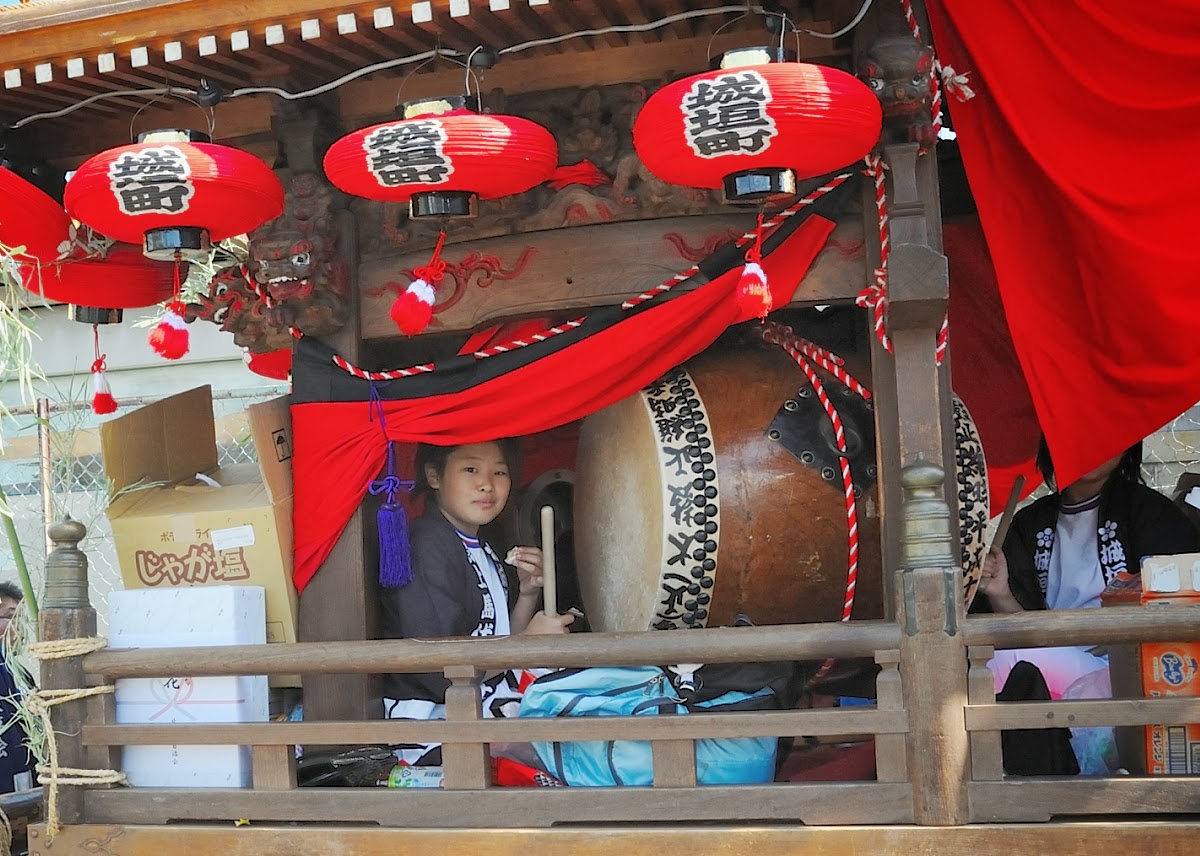
Autumn has finally come and we are all relieved that the hot summer heat appears to be gone. Autumn also means that it is time for the fall danjiri festival in my neighborhood. There is a real sense of belonging and community among those who participate. It takes much effort to wear the clothes and pull and push the heavy danjiri through the narrow streets in the neighborhood. There is some danger of the danjiri tipping over or causing damage to houses and structures it passes by. This year a man lost his balance and fell backwards into a grove of trees. My participation in the event (I helped the man out and aside from a few scratches he was OK) increases every year, which means I have less opportunities to photograph the festival. I took an hour off from pushing to get these shots - I felt as though I was slacking off and not pulling my weight. Further challenges for the visual anthropologist...
At the end of the day three neighborhoods came together to share the festivity and a greater sense of community. These last two shots are of the danjiri and umbrella dancers from the neighborhood next to ours.
The fall festival brings neighbors and neighborhoods together in solidarity. It is fun and it is hard work. We were all sore that evening and for the next few days. But it is very much worth the effort.
Click below to see more fall festival photos:
2013 Fall Festival thumbnails
2012 秋祭り(Fall Festival)
2010 Local Matsuri in Classic Black & White
2010 Local Matsuri In Living Color
Subscribe to:
Posts (Atom)