Explorations and experiments in visual representations - multimodality, sensory ethnography, reflexivity, autoethnographic vignettes, ethnographic photography and ba...
Tuesday, April 17, 2012
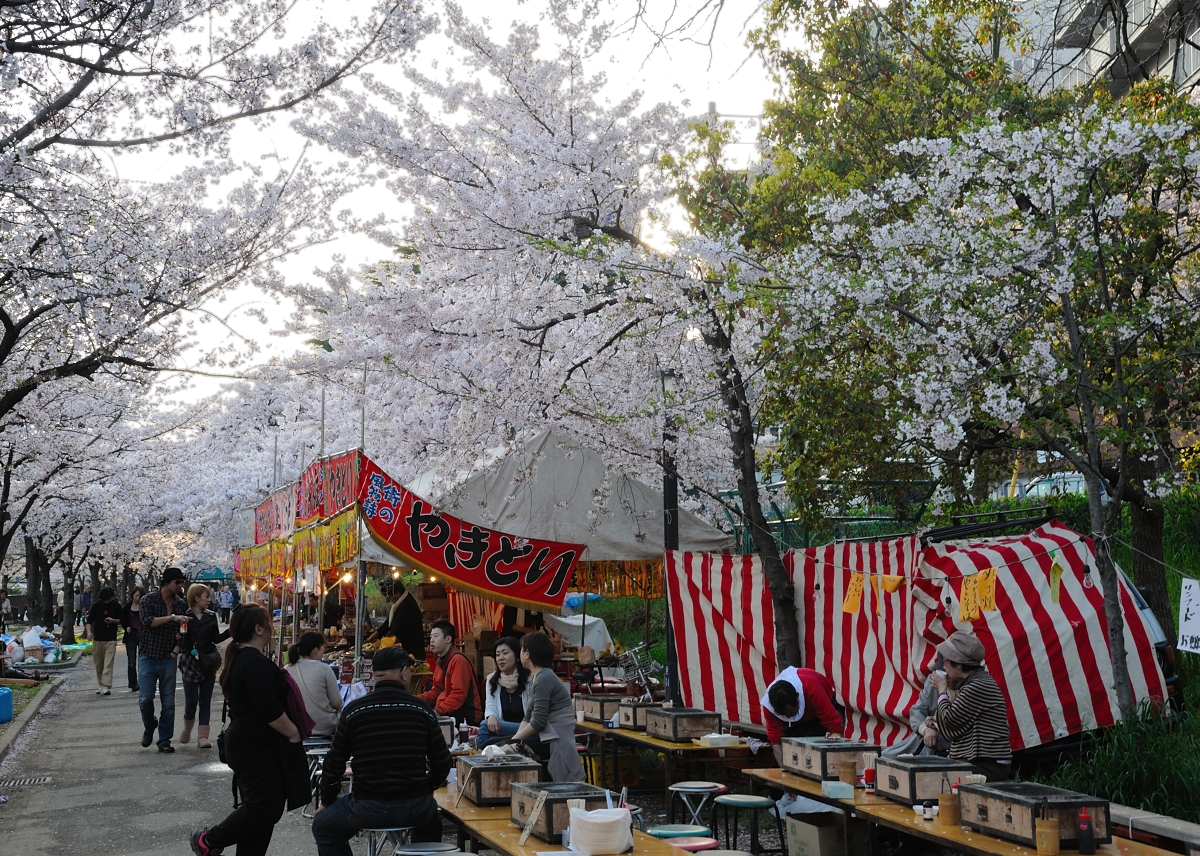
お花見: Cherry Blossom Viewing 2012 Part 2 - Temmabashi during non-peak hours
The riverside of the Okawa River near the Temmbashi Keihan Train Station is one of the most popular spots for ohanami in Osaka. As such it is extremely crowded with people and food stalls on the weekends and evenings during the sakura season. However if one goes during midday it is not so crowded. One can stroll along the river under the cherry blossoms, enjoy the food stalls and sit leisurely on park benches. The river cruises are quite pleasant as well. I was lucky enough to visit the area during a recent research day.
Saturday, April 14, 2012
Body/Comm Spring 2012 Poster Workshop: Beauty in Contemporary Japan
Beauty in Contemporary Japan was once again taken up by students of "The Body and Communication in Japan" class during a recent poster workshop session. Students balanced academic sources and their own observations of beautiful women and men (both were assigned as homework) in their creative endeavors. Common themes included youthful cuteness, thinness, light skin (from products and through genetics via the popular half Japanese phenomena), small faces and big eyes (and various methods to accomplish these goals), shorts to emphasize/create long, shapely legs, fingernail art and accessories. See each poster for more details. Students will next take up fashion and other forms of body ornamentation (tattoos, body pierces) to explore the ultimate question of how body image and presentation contribute to communication.
Click here to see posters from previous semesters.
Tuesday, April 10, 2012
お花見: Cherry Blossom Viewing 2012
It's that time of year again. This year we ventured to the Mitsujima area in Kadoma-shi for ohanami (cherry blossom viewing) activities. The area boasts a long canal with cherry trees on either side. The neighborhood association provides free boat rides. Many people enjoyed the boat rides and food/drink under the sakura.
Monday, April 9, 2012
"Deaf student qualifies to teach English in Nagoya"
Thanks to GH for calling this to my attention. Photo and story borrowed from The Japan Times Online.
A deaf student at Nagoya Gakuin University who obtained a license to teach English to students with impaired hearing graduated on March 15.
Misato Fujiwara, 23, will start teaching at Aichi Prefectural Nagoya School for the Aurally Disabled in Chikusa Ward, Nagoya, on Wednesday.
Fujiwara wore a traditional "hakama" outfit to the graduation ceremony at Nagoya Congress Center in Atsuta Ward.
"I like wearing the outfit because I can feel myself straightening up," she said.
All speeches and announcements during the ceremony were interpreted in sign language for Fujiwara.
When the university's president, Hisao Kibune, said in his address that "what makes a difference in your life are courage and willingness to change," she nodded her approval.
When she was interviewed after the ceremony, she introduced herself in fluent English: "My name is Misato Fujiwara. I love English!"
At the time she enrolled, the freshman was the only deaf student at the university and told the faculty she wanted to study in exactly the same way as the other students. In response, the faculty introduced a "note-taker system" to allow other students to take lecture notes for her.
"The most difficult thing was to look for a student who could help me. Other than that, I didn't feel myself to be disabled," Fujiwara said.
As a sophomore, she met an English-language teacher who also had hearing difficulties and became determined to take a similar path, hoping "to teach deaf students the fun of learning English."
She earned enough credits to graduate after four years, but extended her studies by another year to obtain a teaching license.
"She is a great student and seems like she doesn't feel disabled," a university official said.
While studying English sign language, Fujiwara also practiced pronunciation, repeatedly trying out words until she mastered the correct form.
Her determined efforts were rewarded when she passed the teaching exam.
"As I am deaf myself, I would like to move forward with my students by putting myself in their shoes," said Fujiwara.
"They can't hear but if they have a strong will to communicate, they will be understood in English, too."
Link: http://www.japantimes.co.jp/text/nn20120407cc.html
It should be noted, and not to belittle any accomplishment, that other deaf people have become English teachers as well. I tutored one such woman in English pronunciation as she had failed that part of the test before. Yes, even deaf people who want to teach English to deaf students have to be tested in English pronunciation in order to get their teaching license. Ultimately she was able to pass the speaking part of the test by using a microphone to amplify her voice. While her pronunciation was perfect, her voice was weak and hard to hear. She is now a teacher at a deaf school.
Sunday, April 8, 2012
"Interrogations filmed in 97% of major cases"
For those of us who have been following this story for quite some time, this appears to be good news. From the Daily Yomiuri Online, 4/7/12:
Audio and video recordings of interrogations by prosecutors were carried out in 97 percent of major criminal cases from April 2011 to February 2012, according to the Supreme Public Prosecutors Office.
Of all 69 cases handled by special investigation units at 13 district prosecutors offices nationwide, interrogations were recorded in 67 cases. Of that number, interrogations in 28 cases were filmed in their entirety.
The average length of the recordings was 61 hours, with the longest at 127 hours.
Interrogation recording began a year ago following an evidence tampering scandal involving the Osaka District Public Prosecutors Office.
Link: http://www.yomiuri.co.jp/dy/national/T120406004353.htm
Audio and video recordings of interrogations by prosecutors were carried out in 97 percent of major criminal cases from April 2011 to February 2012, according to the Supreme Public Prosecutors Office.
Of all 69 cases handled by special investigation units at 13 district prosecutors offices nationwide, interrogations were recorded in 67 cases. Of that number, interrogations in 28 cases were filmed in their entirety.
The average length of the recordings was 61 hours, with the longest at 127 hours.
Interrogation recording began a year ago following an evidence tampering scandal involving the Osaka District Public Prosecutors Office.
Link: http://www.yomiuri.co.jp/dy/national/T120406004353.htm
Saturday, April 7, 2012
Privacy Gone Too Far (?) Leads to Offensive Photographic Methods?
Photo and story borrowed from WPLG News, Local10.com.
Parents call school photo 'offensive, degrading'
Child's face replaced with cartoon-like head
It's a school picture that makes jaws drop at just one glance.
More than a dozen students in Eileen Diaz's Second Grade Class at Sawgrass Elementary are grouped together in three neat rows.
Some are smiling, some are not and one doesn't even appear human.
Right smack in the middle of the photo is a cartoon-like head placed on the shoulders of a boy where his face would be.
People who saw it called it "offensive" and "degrading". Parent Gabriella Cans, whose son is just a toddler, said she felt sorry for the boy and believes the image is humiliating.
...
So, how did it get there?
Broward County Schools directed us to the Davie-based private company that took the photo.
David Claussen and his wife own Broward County Pictures which they say has been in the school picture-taking business for 37 years.
He didn't want to speak on camera, but off camera said the last thing he ever wanted to do was offend. In fact, he thought it was odd himself.
As he tells it, after the picture was taken a liaison with the Parent Teacher's Association, that helped organize the photo shoot at the school, notified them that two of the students pictured needed to be removed because their parents did not sign a consent form.
Claussen said he was able to use the photo editing software Adobe Photoshop to lift one of the kids out, but had explained to them that there was a problem with the second student. He was sitting in the front row, right in the middle.
He showed me the notes he had written down on a white piece of paper as the pair discussed what to do. He said he would have gladly come out there to reshoot the image. Instead there was talk about putting a star over his face and then, he said, the P.T.A. asked him to place a smiley face.
He's never received a request like that before. In the nearly four decades he's been in business he told Local 10 he's never done such a thing.
Link to complete story: http://www.local10.com/news/Parents-call-school-photo-offensive-degrading/-/1717324/10151720/-/2yu1sjz/-/
Friday, April 6, 2012
"Couples immortalize engagement with photos"
From today's Daily Yomiuri Online:
A photographer zooms in on Seita Tokoi and his fiancee, Akina, as they stroll hand-in-hand on the streets of Shibuya and Harajuku in Tokyo.
Before getting married last June, the couple had a photographer follow them around for a few hours and take their photos.
"After we got married, those pictures felt like they were a kind of family portrait. We're happy to have photos that capture us at that very moment," Seita said, adding the idea was recommended to them by a friend.
Afterward, the couple visited the shop where they first met for another photo shoot.
"The whole photo session became a good memory for us," he said.
An increasing number of couples are eager to hire professional photographers to take pictures of them dating in an effort to turn "their last moments as a dating couple into a precious memory."
These pictures are known as "engagement photos," and some studios are turning the trend into a new business.
"Compared to 'maedori' [prewedding photo shoots in ceremonial dress], I can capture a more casual look and relaxed expressions," said Sayaka Watanabe, a photographer at Tokyo-based photo studio One Style who took the photos of Tokoi and his fiancee. "These photos are candid, too."
Last year, One Photo started an engagement photo business for about 40,000 yen per couple. The photo shoot is free for couples who also hire the studio to take their wedding photos.
Watanabe has taken photos for about 10 couples since the studio began its engagement photo business. Some pictures feature a couple cycling or posing in front of their middle schools. Many of these pictures are displayed on a huge screen during the wedding ceremony or printed on wedding invitations.
The number of studios offering engagement photos has increased nationwide. For example, Osaka-based La-vie Factory, which operates 10 studios nationwide, offers a similar service.
The wedding magazine Zexy featured engagement photos in its November issue. According to the magazine's editors, engagement photos are common in the West and have become popular in Japan over the last few years. When Prince William and Catherine Middleton announced their engagement, a photo featuring the royal couple wearing casual clothes was released and attracted a lot of attention in Japan.
Orie Maruyama, Zexy's deputy chief editor, said, "More people seem to consider the engagement period a precious time and want a reminder that lasts forever."
"By hanging up this happy picture at home, a couple may feel stronger about staying together forever," Maruyama said.
Some couples ask photographers to accompany them on a trip to their hometowns, or somewhere far away.
"These days, many people aren't so shy. They want other people to see them," said Chuo University Prof. Masahiro Yamada, a family sociology expert. "They're used to posting their everyday lives and feelings on blogs or Twitter, and people's understanding of privacy has changed."
"Under the circumstances, many couples might also be thinking, 'If we take photos, let's make ourselves more presentable and let people know about our daily lives.'"
Link: http://www.yomiuri.co.jp/dy/features/arts/T120321004177.htm
A photographer zooms in on Seita Tokoi and his fiancee, Akina, as they stroll hand-in-hand on the streets of Shibuya and Harajuku in Tokyo.
Before getting married last June, the couple had a photographer follow them around for a few hours and take their photos.
"After we got married, those pictures felt like they were a kind of family portrait. We're happy to have photos that capture us at that very moment," Seita said, adding the idea was recommended to them by a friend.
Afterward, the couple visited the shop where they first met for another photo shoot.
"The whole photo session became a good memory for us," he said.
An increasing number of couples are eager to hire professional photographers to take pictures of them dating in an effort to turn "their last moments as a dating couple into a precious memory."
These pictures are known as "engagement photos," and some studios are turning the trend into a new business.
"Compared to 'maedori' [prewedding photo shoots in ceremonial dress], I can capture a more casual look and relaxed expressions," said Sayaka Watanabe, a photographer at Tokyo-based photo studio One Style who took the photos of Tokoi and his fiancee. "These photos are candid, too."
Last year, One Photo started an engagement photo business for about 40,000 yen per couple. The photo shoot is free for couples who also hire the studio to take their wedding photos.
Watanabe has taken photos for about 10 couples since the studio began its engagement photo business. Some pictures feature a couple cycling or posing in front of their middle schools. Many of these pictures are displayed on a huge screen during the wedding ceremony or printed on wedding invitations.
The number of studios offering engagement photos has increased nationwide. For example, Osaka-based La-vie Factory, which operates 10 studios nationwide, offers a similar service.
The wedding magazine Zexy featured engagement photos in its November issue. According to the magazine's editors, engagement photos are common in the West and have become popular in Japan over the last few years. When Prince William and Catherine Middleton announced their engagement, a photo featuring the royal couple wearing casual clothes was released and attracted a lot of attention in Japan.
Orie Maruyama, Zexy's deputy chief editor, said, "More people seem to consider the engagement period a precious time and want a reminder that lasts forever."
"By hanging up this happy picture at home, a couple may feel stronger about staying together forever," Maruyama said.
Some couples ask photographers to accompany them on a trip to their hometowns, or somewhere far away.
"These days, many people aren't so shy. They want other people to see them," said Chuo University Prof. Masahiro Yamada, a family sociology expert. "They're used to posting their everyday lives and feelings on blogs or Twitter, and people's understanding of privacy has changed."
"Under the circumstances, many couples might also be thinking, 'If we take photos, let's make ourselves more presentable and let people know about our daily lives.'"
Link: http://www.yomiuri.co.jp/dy/features/arts/T120321004177.htm
Tuesday, March 27, 2012
"Mr. Hashimoto Attacks Japan's Constitution"
Is this post relevant for a visual anthropology-themed blog? Perhaps this post might best be filed under outrage?
Visual anthropology as I see it certainly includes the visions and images of society and culture; those visions of influential politicians like Osaka Mayor Hashimoto fall into this category. Aside from his "One Osaka" platform, he has been promoting ideas and ordinances aimed at giving him greater power at the expense of the rights of individuals. One of these rights is privacy, an issue that VAOJ has been concerned about in terms of protecting the visual anthropologist and those s/he studies during ethnographic fieldwork (especially the issue of photographing individuals in public). The Japanese public might be considered paranoid in terms of protecting their privacy; when politicians abuse privacy the environment can only get worse, making anthropological fieldwork that much more challenging. Is this too much of a stretch for VAOJ to get political? That's up to you. But anyone concerned with Japanese politics, human rights, privacy and/or living in Osaka should read this new article by by Lawrence Repeta at Japan Focus. Here is his introduction:
On February 6, 2012 Osaka Mayor Hashimoto Toru issued an order to all Osaka City employees compelling them to disclose personal information concerning labor union activity, their support for political candidates, and other sensitive matters. The survey includes such questions as “In the last two years, have you participated in any activities in support of a particular politician?” and “In the last two years, has a co-worker ever requested that you vote for a particular politician?” It goes on to request the identities of such co-workers or others who invited the respondent to participate in political activities. Each respondent must provide name, employee number and work description. (An English translation of the Hashimoto Survey is found at the end of the article.)
Although most questions in the Survey require respondents to identify themselves, the Survey also provides directions to a designated “reporting window” that create the opportunity to snitch on one’s enemies anonymously. This episode is illustrative of ongoing threats to the already precarious status of individual rights in Japan.
Mr. Hashimoto’s cover note includes a stiff reminder that he’s the boss: “this questionnaire is not a voluntary matter. It requires factually correct responses from all employees by order of the Mayor. In cases where responses are not true, penalties may be applied.”
The audacity of this inquiry into workers’ political and union activities and relationships is breathtaking. This is an intellectual strip search designed to enable the Mayor to create detailed personal profiles of all Osaka City employees. If these survey results are compiled, Mr. Hashimoto will be able to identify his political supporters and opponents with a few key strokes and then be free to find ways to reward and punish at his leisure. Protections for fundamental rights have been embedded in democratic constitutions all over the world and in international human rights treaties precisely to protect against this kind of abuse of power.
Link to entire article: http://japanfocus.org/-Lawrence-Repeta/3728
Click here for more VAOJ coverage of Mr. Hashimoto.
Visual anthropology as I see it certainly includes the visions and images of society and culture; those visions of influential politicians like Osaka Mayor Hashimoto fall into this category. Aside from his "One Osaka" platform, he has been promoting ideas and ordinances aimed at giving him greater power at the expense of the rights of individuals. One of these rights is privacy, an issue that VAOJ has been concerned about in terms of protecting the visual anthropologist and those s/he studies during ethnographic fieldwork (especially the issue of photographing individuals in public). The Japanese public might be considered paranoid in terms of protecting their privacy; when politicians abuse privacy the environment can only get worse, making anthropological fieldwork that much more challenging. Is this too much of a stretch for VAOJ to get political? That's up to you. But anyone concerned with Japanese politics, human rights, privacy and/or living in Osaka should read this new article by by Lawrence Repeta at Japan Focus. Here is his introduction:
On February 6, 2012 Osaka Mayor Hashimoto Toru issued an order to all Osaka City employees compelling them to disclose personal information concerning labor union activity, their support for political candidates, and other sensitive matters. The survey includes such questions as “In the last two years, have you participated in any activities in support of a particular politician?” and “In the last two years, has a co-worker ever requested that you vote for a particular politician?” It goes on to request the identities of such co-workers or others who invited the respondent to participate in political activities. Each respondent must provide name, employee number and work description. (An English translation of the Hashimoto Survey is found at the end of the article.)
Although most questions in the Survey require respondents to identify themselves, the Survey also provides directions to a designated “reporting window” that create the opportunity to snitch on one’s enemies anonymously. This episode is illustrative of ongoing threats to the already precarious status of individual rights in Japan.
Mr. Hashimoto’s cover note includes a stiff reminder that he’s the boss: “this questionnaire is not a voluntary matter. It requires factually correct responses from all employees by order of the Mayor. In cases where responses are not true, penalties may be applied.”
The audacity of this inquiry into workers’ political and union activities and relationships is breathtaking. This is an intellectual strip search designed to enable the Mayor to create detailed personal profiles of all Osaka City employees. If these survey results are compiled, Mr. Hashimoto will be able to identify his political supporters and opponents with a few key strokes and then be free to find ways to reward and punish at his leisure. Protections for fundamental rights have been embedded in democratic constitutions all over the world and in international human rights treaties precisely to protect against this kind of abuse of power.
Link to entire article: http://japanfocus.org/-Lawrence-Repeta/3728
Click here for more VAOJ coverage of Mr. Hashimoto.
Monday, March 26, 2012
Spring Break is Over - Let the Hanshin Goods Begin!
Some might argue that the taste of spring in Japan is ume (plum) or sakura (cherry). VAOJ begs to differ with these stereotypes, at least for the year 2012. This year the taste of spring is a light cheese paste sucked out of a plastic tube emblazoned with the Hanshin Tigers logo. I found this at my local supermarket yesterday and took it as a good sign. Hanshin fans are concerned this year about our local team due to a new manager and aging/injured players. But the early release of the cheese (undoubtedly to be followed by a plethora of other Hanshin-ized products) combined with the Tigers' defeat of the visiting Seattle Mariners during an exhibition game yesterday bring warmth to our hearts despite the continuing cold temperatures outside. This warmth is especially welcome for me after spending spring break in Japan's 48th prefecture and tropical paradise, Hawaii (look for "Japanese" Hawaii pics on this blog in the next few days). Visual Anthropology students are well into their blogs (see links to the left below) and JSL Study Group members are signing better than Obama. Once midterm exams are done and the cherry blossoms are here, things will only get better. Enjoy Spring!
Sunday, March 25, 2012
"Osaka teacher who refused to stand for anthem loses job"
And the local Osaka saga continues... From The Mainichi Daily News, 3/25/12:
A 61-year-old male teacher who refused to stand up during the singing of the "Kimigayo" national anthem at a graduation ceremony at an Osaka prefectural high school in February has been notified that his services are no longer required, local education officials said Saturday.
The teacher, who had been rehired by the school after reaching the mandatory retirement age of 60, was highly evaluated by the school principal, who gave him the second highest competence rating. Nonetheless, he became the first teacher to be effectively sacked among a group of teachers at public high schools in Osaka Prefecture who were reprimanded earlier this month for similar behavior, a civic group said.
Accusing the prefectural education board of using the dismissal as a warning to others, the group opposes the compulsory gesture of respect for the Hinomaru national flag and the Kimigayo, which critics say symbolizes Japan's past imperialism and militarism. It plans to hold a meeting next week to consider filing a lawsuit over a series of punishments for teachers over the matter.
The issue stems from an ordinance that obliges teachers and school staff to stand and sing the Kimigayo. It was approved last June by the Osaka prefectural assembly to develop a spirit of patriotism among students, when current Osaka Mayor Toru Hashimoto was governor.
The teacher concerned, who was rehired last April, had been informally told in February that he could keep his position for the coming academic year, but on Monday received a written notice from the education board that the arrangement was being terminated. He is considering filing a complaint with the prefectural personnel committee, he and others said.
Among those reprimanded, seven other teachers were expecting to be rehired next April, but the education board said it is now considering what to do with them.
Link: http://mdn.mainichi.jp/mdnnews/news/20120325p2g00m0dm001000c.html
If you haven't been following this story at VAOJ, you can start here and work your way back.
A 61-year-old male teacher who refused to stand up during the singing of the "Kimigayo" national anthem at a graduation ceremony at an Osaka prefectural high school in February has been notified that his services are no longer required, local education officials said Saturday.
The teacher, who had been rehired by the school after reaching the mandatory retirement age of 60, was highly evaluated by the school principal, who gave him the second highest competence rating. Nonetheless, he became the first teacher to be effectively sacked among a group of teachers at public high schools in Osaka Prefecture who were reprimanded earlier this month for similar behavior, a civic group said.
Accusing the prefectural education board of using the dismissal as a warning to others, the group opposes the compulsory gesture of respect for the Hinomaru national flag and the Kimigayo, which critics say symbolizes Japan's past imperialism and militarism. It plans to hold a meeting next week to consider filing a lawsuit over a series of punishments for teachers over the matter.
The issue stems from an ordinance that obliges teachers and school staff to stand and sing the Kimigayo. It was approved last June by the Osaka prefectural assembly to develop a spirit of patriotism among students, when current Osaka Mayor Toru Hashimoto was governor.
The teacher concerned, who was rehired last April, had been informally told in February that he could keep his position for the coming academic year, but on Monday received a written notice from the education board that the arrangement was being terminated. He is considering filing a complaint with the prefectural personnel committee, he and others said.
Among those reprimanded, seven other teachers were expecting to be rehired next April, but the education board said it is now considering what to do with them.
Link: http://mdn.mainichi.jp/mdnnews/news/20120325p2g00m0dm001000c.html
If you haven't been following this story at VAOJ, you can start here and work your way back.
Subscribe to:
Posts (Atom)