Announcement from H-Japan:
University of Michigan Digital Library Production Service (DLPS) has completed 3 new digital image collection projects in Japanese studies. These collections are open to the public for educational and research purposes.
Brower Fund Collection: Playing Cards:
http://quod.lib.umich.edu/b/brower1ic
Alfred Hussey Collection: Japan's Constitution Slides:
http://quod.lib.umich.edu/h/hussey1ic
Alfred Hussey Collection: Japan's Constitution Photo Album:
http://quod.lib.umich.edu/h/hussey2ic
See also the UM Digital Library Production Service (DLPS) for all of their on-line resources:
http://quod.lib.umich.edu/lib/colllist/

Monday, August 19, 2013

Monday, August 12, 2013
Announcement: 2013 Visual Documentary Project - SE ASIA
Announcement from H-ASIA:

For more information: http://sea-sh.cseas.kyoto-u.ac.jp/visual-documentary-project-2013/

For more information: http://sea-sh.cseas.kyoto-u.ac.jp/visual-documentary-project-2013/
Saturday, August 3, 2013
Local Matsuri V: くわしく


References:
Visual Anthropology of Japan, Local Matsuri I: The Mikoshi, posted July 30, 2013.
Visual Anthropology of Japan, Local Matsuri II: Evening Activities, posted July 31, 2013.
Visual Anthropology of Japan, Local Matsuri III: Tamago Senbei, posted August 1, 2013.
Visual Anthropology of Japan, Local Matsuri IV: People, posted August 2, 2013.
Friday, August 2, 2013
Local Matsuri IV: People

While photographers recognize that a subject’s uncertainty about the use of a picture is often the source of interactional tension, they are for the most part sufficiently confident about the harmlessness of their photographing (to subjects) or its importance (to themselves, or to “public information”) and sufficiently interested in carrying on doing it that consent is not so much to be reckoned with among subjects as dispensed with (Henderson 1988: 92).
I like a bit of privacy myself, especially when it is so scarce a commodity these days. But I never take embarrassing pictures of people on the street and I always try and respect them, communicate with them and share my photos with them if I can. Japanese people are on the whole very cool with this. And if they don’t want their picture taken, 95 times out of 100 they just turn the other way (Goodrich, September 22, 2009).

It’s not easy taking photos of people in public that you don’t know. This is the challenge of street photography. One might ask what is the purpose of such an endeavor? To capture interesting characters and/or representatives of Japanese culture? Does this really add to the sociology of Japan?
It was my intention to walk around the matsuri and take pictures of people enjoying the festival. I especially wanted to photograph people wearing brightly colored summer yukata. I found, however, that people were busy having fun and I didn’t feel right interrupting them. I did ask a few yukata-clad women if I could photograph them but they all refused. And I understood. After all, who was this foreign guy with a camera, and what would he be doing with the pictures? As I walked slowly through the masses I felt as if I was some sort of perverse voyeur stalking prey.
But once again the mixed blessing of being a foreigner kicked in. People began calling out to me in simple English and were surprised when I responded in Japanese. During these short/fun interactions I asked if I could take their photographs and they answered by flashing the peace sign along with a big smile. Some people wanted to take my picture (as if I were some sort of celebrity?).
I also found I could take pictures of people working at food stalls if I bought something. People were also willing to be photographed if I asked a question about the festival or had an extended conversation with them.


For the visual anthropologist a bit of street photography might be an early phase of fieldwork. The camera can be a tool for creating interactions and building rapport. And of course the photographs are data, and a good source for reciprocity (giving photos to the people you photograph). Visual anthropology is all about long-term collaboration and negotiation in the areas of privacy and representation. But perhaps we are getting too serious here (when you do want to get serious, click here for more on the ethics of public photography in Japan). We shouldn’t lose sight of the topic, the Local Matsuri. We have enjoyed the mikoshi, the evening activities, the food and now let’s enjoy the people.
The next post completes this VAOJ arc - Local Matsuri V: くわしく.
References:
Goodrich, Alfie. Japanorama Blog. "Faces of Tokyo: street photography in the megalopolis." Posted on September 22, 2009. http://japanorama.co.uk/2009/09/22/faces-of-tokyo-street-photography-in-the-megalopolis/
Henderson, Lisa. "Access and consent in public photography." Image ethics: The moral rights of subjects in photographs, film and television (1988): 91-107.
Visual Anthropology of Japan, Local Matsuri I: The Mikoshi, posted July 30, 2013.
Visual Anthropology of Japan, Local Matsuri II: Evening Activities, posted July 31, 2013.
Visual Anthropology of Japan, Local Matsuri III: Tamago Senbei, posted August 1, 2013.
Visual Anthropology of Japan, Ethics of Visual Anthropology in Japan - Part Seven: The Guidelines, posted February 13, 2009.
Thursday, August 1, 2013
Local Matsuri III: Tamago Senbei

I could justify this post by claiming the importance of the research of food in anthropology with examples like the following:
The study of food and eating has a long history in anthropology, beginning in the nineteenth century with Garrick Mallery and William Robertson Smith... We contend that the study of food and eating is important both for its own sake since food is utterly essential to human existence (and often insufficiently available) and because the subfield has proved valuable for debating and advancing anthropological theory and research methods. Food studies have illuminated broad societal processes such as political-economic value-creation, symbolic value-creation, and the social construction of memory. Such studies have also proved an important arena for debating the relative merits of cultural and historical materialism vs. structuralist or symbolic explanations for human behavior, and for refining our understanding of variation in informants' responses to ethnographic questions (Mintz and Du Bois 2002).
For more contemporary examples of the research of food one could check out the Society for the Anthropology of Food and Nutrition blog.

But to be honest I am posting about Tamago Senbei because not only is it a popular snack at the Local Matsuri, it is one of my favorites...

Who can resist a shrimp cracker topped with okonomiyaki sauce, crunchy tempura refuse (tenkasu), mayonnaise and a heart shaped egg - all for only 200 yen. At this stall there was a lottery of sorts; if you chose a certain number you could get 2 or even 3 eggs.

Hungry?
Still want more of the Local Matsuri? The next VAOJ post features Local Matsuri IV: People.
References:
FoodAnthropology, Society for the Anthropology of Food and Nutrition. http://foodanthro.com/tag/anthropology-of-food/
Mintz, Sidney W. and Christine M. Du Bois, The Anthropology of Food. In Annual Review of Anthropology, Vol. 31: 99-119, October 2002.
Visual Anthropology of Japan, Local Matsuri I: The Mikoshi, posted July 30, 2013.
Visual Anthropology of Japan, Local Matsuri II: Evening Activities, posted July 31, 2013.
Wednesday, July 31, 2013
Local Matsuri II: Evening Activities

Michael Ashkenazi (1993) contextualizes the Japanese matsuri as having three qualities: First, it is unusual (different from daily life), recreational and entertaining. The image of matusuri is something to be experienced rather than merely seen. Large numbers of participants strengthen this image. Second, the unusual atmosphere of festivity is a place of economics and other transactions different from everyday commerce. Participants are able to enjoy a wide range of products and activities for a price. Third, the matsuri involves an ever-changing mass of participants from different social categories rather than a static homogenous group.
Ashzenkazi's qualities seem to match the Evening Activities part of the local matsuri. In the last VAOJ post I discussed and illustrated the procession of the mikoshi. This post illustrates the night time market and performances that take place in the summer festival.

One side of the river near the shrine was packed with booths selling various snacks and food. Some of the stalls were devoted to games and tempted participants to win prizes such as anime inspired stuffed animals, toy guns, balloons and whistles, gold fish and posters of pop idols. As the evening wore on, more and more people came to eat and play. It was difficult to move through the masses of people eating, drinking, pushing baby carriages, socializing... The trick was to purchase your snack and then find a small place for yourself or group to eat it.

Meanwhile preparations were being made by at the shrine. The show would start when it got dark, at 7:30 PM.

This particular shrine is famous because there is a train station right above it. The kami-deity associated with the shrine resides in a large 700 year old Camphor tree. When the train station was being built, the tree could not simply be cut down. Thus the station was built around it.

The first entertainment of the night is a taiko drum group.


Followed by a hip-hop dance performance.

Next was a group of young girls doing a yosakoi dance, very energetic with gymnastic moves and a traditional feel to it.

Followed by a ballet performance.

The second evening of the festival featured Kawachi ondo and Goshu ondo, styles of folk songs originating from Osaka and Shiga prefectures, respectively.

People danced the bon odori to these musical styles. The Obon Festival, also know as the festival of the dead, is usually observed in the middle of August. It is a Buddhist custom where people welcome the spirits of their deceased ancestors back home. Another part of the celebration is to perform folk dances, the bon odori. These dances usually have people dancing in a circle with relatively simple and repetitive movements. The movements of the dance vary from region to region. It is not unusual for bon odori to take place at other times of the summer or even at a Shinto shrine; it seems to be a part of the celebration of summer.

Bon odori seems to be a perfect example of Victor Turner's communitas (1969), where people of different social status come together as equals to perform and promote a strong sense of community. Although there is a program/schedule for the dance, the performance itself can be seen as anti-structure. The ritual attracts all kinds of people to participate whether they intended to do so or not. Semi-professional dancers in costume are joined by community members, housewives, old drunk men, young children and even yanki/bosozuko/bikers to dance and have fun. Communitas feels good...

Yes, and a good time was had by all. The Local Matsuri juxtaposes time and space while bringing and blending together Shinto and Buddhist customs, Japanese and foreign dances, regional traditions and multitudes of people. But the visual anthropologist feels the need to show more of the Local Matsuri. The next VAOJ post features Local Matsuri III: Tamago Senbei.
References:
Ashkenazi, Michael. Matsuri: Festivals of a Japanese town. University of Hawaii Press, 1993.
Turner, Victor. “Liminality and Communitas,” in The Ritual Process: Structure and Anti-Structure. Chicago: Aldine Publishing, 1969. pp. 94-113, 125-130.
Visual Anthropology of Japan, Local Matsuri I: The Mikoshi, posted July 30, 2013.
Tuesday, July 30, 2013
Local Matsuri I: The Mikoshi
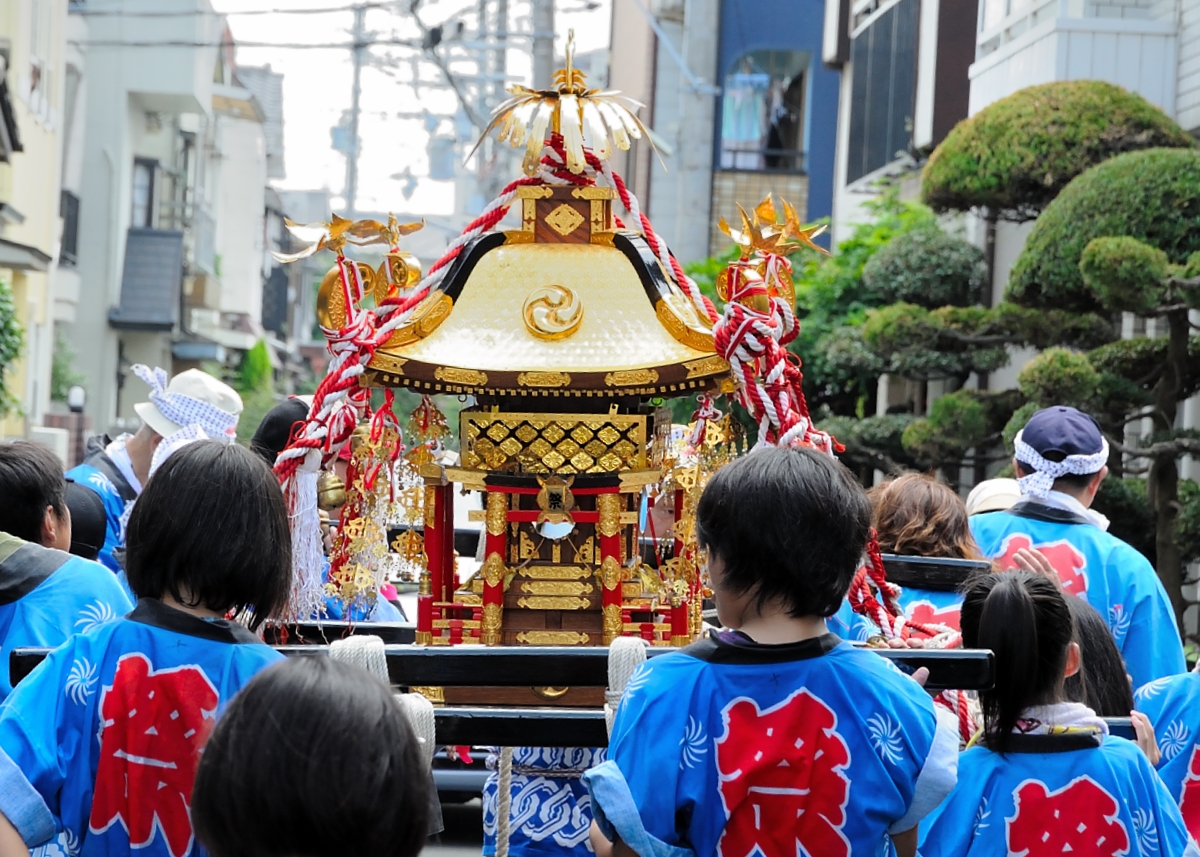
A festival is like a circus that has spilled out over a whole neighborhood; it brings with it the bitter-sweet feeling that no matter where you contrive to be, you are unavoidably missing most of the fun. A festival is a garden of delights, and part of the joy of it is knowing there is just too much joy abroad for any one person top absorb.
But the most conspicuous activity of the festival centers about the excitement of the street procession (Sadler 1972:89).
Summer in Japan brings with it many matsuri, or festivals, especially those centered on parading a Shinto deity on a portable shrine, or mikoshi, around the neighborhood that worships at the local shrine. The idea is that the deity can tour the neighborhood and bestow blessings upon the people of the parish (especially those who give contributions along the way). Another important part of the matsuri is the evening activities: food and game stalls are set up near the shrine and within the shrine grounds itself many performances (especially dances) take place.
This last weekend a shrine near my house (but in a different neighborhood) held its annual summer festival. This was another great opportunity for the visual anthropologist to take photos and interact with the neighbors to learn more about local festival traditions. These traditions vary greatly, even in neighborhoods of close proximity. My own neighborhood holds an autumn festival centered on a danjiri rather than a mikoshi.

Early Sunday afternoon I heard whistles and shouts of wasshoi wasshoi ("to stay with harmony") behind my house. I grabbed my camera and went to meet the street procession. There were two small mikoshi as this neighborhood catered to children's participation. Mothers and older gentlemen from the neighborhood helped the children manage the parade route. As I met them they were about to take a break. I took a few photos before they stopped. Then I intended to leave as I have seen these processions many times. But before I could leave I was approached by an older man who gave me a can of juice. Another man encourage me to take photos of the mikoshi. He then asked me to take a group shot of the participants at the conclusion of the parade an hour later. So I ended up following the mikoshi through the winding streets while curious participants asked where I was from, what I was doing in Japan and quizzed me on my Japanese language skills. Some children literally poked me in the ribs, wanting to get a feel for the first foreigner they met (!). My foreignness was a mixed blessing. It gave me a reason for being there and taking photos (the assumption being that I had never encountered such cultural practices before in my own country). But at the same time I was treated as an oddity (mostly with politeness but sometimes with jest that some might consider offensive). Very few could understand that I lived close to them for over 8 years and many children couldn't believe I had moved to Japan before they we even born.

There was one encounter with children that was a pleasant surprise. Two elementary school aged girls were asking me about my origins and such. The older girl began making fun of me (as children often tend to do...) and was making broad gestures with her arms. I started to tease her back and asked if she was doing sign language. The the younger girl then signed to me: "Can you do sign language?" It turned out she was hard of hearing and usually wore a hearing aid. She took it out this day because of all the water that was being sprayed on the participants to keep them cool (I had to pay special attention to this activity to protect my camera). She told me she was one of 12 students in a special class for hard of hearing children at her school. We continued chatting in (very basic) sign language until the end of the break, much to the surprise of the adults nearby.

Coordinating the procession on the narrow streets is challenging, especially when other pedestrians and bike riders want to get through.

I usually don't post photos of young kids, but since their parents didn't object, I couldn't resist. Besides, the kids told me that they were disguised as dorobo, or thieves.

And so finally at the end of the procession the group took another break to drink juice and cool down. One of the organizers then announced in his megaphone that all were to assemble so that the American could take their picture. He had to make this same announcement a few times before everyone followed his orders. As the children posed mothers stood in front of them taking their own photos on their smart phones before the organizer told them to get out of the way so I could take the shot. And here it is:

A nice memorial photo for the day... I plan to give this photo along with others I took to the event organizers in digital form so they can distribute it to all the participants.
Below, a different group returns to the shrine after touring their own neighborhood. Sometimes it is difficult to understand where the boarders between neighborhoods are in Japan. Following the mikoshi (or danjiri) gives one a good idea of the boundaries.

I like the portable taiko drum...

It was a busy weekend in the neighborhood, too much to cover in one post. Coming up next on VAOJ... Local Matsuri II: Evening Activities
References:
Center for Regional Sustainable Initiatives Newsletter, No. 3, January 31, 2012.
Matsuri: Festival and Rite in Japanese Life, Institute for Japanese Culture and Classics, Kokugakuin University, 1988.
Sadler, A. W. "Carrying the mikoshi: Further field notes on the shrine festival in modern Tokyo." Asian folklore studies 31.1 (1972): 89-114.
Monday, July 29, 2013

Friday, July 19, 2013
Communist Party Campaigns at Kyobashi Station in Osaka

Sunday is election day in Japan with seats in the upper house up for grabs. Party heads have been traveling throughout Japan to support local candidates. I happened to be at the Kyobashi station in Osaka when Japanese Communist Party President Kazuo Shii was lending his support for local candidate Kotaro Tatsumi. A large crowd had gathered to hear the speeches and show their discontent for the majority coalition (Liberal Democratic Party and Komeito) and the Japan Restoration Party. It was encouraging to hear sane voices and see so many people concerned with politics. If you are eligible to vote in Japan please don't forget to do so on Sunday.


See how the event was covered on Kotaro Tatsumi's web site (in Japanese): http://www.tatsumi-kotaro-jump.com/activity-report/post-2162.html
Subscribe to:
Posts (Atom)